Showing posts with label Bill McCarthy. Show all posts

Monday, January 31, 2022

PolitiFact doesn't know the meaning of 'and'?

 Well, well, well.

I've had to focus on things other than PolitiFact Bias posts lately, but PolitiFact and its owner, the Poynter Institute have pulled me out of semi-retirement with an extraordinary clunker of a fact check.

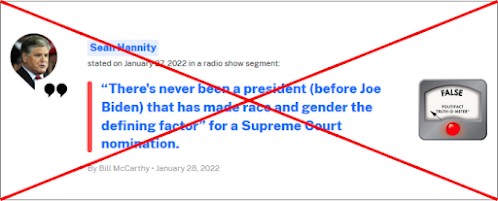
Behold:


PolitiFact's fact check defies logic and establishes an early leader in the "Worst Fact Check of the Year" contest.

The "False" conclusion fails because it rests on a failure to understand the simple logic of "and." The conclusion would work for the logic of "or." But Hannity said "and" not "or."

If Bill says the square is green or red then the square confirms Bill's statement if it is red. Likewise the square confirms Bill's statement if it is green. Bill would be right either way.

But if Bill says the square is green and red then it's a different ballgame.

In the second case the square confirms Bill's statement if it is both green and red. So a square that is half green and half red could confirm Bill's statement. A square that is simply green would contradict Bill's statement. The same goes for a square that is red and not green.

This is extraordinarily basic logic and PolitiFact doesn't get it. 

 Observe how PolitiFact looks to prove Hannity false:

The claim ignored that both Trump and Reagan made similar vows to nominate women to the Supreme Court, then followed through on those promises. Other presidents in history have also considered race and religion as they have made their picks.

We rate Hannity’s claim False.

So, by analogy, PolitiFact says if Trump and Reagan both nominated green squares then both Trump and Reagan each nominated squares that were both green and red.

That's 2+2=5 territory.

Making this even more hilarious, PolitiFact's parent company, the esteemed Poynter Institute, chose to highlight this fact check at the main site. In the title, Poynter's headline writer substituted a comma for the "and," masking the error of logic for those who do not read the "fact check."


Saturday, May 15, 2021

Tucker Carlson out of context

If  politicians take facts and presents them out of context, PolitiFact uses its "Truth-O-Meter" to punish them.

If PolitiFact takes politicians out of context and issues ratings based on its own bad behavior, that's just part of a day's work for the worst mainstream fact checker in the United States.

Speak of the devil:


We're showing the presentation PolitiFact used on its Facebook page. PolitiFact used the same wording in the deck section of its PolitiFact.com website.

Immediately one should notice that the claim that a COVID-19 vaccine might not work seems consistent with estimated efficacy rates in the 70 to 96 percent range as estimated the the vaccines' manufacturers. The CDC website comes right out and says "Some people who are fully vaccinated against COVID-19 will still get sick because no vaccine is 100% effective."

PolitiFact gave Carlson's a "Pants on Fire" rating for saying vaccines might not work. Does the CDC get that rating, too?

Let's look to the concluding paragraphs of the fact check to see what PolitiFact said Carlson got wrong.

Carlson said, "Maybe (the COVID-19 vaccine) doesn't work, and they're simply not telling you that."

That claim is countered by clinical trials and real-world studies that show the available vaccines effectively protect against COVID-19 infections and severe symptoms.

PolitiFact makes it sound like vaccines are 100% effective, regardless of the statement from the CDC. Not only do the vaccines protect you from infection, they protect you from severe symptoms after you're infected, by PolitiFact's telling. Without fail? Or is it possible the vaccine might not work?

Maybe PolitiFact simply missed Carlson's point. Perhaps the fact checkers think Carlson believes the vaccines do not work at all even though earlier in the same program he affirmed that they work.

We have two more concluding paragraphs from PolitiFact: 

Carlson based his claim largely on the fact that the CDC still recommends that fully vaccinated people wear masks and keep their distance in public spaces. Carlson said he couldn’t think of a reason why the CDC would do that, but we found some pretty simple explanations. 

Experts said those precautions are advisable because most of the U.S. population remains unprotected and because scientists are still studying to what extent the vaccines stop transmission, among other things.

Carefully note in the last paragraph how PolitiFact justifies the continued use of masks and social distancing for vaccinated people. PolitiFact mentions unprotected people and the possibility of transmission from vaccinated persons. It's two clauses describing one reason, with the reader left to guess at the "other things."

PolitiFact is saying scientists think the vaccine may not work to prevent transmission of the virus from vaccinated people to unprotected people.

Will PolitiFact rate itself or the scientists whose views it touts "Pants on Fire"?

How can fact checkers fire so wide of the mark?

It was and is obvious Carlson was making a point about the rhetoric about the vaccine. Get it, it works, said the government, and we can get back to normal. Later, the government says it's nice you got the vaccine but you can't get back to normal.

Carlson has a legitimate point, and PolitiFact's own reasoning proves it ("scientists are still studying"). Why are the scientists still studying it? Because it might not work to prevent transmission.

Fact checkers should not fail to figure out such basic stuff.

PolitiFact provided a link to Facebook for watching the relevant segment of Carlson's show. Their link didn't work for us, but we found the video independently and found the link matches what PolitiFact posted (huh? yeah). We're providing the same link in hopes that it works better for our readers.

It worked in pre-publication testing, but we shall see.

Tuesday, January 26, 2021

PolitiFact writes up Capitol riot, omits mention of John Sullivan

PolitiFact wants you to know right-wing groups were solely responsible for the Capital riot in early 2021--even if it's not necessarily true.

PolitiFact politisplained it in a Jan. 20, 2021 article by Daniel Funke:

Since Jan. 6, we’ve fact-checked several claims that blame antifa, short for anti-facist, for the breach of the U.S. Capitol Building. Republican lawmakers, conservative pundits and social media users have said the loose coalition of communists, socialists and anarchists infiltrated a crowd of Trump supporters to stoke violence.

There is no evidence to support those claims.

PolitiFact plays an interesting game with antifa. On the one hand, it's a "loose coalition of communists, socialists and anarchists" but on the other hand it's just an idea with no structure of membership, so it's next to impossible to identify people as "antifa" even if they are communists, socialists or anarchists.

Funke's article struck us as fascinating for its failure to mention John Sullivan, the left-winger who took video of the rioting and exhorted the rioters with cries such as "We accomplished this s**t. We did this together." (Newsweek)

Sullivan was among those charged in association with the rioting. But he remained unmentioned when Funke gave the rundown of those who were charged:

FBI Assistant Director Steven D'Antuono said during a Jan. 8 press briefing that there was "no indication" that antifa activists were involved in the insurrection. Since then, the U.S. Attorney’s Office for the District of Columbia has charged more than 100 people with crimes related to the Capitol riot, many who bragged on social media about taking part, and the FBI has arrested more than 40. Several suspects appear to have connections to militia and far-right groups.

 Guess what? Sullivan was one of those charged (Deseret News, via MSN):

John Earle Sullivan, 25, was charged federally on Wednesday with being on restricted property, civil disorder and “violent entry or disorderly conduct,” according to a complaint filed in U.S. District Court in the District of Columbia.
These days the media do not associate Sullivan with antifa or Black Lives Matter.

But let's dwell on the past.

Sullivan's History in the Media

The media have reported that Sullivan organized Insurgence USA. The Insurgence USA website peddles the kind of protest gear the public associates with antifa.

Is Sullivan just a right-wing capitalist trying to take advantage of left-wing rubes? Maybe. Let's look for press reports using "Sullivan" and "Insurgence USA" as our search terms, focusing on 2020 and before.

The Guardian (July 27, 2020)

That same Black Lives Matter protest that inspired Robertson’s fear was originally planned as a pro-police event in downtown Provo. John Sullivan, 26, the founder of Insurgence USA, a group for racial justice and police reform, organized a counter-protest alongside several other organizers. Protesters were to meet at the Provo police station at 6.30pm that night.
Newsweek (July 23, 2020):

John Sullivan, of the Insurgence USA activist group, was armed with a rifle for around two hours during what was promoted online as a "Solo Armed Stance" in protest at the unidentifiable agents who have been seen forcing protesters into unmarked vehicles in Portland, Oregon.

It's entirely worth noting that the left-wing protest community aired concerns about Sullivan in late 2020, as reported by the Daily Dot (links lead to profanity-laced reports). At the same time, the reports acknowledge Sullivan's connection to BLM/antifa activity:

last night he leaked the details of a secret event. luckily spotters OTG were able to shut it down before it started once they began to see an increase in police activity.

The report suggests Sullivan received the details of a secret event involving illegal activity. Without receiving such details, leaking them proves difficult.

"Sullivan denied being affiliated with antifa"

The Daily Dot article also contains an amusing (and common) example of liberal press credulity. It points to a Rolling Stone interview of Sullivan in which he supposedly "denied being affiliated with antifa."

But the supposed denial is a non-denial denial (bold emphasis added):

Sullivan carried a simple setup: a cellphone mounted on an image-stabilizing gimbal. Fitting into the mob, he says, required mirroring its revolutionary sentiments. “I was worried about people recognizing me and thinking that I was Antifa or, like, BLM or whatever,” he says. “The entire time they’re yelling, ‘Fuck Antifa! Fuck, BLM.’ I’m not saying I’m Antifa, by any means. But I definitely believe Black Lives Matter.”

Reported accurately, Sullivan did not deny affiliation with antifa. He denied he was saying he was affiliated with antifa. That's not the same thing. We're in trouble when journalists either can't tell the difference or apply spin to obscure the difference.

And if Sullivan had offered a full-throated denial of an affiliation with antifa, that would still not serve as dispositive evidence that no affiliation existed when he gave the interview. How many members of antifa have been publicly identified based on their own admission?

As things stand, we do not have definitive evidence Sullivan sustained a relationship with the antifa movement. But we do have evidence of at least a temporary connection to a secretive left-wing organization planning illegal activity.

Why is Sullivan entirely missing from Funke's report?

When PolitiFact Reported About Sullivan

We found Sullivan's absence from Funke's report even more strange given that PolitiFact previously did some reporting on Sullivan. The "fact check," by Bill McCarthy, supposedly covered the same subject as Funke's,the allegation that antifa incited the riot:

(C)laims faulting antifa for the violence at the Capitol keep coming. The latest target is Utah’s John Sullivan, the founder of Insurgence USA, an activist group against police brutality.

McCarthy's article published on Jan. 8, 2021. Did Funke somehow not know about it? It's not linked in Funke's story, though he linked other fact checks about the Capitol riot.

On Jan. 15, 2021, PolitiFact updated McCarthy's story noting Sullivan's arrest over his part in the D.C. riot. Did Funke also not know about that?

To be sure, McCarthy's article tries to downplay Sullivan's involvement in the riot, even assuring readers there's no proof he incited the insurgency. That occurs shortly before including quotations of things Sullivan said during the riot, such as "Let's burn this s--- down."

We can't help but think that if the Democratic managers of the Trump impeachment case had Trump on record telling the D.C. crow "Let's burn this s--- down" it would improve the case for Trump's impeachment. Supposedly Trump incited the Capitol insurrection, requiring his impeachment.

Summary

While there's no unequivocal case, at least for now, that John Sullivan counts as antifa or Black Lives Matter, a competent debunking of antifa/BLM involvement in the Capitol riot should not omit all mention of the strongest evidence of that involvement. 

And PolitiFact may want to look up the definition of "incited." 

It's a bit absurd to claim there's no evidence antifa incited the Capitol riot, quote somebody saying "Let's burn this s--- down" and then take the man at his word that he's not antifa when that wasn't what he said.


Correction Jan. 26, 2021: We misspelled "Capitol" as "Capital"in one of two instances in our summary section. That's fixed with this update.

Friday, January 22, 2021

Why does PolitiFact claim it allows license for hyperbole?

It makes sense for a fact checker to account for figures of speech such as hyperbole. And PolitiFact plainly states in its description of its principles that it allows license for hyperbole (bold emphasis added):

In deciding which statements to check, we consider these questions:

• Is the statement rooted in a fact that is verifiable? We don’t check opinions, and we recognize that in the world of speechmaking and political rhetoric, there is license for hyperbole.

For us, the mystery is why PolitiFact makes this claim and then blatantly fails to honor it.

Today we add another example to the collection.

The $38 Burrito?

Turning Point USA commentator Jordan Rachel tweeted about the $15 minimum wage:


Rachel's tweet fits perfectly the form of hyperbole. She chose an extremely high price for the future burrito and took care to offer no clear sign the statement was intended to be taken literally. One would encourage literal interpretation by plainly stating something like "Increasing the minimum wage to $15 will result in $38 burritos."

PolitiFact's graphic presentation of its fact check misleadingly frames Rachel's statement as exactly the latter type of claim:


PolitiFact unfairly manipulates Rachel's claim. Her claim is an if/then statement emphasizing the truth that the $15 minimum wage increase counts as an inflationary policy.

Rachel gets no credit for that point from PolitiFact. We don't know precisely why she gets no credit for that point, but we can at least say with certainty that PolitiFact claim that it allows license for hyperbole rings false.

Hyperbole is not mere exaggeration

As a figure of speech, hyperbole is not the same thing as mere exaggeration. If it was, then fact checkers shouldn't need to take it into account. They could simply show in factual terms how far off the exaggeration fell from the truth and leave it at that.

Hyperbole counts as common figure of speech. Perhaps the modern journalist simply understands it poorly. In the interest of public education, we recommend to our readers the account of hyperbole at YourDictionary.com:

Hyperbole, from a Greek word meaning “excess,” is a figure of speech that uses extreme exaggeration to make a point or show emphasis. It is the opposite of understatement.

You can find examples of hyperbole in literature and everyday speech. You wouldn’t want to use it in nonfiction works, like reports or research papers, but it’s perfect for creative writing and communication, especially when you want to add color to a character or humor to a story.

We encourage readers to click the link and read through it all.

No Sign PolitiFact Considered the Possibility of Hyperbole

As for the fact checkers at PolitiFact, we see no sign at all they considered interpreting Rachel's statement as hyperbole.

The summary section of the fact check fairly displays the rush to judgment:

Our ruling

Rachel said a $15-an-hour minimum wage would raise the price of a Taco Bell burrito to $38.

This claim is countered by available evidence, including the current burrito prices at Taco Bell locations in cities and counties where a $15 minimum wage is in effect. Four economists characterized the claim as a far-off estimate at odds with economic theory.

We rate Rachel’s statement False.

 Misleading and disgraceful.

We expect a conscientious fact-checking organization to make a plausible attempt to achieve consistency between policy and practice. If the policy is A and the practice is B, change one of them to match the other.

In claiming to allow license for hyperbole and failing to allow license for hyperbole, PolitiFact deceives its readers.

Sunday, September 6, 2020

Viva Frei: PolitiFact is Fake News

Rest assured, PFB readers, the recent lack of new content at PolitiFact Bias has nothing at all to do with improved work at PolitiFact. PolitiFact stinks as badly as ever. We just don't have the time right now to devote to publishing.

But it was worth taking a moment to highlight a video blog by Viva Frei, a Canadian neighbor who happened to notice some problems at PolitiFact.

Frei hits PolitiFact over a story on cash bail, and hits PolitiFact over a fact check of the claim Speaker Nancy Pelosi (D, Calif.) broke the law when she tore up the copy of the State of the Union address Trump delivered to her before Congress.


Frei's certainly caught PolitiFact grading a different claim than it claimed to fact check on the bail issue. Only the United States and the Philippines have money bail systems dominated by private commercial bond companies. A good number of other countries have money bail systems, and the claimant, Gavin Newsom, did not bother with that kind of specificity. The "Mostly True" rating could not apply for that reason alone.

Enjoy the video! And hat tip to reader "Brian" for bringing the video to our attention.

Monday, June 8, 2020

PolitiFact mangles fact check of Larry Elder

Editor's note June 8, 2020: We intended to acknowledge when we published that Newsbusters beat us to the punch with a story on PolitiFact's Larry Elder fact check. Our version does not rely on that version in any sense. We're taking the opportunity with this update to fix an improper use of its/it's in the second paragraph

The reason we do not trust PolitiFact fact-checking?

It's because we accepted PolitiFact's challenge to second-guess its work even before PolitiFact started asking. What we found then isn't pretty. It still isn't pretty.

Let's have a look at PolitiFact's June 5, 2020 fact check of conservative radio talk show host Larry Elder.


In Context

PolitiFact claims, as part of its statement of principles, to fact check claims in their original context.

How did PolitiFact do on that?

As the U.S. entered a second week of protests after the death of George Floyd, conservative radio host Larry Elder argued that "cops rarely kill anybody, let alone an unarmed black person."

"Last year, there were nine unarmed black people killed. Nineteen unarmed white people," Elder said June 2 on Fox News host Sean Hannity’s TV show.

We had no luck getting the linked Fox News video to play. Likely Fox News shoulders the blame for that. We got around the problem by going to a transcript posted at Fox News. A version of the Hannity show we found at an alternative source varied substantially from the Fox News transcript. But the transcript had the words PolitiFact used, so we're assuming the video version we found was somehow corrupted.

Here's the transcript version of Elder's words with bold emphasis to highlight the part PolitiFact quoted:

HANNITY: Shoot him in the leg he said, Larry. If he comes at you, if somebody comes up at you with a knife, just shoot him in the leg and not a word about all the officers shot, killed, injured in the process, that even last night. Not a word today.

LARRY ELDER, SALEM RADIO HOST: Yes, it's unreal. The number one responsibly of government is to protect people and property and that is not happening. And, Sean, what is so maddening about all of this, and we touched on this the other night, the premise is false. It is not true that the police are out there mowing down black people.

Again, according to the CDC, in the last 45 years, black -- killings of blacks by the police have declined 75 percent. Last year, there were nine unarmed black people killed, 19 unarmed white people. Name the unarmed white people who were killed. You can't because the media gives to the impression that this is something that happens all the time.

Obama says this ought not be normal. Mr. Former President, it's not normal, it is rare. Cops rarely kill anybody let alone an unarmed black person. And the idea that this happens all the time is why some of these young people are out in the streets, and it is simply false. Isn't that good news? It's not true!

We consider it an unorthodox treatment of a quotation to present the first part of the quotation before the second part. On the positive side, PolitiFact's construction does appear to capture the point Elder was trying to make: Police rarely kill unarmed black people. Elder's earlier comment about police not "mowing down black people" helps make clear he was talking about intentional actions resulting in the deaths of blacks.

The problem? PolitiFact treated Elder's claim as though he was making a different point.

PolitiFact:
(T)he number of unarmed people killed in encounters with law enforcement in 2019 is higher for both races than Elder claimed. How much higher is not clear.  What is clear, experts told us, is that despite what Elder’s absolute numbers may suggest, black people in the U.S. have died from fatal encounters with police at a disproportionate rate.
PolitiFact replaces Elder's point with "what Elder's absolute numbers may suggest," and uses the disagreement of experts with that suggestion to suggest Elder's point was wrong.

We'll see that PolitiFact argued a straw man.


Absolute Numbers

Elder was too vague in describing his statistic on police killings of unarmed persons, though arguably the context he established of "mowing down" was a legitimate clue he was talking about shootings. But PolitiFact did not rest its argument on Elder's ambiguity. PolitiFact argued Elder's raw numbers might produce a false impression that police killings of unarmed blacks are not disproportionate.

Elder said police killed nine unarmed blacks and 19 unarmed whites.

PolitiFact, using data from "Mapping Police Violence," corrected those numbers counting all deaths caused by police, whether on-duty or off-duty. The findings?

Mapping Police Violence said police killed 28 unarmed blacks and 51 unarmed whites.

By Elder's numbers, killings of unarmed blacks made up 32.1 percent of combined killings of unarmed whites and blacks.

By Mapping Police Violence's numbers, killings of unarmed blacks made up 35.4 percent of combined killings of unarmed whites and blacks.

That does not count as a major difference. If Elder had used the same numbers PolitiFact used PolitiFact could still have claimed Elder's raw numbers "may suggest" black people in the U.S. have not died from fatal encounters with police at a disproportionate rate.

Elder wasn't saying anything about disproportionate rates any more than Mapping Police Violence was. Elder was making the point that the killings have gone down over time to become rare.

Though Mapping Police Violence only posts data back through 2013, its chart from unarmed black victims of police killings would support Elder's point:


Disproportionate Rates?

PolitiFact (citing experts!) said deaths of unarmed black victims of police killings were disproportionally high. But PolitiFact made the comparison in terms of overall U.S. population. That counts as the wrong measure. Finding the proportionality of those killings requires apples-to-apples comparisons of the number of police encounters according to race.

The Centers for Disease Control has done preliminary research in that direction.

Missing the Point?

Bearing in mind Elder's apparent point that black deaths at the hands of police are decreasing, let's review PolitiFact's concluding rationale for its "Mostly False" rating.

PolitiFact credited Elder for using numbers that matched those published by the Washington Post. PolitiFact noted the Post's numbers "have increased since Elder made his claim," but PolitiFact principles say it grades statements according to information available at the time. So the increase to the Post's numbers ought to be moot in grading Elder's claim.

PolitiFact dinged Elder for not including all killings of unarmed blacks. But given Elder's point, his statistic only needs to serve as a representative benchmark for the decrease he claimed. PolitiFact presented no evidence Elder failed to do that. In other words, if counting all killings by police whatever the means leads to the same type of decrease over time, Elder's central point still finds support.

Finally, PolitiFact charged that Elder "omitted important context: that black people in the U.S. are disproportionately killed by police relative to their share of the population. But as we pointed out, share of the population is the wrong measure. In addition, it is not clear that Elder's point needs that context. A decrease in black deaths at the hands of police is a decrease regardless of  whether it remains disproportional. This part of PolitiFact's argument resembles a straw man.

This type of slipshod fact-checking occurs frequently at PolitiFact.


Afters: Experts Among Us

PolitiFact has unceremoniously dumped its past assurance to readers that it cites unbiased experts. Surveying the pool of experts PolitiFact cites tends to show a distinct leftward lean. Let's have a look at the pool of experts for this fact check:

  1. Frank Edwards: No FEC record we could find. Twitter account offers mere hints of a leftward lean
  2. Lorie Fridell: FEC record shows she gives to Democrats
  3. Brian Burghart: No FEC record we could find. Job: journalist
A leftward lean does not make an expert wrong, of course. We do find PolitiFact has an apparent history of picking sources that fit its chosen narrative while leaving out dissenting voices. And that tendency seems worse than ever this year.

Wednesday, June 3, 2020

PolitiFact: A peaceful protest is a peaceful protest is a peaceful protest

When President Trump said he supports peaceful protestors, the protectors of democracy at PolitiFact jumped into their batmobile and sprang into action, ready and willing to confront Trump's rhetoric with conflations of constitutional right to assembly with other forms of peaceful protest.
Trump has said before that peaceful protests are the hallmark of democracy.

...

But Trump has also pushed back against protests, especially the Black Lives Matter movement. We reviewed his record.
Did Trump push back against the right to protest or was it against the content of the protest? Do we even care?

To illustrate Trump's pushback against protests, especially Black Lives Matter protests, PolitiFact led with a lengthy subsection on former NFL player Colin Kaepernick. Kaepernick, while doing his job for an NFL football team, knelt during the National Anthem in support of the Black Lives Matter cause. The performance of the National Anthem precedes the start of NFL games.

It's not a freedom of assembly issue. But if Kaepernick assembled with others peacefully in public to take a knee during a performance of the anthem and Trump opposed the assembly and not the point of the protest, then PolitiFact would have Trump dead to rights.

That's a big "if."

Strike one.

Next up, PolitiFact presented the example of Rep. Maxine Waters, who called for U.S. society to shun and harass the members of Mr. Trump's cabinet. Presumably refusing service and generally harrassing Trump's cabinet on ideological grounds passes as some sort of peaceful pubic protest. PolitiFact made no particular effort to associate Waters' recommended protest with the Black Lives Matter movement, instead attaching it to border policy.

It doesn't seem certain that trying to totally exclude Trump's cabinet from conducting any type of business in public, including dining and grocery shopping, properly counts as a peaceful protest. If everyone followed Waters' prescription the Cabinet would need to grow its own food or else starve unless it met the demands of the peaceful protestors.

Needless to say, PolitiFact doesn't delve into that.

Strike two.

Apparently PolitiiFact finished with Trump's focus in opposition to Black Lives Matter, moving on to Mr. Trump's intolerance of heckling at his campaign rallies.

PolitiFact does not point out that heckling at a private rally open to the public is not a good example of the exercise of the right to free assembly.
Leading up the 2016 election, then-candidate Trump reserved harsh words for protesters who popped up at his rallies, including those whose actions were peaceful.
For PolitiFact, there is no important distinction between showing up to heckle at a campaign rally held in a private venue and the right to public assembly. Peaceful protest is peaceful protest is peaceful protest. I wonder how long I could peacefully protest in Jon Greenberg's office before seeing the issuance of a trespass order?

Greenberg opposes peaceful protest.

See how that works?

Strike three.

But PolitiFact lacks the good grace to return to the dugout after merely three strikes:

When opponents of placing Brett Kavanaugh on the Supreme Court marched and rallied, Trump referred to them as "a mob" and tagged all Democrats in the midterm elections as "too extreme and too dangerous to govern." 

"Republicans believe in the rule of law — not the rule of the mob," Trump tweeted Oct. 11, 2018.

We're not sure how PolitiFact deduced that Trump was talking about peaceful protests in his tweet. He wasn't responding to anybody else's tweet. We suppose that PolitiFact's sole evidence was the date of the tweet plus Trump's use of the word "mob." Because fact-checking?

Here's the tweet:
Are we playing "Pin the Context on the Tweet" or what?

And how would opposing giving in to protestors' demands oppose their right to protest? Is it appropriate to conflate opposition to protestors' demands with opposition to their right to peacefully protest?

Isn't that exactly what PolitiFact is doing?

It appears to us that PolitiFact argues that one cannot support peaceful protest without supporting the specific demands of the peaceful protestors.

But that's insane isn't it?

A fair examination of the topic must draw the distinction between supporting the right to protest and supporting the specific cause of the protestors.

Strike four. Go sit down, PolitiFact.

Thursday, December 19, 2019

PolitiFact disagrees with IG on IG report on CrossFire Hurricane

What to do when the Inspector General and PolitiFact disagree on what an IG report says?

Well, the IG has no Pulitzer Prize, so maybe trust the fact checkers?

PolitiFact, Dec. 11, 2019:

The investigation was not politically motivated

The IG report also dismissed the notion that the investigation was politically motivated.
Inspector General Michael Horowitz, during Senate testimony on Dec. 18, 2019 (The Epoch Times):
Then [Sen. Josh Hawley (R-Mo.)] asked, “Was it your conclusion that political bias did not affect any part of the Page investigation, any part of Crossfire Hurricane?”

“We did not reach that conclusion,” Horowitz told him. He added, “We have been very careful in connection with the FISA for the reasons you mentioned to not reach that conclusion, in part, as we’ve talked about earlier: the alteration of the email, the text messages associated with the individual who did that, and then our inability to explain or understand or get good explanations so we could understand why this all happened.”
We confirmed The Epoch Times' account via C-SPAN. It edits the exchange for clarity without altering the basic meaning of the exchange. We invite readers to confirm it for themselves via an embedded clip (around 3:11)*:


Seriously, we count the PolitiFact's Pulitzer as no kind of reasonable evidence supporting its reliability. Pulitzer juries do not fact check content before awarding prizes.

It seems clear PolitiFact committed the fallacy of argumentum ad ignorantiam. When the IG report repeatedly said it "found no testimonial or documentary evidence that these operations resulted from political bias or other improper considerations" or similar words, PolitiFact made the fallacious leap to conclude there was no political bias.

Pulitzer Prize-winning and IFCN-verified PolitiFact.

We need better measures of trustworthiness.


*Our embedded clip ended up shorter than we expected, for which we apologize to our readers. Find the full clip here.

Thursday, December 12, 2019

William Barr, PolitiFact and the biased experts game

Is it okay for fact checkers to rely on biased experts for their findings?

Earlier this year, Facebook restricted distribution of a video by pro-life activist Lila Rose. Rose's group complained the fact check was biased. Facebook relied on the International Fact-Checking Network to investigate. The investigator ruled (very dubiously) that the fact check was accurate but that the fact checker should have disclosed the bias of experts it cited:
The failure to declare to their readers that two individuals who assisted Science Feedback, not in writing the fact-check but in reviewing the evidence, had positions within advocacy organizations, and the failure to clarify their role to readers, fell short of the standards required of IFCN signatories. This has been communicated to Science Feedback.
Perhaps it's fine for fact checkers to rely on biased experts so long as those experts do not hold positions in advocacy organizations.

Enter PolitiFact and its December 11, 2019 fact check of Attorney General William Barr.

The fact check itself hardly deals with the substance of Barr's claim that the "Crossfire Hurricane" investigation of possible collusion between the Trump campaign and Russia was started on the thinnest of evidence. Instead, PolitiFact sticks with calling the decision to investigate "justified" by the Inspector General's report while omitting the report's observation that the law sets a low threshold for starting an investigation (bold emphasis added).
Additionally, given the low threshold for predication in the AG Guidelines and the DIOG, we concluded that the FFG informat ion, provided by a government the United Stat es Intelligence Community (USIC) deems trustworthy, and describing a first-hand account from an FFG employee of a conversation with Papadopoulos, was sufficient to predicate the investigation. This information provided the FBI with an articulable factual basis that, if true, reasonably indicated activity constituting either a federal cri me or a threat to national security, or both, may have occur red or may be occurring. For similar reasons, as we detail in Chapter Three, we concluded that the quantum of information articulated by the FBI to open the individual investigations on Papadopoulos, Page, Flynn, and Manafort in August 2016 was sufficient to satisfy the low threshold established by the Department and the FBI.
The "low threshold" is consistent with Barr's description of "thinnest of suspicions" in the context of prosecutorial discretion and the nature of the event that supposedly justified the investigation (the Papadoupolous caper)*.

But in this post we will focus on the experts PolitiFact cited.

Rosa Brooks

Rosa Brooks, professor of law and policy at Georgetown University, told us that Barr’s assessment that the suspicions were thin "appears willfully inaccurate."

"The report concluded precisely the opposite," she said. "The IG report makes it clear that the decision to launch the investigation was justified."
If PolitiFact were brazen enough, it could pick out Brooks as a go-to (biased) expert based on her Twitter retweets from Dec. 10, 2019.


Brooks' tweets also portray her as a Democrat voter. So does her pattern of political giving.

Jennifer Daskal

Jennifer Daskal, professor of law at American University, agreed. "Barr’s statement is at best a misleading statement, if not a deliberate distortion, of what the report actually found," she said.
Daskal's Internet history shows little to suggest she pre-judged her view on Barr's statement. On the other hand, it seems pretty plain she prefers the presidential candidacy of Pete Buttgieg (one example among several). Plus Daskal has tended to donate politically to Democrats.

Robert Litt

PolitiFact contacted Litt for his expert opinion but did not mention him in the text of the fact check.

We deem it unlikely PolitiFact tabbed Litt to counterbalance the leftward lean of Brooks and Daskal. Litt was part of the Obama administration and his appointment carried an unusual political dimension to it. Litt failed his background check but was installed in the Clinton Justice Department in a roundabout way.

Litt, like Brooks and Daskal, gives politically to Democrats.


So what's the problem?

We think it's okay for PolitiFact to cite experts who lean left and donate politically to the Democratic Party. That's not the problem.

The problem is the echo-chamber effect PolitiFact achieves by choosing a small pool of experts all of whom lean markedly left. As we've noted before, that's no way to establish anything akin to an expert consensus. But it serves as an excellent method for excluding or marginalizing contrary arguments.

It's not like those are hard to find. It seems PolitiFact simply has no interest in them.


*It's worth noting that the information Papadoupoulos shared with the Australian, Downer, came in turn from the mysterious Joseph Mifsud.

Friday, June 22, 2018

PolitiFact Corrects, We Evaluate the Correction

PolitiFact corrected an error in one of its fact checks this past week, most likely in response to an email we sent on June 20, 2018.
Dear PolitiFact,

A recent PolitiFact fact check contains the following paragraph (bold emphasis added):
Soon after, in February 2017, Nehlen wrote on Twitter that Islam was not a religion of peace and posted a photo of a plane striking the World Trade Center with the caption, "9/11 would’ve been a Wonderful #DayWithoutImmigrants." In the following months, Nehlen also tweeted that "Islam is not your friend," implied that Muslim communities should be bombed and retweeted posts saying Bill and Hillary Clinton were murdering associates.

The hotlink ("implied") leads to an archived Twitter page. Unless I'm missing somelthing [sic], the following represents the best candidate as a supporting evidence:


Unless "Muslim no-go zones" represent typical Muslim communities, PolitiFact's summary of Nehlen's tweet distorts the truth. If a politician similarly omitted context in this fashion, would PolitiFact not mete out a "Half True" rating or worse?

If PolitiFact excuses itself from telling the truth where people accused of bigotry are involved, that principle ought to appear in its statement of principles.

Otherwise, a correction or clarification is in order. Thanks.
We were surprised to see that PolitiFact updated the story with a clarification within two days. And PolitiFact did most things right with the fix, which it labeled a "clarification."

Here's a checklist:
  1. Paid attention to the criticism
  2. Updated the article with a clarification
  3. Attached a clarification notice at the bottom of the fact check
  4. Added the "Corrections and Updates" tag to the article, ensuring it would appear on PolitiFact's "Corrections and Updates" page
Still, we think PolitiFact can do better.

Specifically, we fault PolitiFact for its lack of transparency regarding the specifics of the mistake.

Note what Craig Silverman, long associated with PolitiFact's owner, the Poynter Institute, said in an American Press Institute interview about letting readers know what changed:

News organizations aren’t the only ones on the internet who are practicing some form of journalism. There are a number of sites or blogs or individual bloggers who may not have the same standards for corrections. Is there any way journalists or anyone else can contribute to a culture of corrections? Where does it start?

SILVERMAN: Bloggers actually ended up doing a little bit of correction innovation. In the relatively early blogging days, you’d often see <strike>strikethrough</strike> used to cross out a typo or error. This was a lovely use of the medium, as it showed what was incorrect and also included the correct information after. In that respect, bloggers modelled good behavior, and showed how digital corrections can work. We can learn from that.

It all starts with a broad commitment to acknowledge and even publicize mistakes. That is the core of the culture, the ethic of correction.
We think Silverman has it right. Transparency in corrections involves letting the reader know what the story got wrong. In this case, PolitiFact reported that a tweet implied that somebody wanted to bomb Muslim communities. The tweet referred, in fact, to a small subset of Muslim communities (so small PolitiFact says they do not exist hey that one failed its fact check and I forgot to remove it from the first published draft) referred to as "no-go zones"--areas where non-Muslims allegedly face unusual danger to their person and property.

PolitiFact explained its error like this:
This fact-check has been updated to more precisely refer to a previous Nehlen tweet
That notice is transparent about the fact the text of the fact check was changed and transparent about the part of the fact check that was changed (information about a Nehlen tweet). But it mostly lacked transparency about what the fact check got wrong and the misleading impression it created.

We think journalists, including PolitiFact, stand to gain public trust by full transparency regarding errors. Though that boost to public trust assumes that errors aren't so ridiculous and rampant that transparency instead destroys the organization's credibility.

Is that what PolitiFact fears when it issues these vague descriptions of its inaccuracies?

Still, we're encouraged that PolitiFact performed a clarification and mostly followed its corrections policy. Ignoring needed corrections is worse than falling short of best practices with the corrections.
