Showing posts with label PolitiFact Rhode Island. Show all posts

Friday, June 2, 2017

An objective deception: "neutral" PolitiFact

PolitiFact's central deception follows from its presentation of itself as a "nonpartisan" and neutral judge of facts.

A neutral fact checker would apply the same neutral standards to every fact check. Naturally, PolitiFact claims it does just that. But that claim should not convince anyone given the profound level of inconsistency PolitiFact has achieved over the years.

To illustrate PolitiFact's inconsistency we'll use an example from 2014 via PolitiFact Rhode Island that we just ran across.

Rhode Island's Senator Sheldon Whitehouse said jobs in the solar industry outnumbered jobs in coal mining. PolitiFact used data from the Solar Foundation to help evaluate the claim, and included this explanation from the Solar Foundation's Executive Director Andrea Luecke:
Luecke said by the census report’s measure, "the solar industry is outpacing coal mining." But she noted, "You have to understand that coal-mining is one aspect of the coal industry - whereas we’re talking about the whole solar industry."

If you add in other coal industry categories, "it’s more than solar, for sure. But the coal-mining bucket is less, for sure."
Luecke correctly explained that comparing the numbers from the Solar Foundation's job census to "coal mining" jobs represented an apples-to-oranges comparison.

PolitiFact Rhode Island did not take the rigged comparison into account in rating Whitehouse's claim. PolitiFact awarded Whitehouse a "True" rating, defined as "The statement is accurate and there’s nothing significant missing." We infer from the rating that PolitiFact Rhode Island regarded the apples-to-oranges comparison as insignificant.

However, when Mitt Romney in 2012 made substantially accurate claims about Navy ships and Air Force planes, PolitiFact based its rating on the apples-to-oranges angle:
This is a great example of a politician using more or less accurate statistics to make a meaningless claim. Judging by the numbers alone, Romney was close to accurate.

...

Thanks to the development of everything from nuclear weapons to drones, comparing today’s military to that of 60 to 100 years ago presents an egregious comparison of apples and oranges.
PolitiFact awarded Romney's claim its lowest-possible "Truth-O-Meter" rating, "Pants on Fire."

If Romney's claim was "meaningless" thanks to advances in military technology, is it not reasonable to regard Whitehouse's claim as similarly meaningless? PolitiFact Rhode Island didn't even mention government subsidies of the solar energy sector, nor did it try to identify Whitehouse's underlying argument--probably something along the lines of "Focusing on renewable energy sources like solar energy, not on fossil fuels, will help grow jobs and the economy!"

Comparing mining jobs to jobs for the whole solar energy sector offers no reasonable benchmark for comparing the coal energy sector as a whole to the solar energy sector as a whole.

Regardless of whether PolitiFact's people think they are neutral, their work argues the opposite. They do not apply their principles consistently.

Friday, January 22, 2016

The 2015 "Pants on Fire" bias for PunditFact and the PolitiFact states

Earlier this week we published our 2015 update to our study of PolitiFact's bias in applying its "Pants on Fire" rating.

The premise of the research, briefly, is that no objective criterion distinguishes between a "False" rating and a "Pants on Fire" rating. If the ratings are subjective then a "Pants on Fire" rating provides a measure of opinion and nothing more.

In 2015 the states provided comparatively little data. State franchises, with a few exceptions, seem to have a tough time giving false ratings. The state PolitiFact operations also tend to vary widely in the measurement of the "Pants on Fire" bias. PolitiFact Wisconsin's "Pants on Fire" ratings proportionally treat Democrats more harshly than Republicans, for example.


PolitiFact Florida: PolitiFact Florida's data roughly matched those from PolitiFact National and PunditFact. Those three franchises are the most closely associated with one another since all are based in Florida and tend to share writing and editorial staff. In 2015 the PoF bias number was within a range of five hundredths for each. That's so close that it's suspicious on its face. All three gave Republicans more false ratings than Democrats (4.83, 3.50, 2.43).

PolitiFact Georgia: Though PolitiFact Georgia has operated for a good number of years and has in the past provided us with useful data, that wasn't the case in 2015. PolitiFact Georgia's false ratings went to apparently non-partisan claims.

PolitiFact New Hampshire: PolitiFact New Hampshire historically provides virtually nothing helpful in terms of the PoF bias number. But false ratings for Democrats outnumbered false ratings for Republicans (blue numerals indicate that bias).

PolitiFact Rhode Island: PF Rhode Island rated two statements from Democrats "False."

PolitiFact Texas: PF Texas gave Republicans false ratings an astonishing 8 times more than Democrats. But at the same time, PF Texas produced a PoF bias number harming Democrats. The key to both figures? PF Texas only doled out two false ratings to partisan Democrats. Both were "Pants on Fire" ratings. An entire year with no "False" ratings for Democrats? Texas' previous low for "False" ratings was four (twice).

PolitiFact Virginia: PF Virginia achieved perfect neutrality in terms of our PoF bias number. That's the meaning of a 1.00 score. The "Pants on Fire" claims as a percentage of all false claims was equal for Republicans and Democrats.

PolitiFact Wisconsin: PF Wisconsin continued its trend of giving Democrats the short end of the PoF bias measure. That's despite giving Republicans a bigger share than usual of the total false ratings. The 5.00 selection bias number was easily the all-time high for PF Wisconsin, besting the old mark of 1.57 back in 2011.

PunditFact: PunditFact, we should note, produces data we class in our "Group B." PunditFact tends not to rate partisan candidates, officeholders, partisan appointees or party organizations. It focuses more on pundits, as the name implies. We consider group B data less reliable as a measure of partisan bias than the group A data. But we do find it interesting that PunditFact's data profile lines up pretty closely with the most closely associated PolitiFact entities, as noted above. That finding proves consistent with the idea that PolitiFact ratings say something about the viewpoint of the ones giving the ratings.

Tuesday, December 8, 2015

Justin Katz: "PolitiFact RI Bends Reality to Protect the Bureaucracy"

Justin Katz has a solid history of criticizing PolitiFact, particularly the Providence Journal's PolitiFact Rhode Island.

We belatedly recognize a criticism Katz wrote back in August 2015 posted at the Ocean State Current:
A Rhode Island conservative can only be grateful, I suppose, that PolitiFact RI — the long-standing shame of the Providence Journal — managed to get the word “true” somewhere in its rating of the following statement from the RI Center for Freedom & Prosperity:
Rhode Island will become just the second state to mandate the vaccine … and the only state to do so by regulatory fiat, without public debate, and without consideration from the elected representatives of the people.

Katz catches PolitiFact Rhode Island (the Providence Journal) rating a statement "Half True" for referring to a vaccine "mandate" just as the Providence Journal had done.

Who needs consistency when you're a fact checker?

Visit the Ocean State Current to read the whole of Katz's brief-but-thorough discrediting of PolitiFact Rhode Island's fact check.


Saturday, June 6, 2015

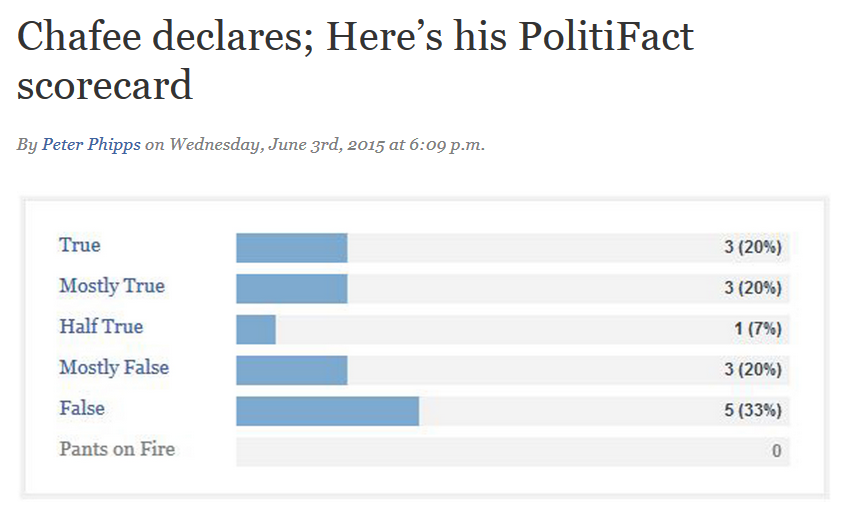
PolitiFact RI presents Lincoln Chafee's "scorecard"

Do PolitiFact's "report cards" mislead?

You betcha!

PolitiFact Rhode Island gave us former Rhode Island governor Lincoln Chafee's scorecard on June 3, 2015. As is often the case, the PolitiFact story highlighting the "scorecard" omitted any caution to readers that the results represent nothing like a social science experiment. And the story includes suggestive sentence pairings like this one (bold emphasis added):
His campaign promises showed a greater measure of constancy. Among the promises we rated, the Linc-O-Meter showed a grinning governor half the time, with 16 of 32 promises kept.
With the sentence we emphasized, PolitiFact Rhode Island implies for its readers that its "scorecard" allows readers to generalize about Chafee's campaign promises, not just the ones PolitiFact RI subjected to its brand of fact-checking.

With almost a full day's worth of comments up at PolitiFact's Facebook page (27), we already have a few that seem to show reader confusion.

"The data base is simply too small to be useful."

With a larger database the story selection process should produce a parallel objection.

"Guess telling the truth is not his strong suit."

"That looks like a terrible set of ratings. Easily poor enough for me to disqualify him as a candidate."

"At least he doesn't have any Pants on Fire."

PolitiFact admits the "report cards" do not represent a social science experiment, albeit their admission is not conspicuous enough to keep readers from making comments such as the above. People see the graph and many believe it shows some type of general truthfulness profile.

PolitiFact refuses to see the extent to which the "report cards" mislead readers, for whatever reason.

Bias, maybe?

Image from PolitiFact.com

Saturday, May 18, 2013

A Fact Too Far

PolitiFact Rhode Island published an article yesterday that highlights the distance between fact checking and what PolitiFact actually does.


Image from PolitiFact

At issue is radio host John DePetro's comments regarding the current resting place of the deceased Boston bomber: "You know, in a way, think of who else is there. That is, President Kennedy is buried not far from there, in Virginia,"

PolitiFact's findings?
We used the Google Maps Distance Calculator to find the actual span between Kennedy's grave at Arlington and the Al-Barzakh Cemetery on Sadie Lane in Doswell, Virginia.

Driving distance: 87 miles.
Bee-line distance: 74 miles.
That's about 55,817 casket lengths.

When we informed DePetro of the distance and asked if he was still bothered, he wrote in an e-mail, "Yes. Insult to bury him so close to JFK. Johnston landfill was my choice or out to sea."
Notice anything missing?  PolitiFact failed to provide a standardized measurement for the linear distance of "not far." Probably because no such definition exists. It's an opinion, and one DePetro articulated quite effectively.

Any guess on PolitiFact's rating?
[T]o say that such a distance should somehow spark offense strikes us as mildly ridiculous, so we rate his statement Pants on Fire!
This is a wholly inappropriate sentence to include in a supposed fact check. We've long argued that there is simply no objective definition of what makes a claim "ridiculous." It's a subjective term determined only by the personal inclinations of PolitiFact's editors. Compounding that subjectivity, PolitiFact finds DePetro's claim only mildly ridiculous in this case. So now not only is the Pants on Fire rating based on an opinion, it's also subject to a sliding scale, the standards for which have yet to be published. Is it a Truth-O-Meter or a mood ring?

It would be interesting to learn when PolitiFact acquired the magical gift of objectively defining what should or should not cause offense. The fact that PolitiFact Rhode Island isn't offended does not make something inoffensive. That's a personal judgement that has no place in a dispassionate determination of fact.

This article is yet another example of how PolitiFact operates as an editorial site sheathed in a false blanket of objectivity. There is simply no way for them to measure the accuracy of DePetro's opinion, and even less possible for them to place a factual determination on what is or isn't offensive.

This is an opinion piece. It's not a fact check. It is dishonest for PolitiFact to suggest otherwise.

Friday, July 13, 2012

Big Journalism: "Politispin: 'Fact-Checkers' Mislead on GOP Leaders' Favorable Unemployment Numbers"

Big Journalism's Tony Lee posted an article yesterday that sets the tone with the first line:
The purportedly unbiased Politifact will go to great lengths to help Democrats.
That's old news around here, but like the liberals who endlessly parrot PolitiFact's spin, we appreciate confirmation bias as much as the next guy. 

So what's all the hubbub about? PolitiFact Rhode Island's rating of GOP gubernatorial candidate John Robitaille's claim that "Unemployment rate dropped in every state that elected a Republican gov. in 2010." Robitaille based his claim on a report done by Robert Elliott. Lee critiques PolitiFact's dance moves:
In a remarkable twisting of facts and logic, Politifact concedes Elliott’s two points are true before somehow rendering those points to be “Half True.”
This isn't the first time in recent memory where PolitiFact found ways to determine accurate figures weren't worthy of a True rating. This rating also adds to the list of experts left with a bad taste in their mouth after dealing with PolitiFact:
“That type of spin would be expected of, say, the Democratic Governors Association, but not a supposedly ‘objective’ and ‘nonpartisan’ news organization that claims to be the official arbiter of the truth,” Elliott told Breitbart News. “It is the insidious nature of PolitiFact's bias that makes them so loathsome.”
Elliot's statements by themselves make Lee's article a must-read. But Lee sweetens the pot by highlighting PolitiFact's use of extraneous evidence to cloud the issue they were ostensibly reviewing:
Politifact then goes on to compare the unemployment rates of the states that simply elected a governor who was from a different party from the predecessor’s, which is a completely different analysis than Elliott’s, which is what Politifact was supposed to be “fact checking.”

When doing that analysis resulted in Republican governors still reducing the unemployment rate faster than Democratic governors, Politifact decided to compare the unemployment numbers of the Republican predecessors in states that elected Democrats and Democratic predecessors in states that elected Republicans. Only then -- when not even comparing the current crop of governors or the past two years, which was the basis of Elliott’s analysis -- was Politifact able to find something they could use to say Democrats (predecessors) were slightly better than Republicans (predecessors) at reducing the unemployment rate.
Lee nails the point, and this reminds me of PolitiFact's treatment of Laura Ingraham's claim about RomneyCare's unpopularity with national voters. In that case, PolitiFact based their entire rating on statistics only from Massachusetts when Ingraham was probably talking about all 50 states. It appears that when PolitiFact doesn't like the initial outcome, they find new facts to throw into the mix until they reach their desired outcome.

The most hilarious part of the rating was that PolitiFact not only conceded, but confirmed Elliot's numbers:
Considering the unemployment rate has fallen in 49 states in the last year, that’s stretching the statistic pretty thin.

We find Robitaille’s claim "is partially accurate but leaves out important details or takes things out of context," our definition of Half True.
If the unemployment rate fell in 49 states, by definition Robitaille's claim is true. Using PolitiFact's logic, if Robitaille had claimed "The sun rose in every state that elected a GOP governor", he'd only be rated Half-True because he left out important details. It's nonsense. And it's not fact checking.

This is the first time we've noticed Tony Lee, but if this installment at Big Journalism is any indication, we're looking forward to highlighting his work in the future. Head over to Breitbart and read the whole thing. There's plenty more to this smackdown.


Bryan adds:

Matthew Hoy of Hoystory also takes issue with PolitiFact's rating of Robitaille.

One might cut PolitiFact a break for trying to take credit into account for the sake of its ratings if the effort was evenly applied and didn't force PolitiFact to largely ignore the definitions it established for its ratings.

What do I think of PolitiFact's execution?  I'd borrow a line from legendary football coach John McKay:  "I'm in favor of it."

Monday, June 4, 2012

Anchor Rising: "Truth Once Again Blowin' In The Wind At PolitiFact"


Monique Chartier of Anchor Rising brings our attention to likely case of PolitiFact bias.

This looks like another classic case where PolitiFact (PolitiFact Rhode Island in this case) applies a hyper-literal interpretation to a statement that is plainly true when given normal charitable interpretation.

Specifically, Lisa Blais of the Ocean State Tea Party In Action group appeared on WHJJ 920's Helen Glover Show.  During that appearance, Blais said ""As you know, we came out against Deepwater.  And everybody is now paying for it in their electric bills." 

Blais' comment came in the context of a different case of potentially wasteful government intervention.  Taken in context, Blais is saying that the Deepwater wind turbine project receives its financing from electric bills.  Blais was not communicating the message that persons paying electric bills today are directly paying for the Deepwater project.  Find Blais' comments at about the two minute mark of the following audio.


PolitiFact ruled based on the idea that the listener would conclude that today's electric bill directly pays for the Deepwater project and gave Blais a ruling of "Barely True."  The PolitiFact story concedes that the project indirectly increases utility bills for today's energy consumer:
In 2009, the legislature and Gov. Donald Carcieri modified that law, requiring National Grid to actively encourage renewable energy projects; one of them was to be an undersea power line from Block Island to the mainland.
(...)
National Grid has racked up some legal costs dealing with that power line and those costs are being passed on to consumers as part of a 0.007 cents per kilowatt hour surcharge on their bills. For the typical residential customer -- who uses about 500 kilowatts per month -- that surcharge translates to no more than 3.5 cents per month.
Even taken hyper-literally Blais' claim was partly true, but the real crime is PolitiFact's decision not to give credit Blais' statement with a normal interpretation.

Blais appeared again today on the Helen Glover Show and gave PolitiFact an appropriate and well-delivered pushback.  Blais point out how PolitiFact went easy on a liberal in a different fact check when the literal interpretation was egregiously wrong.  She correctly observes that PolitiFact's standards abuse the term "standards."


Chartier provided the following update:
Permit me to be more specifical as to how PolitiFact is miss-serving the public and the truth in the case of Lisa's statement. The headline of today's rating is

Tea Party leader Lisa Blais says Rhode Island consumers are now paying for Deepwater wind turbine project in their electric bills.

However deplorable, not everyone delves into an article or an issue. On any given day, many people are only going to skim headlines to pick up the news - I'm guilty of that myself.

And in skimming mode, the all-important modifier "now" in the PolitiFact headline is not likely to register. What will certainly register, however, is the "False". So people are going to come away from this rating thinking, "That's that offshore windmill project, isn't it? I thought it was going to be funded by our electric bills. But PolitiFact says it isn't. That's good!"
Of course PolitiFact is acting hypocritically.  Blais' statement might mislead people.  That's bad, and it deserves a "Mostly False."  PolitiFact similarly misleads people.  That's good, because it gives people an easy way to find the truth in politics without reading every word of a fact check.

Thursday, April 26, 2012

Anchor Rising: "Abortion Question Shows PolitiFact RI's Bias and Ignorance"

Blogger Justin Katz of Rhode Island's "Anchor Rising" recently hit PolitiFact for its poor handling of the abortion issue in a fact check of Jon O'Brien.  O'Brien serves as president of the self-explanatory group Catholics for Choice.

Katz makes great points about the ignorance of Roman Catholic doctrine displayed in the fact check.

Katz:
(I)n order that I may exorcise today's demon, I have to point out the ignorance and bias on display in Eugene Emery's finding that it is "mostly true" that "only 14 percent of Catholics agree with the Vatican's position that abortion should be illegal."
An objective assessment must acknowledge that there are two parts to the question, with a third qualifier necessary for an understanding of the results:
  1. What is the Church's position on the matter?
  2. Do Catholics agree with that position?
  3. In what sense are the respondents "Catholic"?
Katz goes on to show that PolitiFact's fact-finding fudges on all three points.  PolitiFact failed to look into the crucial term "direct abortion" in the portion of the catechism it quoted and made no effort to correlate the actual Catholic doctrines to the poll data.

Katz covers it all and then some, so pay a visit and read it through.

It's worth adding that many Catholics out of agreement with Vatican teaching on abortion think they agree with Vatican teaching on abortion.  Using such statistics often matches a fallacious pattern of argument.

Thursday, January 12, 2012

Anchor Rising: "Cicilline Gifted Another Mostly True From Politifact -- Seriously?"

Patrick Laverty and the Anchor Rising blog give us yet another quality criticism of PolitiFact.

PolitiFact just makes it way too easy.
Ok sure, the funding level was "close". It was in the 90s and it was more than the previous administration. However, as Politifact themselves often say, that isn't what Cicilline said. He said it was at 100% all but two years. It was there for all but six years. That's a big difference.

So the issue really speaks to Politifact's credibility, if they have much left. They are, at best, inconsistent with their rulings especially when it comes to Congressman Cicilline. This is the same newspaper that int 2010 endorsed Cicilline for Congress, in part due to his fiscal management of Providence. 
 PolitiFact's justification for the ruling?
Cicilline, in his off-the-cuff statement, mixed up where the years with the lowest contribution fell. But he made it clear a few times that he was citing figures from memory, so we’ll give him some leeway and rule Mostly True.
It's good to know that one can obtain some leeway if one is citing figures from memory.  At least when PolitiFact decides to grant such leeway (I'm not finding other examples of this kind of treatment).  If you're working from memory then the same set of facts can become more true than otherwise.  Like magic.

Looks like we can add a new wrinkle to the Principles of PolitiFact.