Showing posts with label Lie of the Year. Show all posts

Tuesday, January 30, 2018

PolitiFact editor: "Tell me where the fact-check is wrong"

Ever notice how PolitiFact likes to paint its critics as folks who carp about whether the (subjective) Truth-O-Meter rating was correct?

PolitiFact Editor Angie Drobnic Holan gave us another stanza of that song-and-dance in a Jan. 26, 2018 interview with Digital Charlotte. Digital Charlotte's Stephanie Bunao asked Holan whether she sees a partisan difference in the email and commentary PolitiFact receives from readers.

Holan's response (bold emphasis added):
Well, we get, you know, nobody likes it when their team is being criticized, so we get mail a lot of different ways. I think obviously there's a kind of repeated slogan from the conservative side that when they see media reports they don't like, that it's liberal media or fake news. On the left, the criticism is a little different – like they accuse us of having false balance. You know, when we say the Democrats are wrong, they say, ‘Oh, you're only doing that to try to show that you're independent.’ I mean it gets really like a little bit mental, when people say why we're wrong. If they're not dealing with the evidence, my response is like, ‘Well you can say that we're biased all you want, but tell me where the fact-check is wrong. Tell me what evidence we got wrong. Tell me where our logic went wrong. Because I think that's a useful conversation to have about the actual report itself.
Let us count the ways Holan achieves disingenuousness, starting with the big one at the end:

1) "Tell me where the fact-check is wrong"

We've been doing that for years here at PolitiFact Bias, making our point in blog posts, emails and tweets. Our question for Holan? If you think that's a useful conversation to have then why do you avoid having the conversation? On Jan. 25, 2018, we sent Holan an email pointing out a factual problem with one of its fact checks. We received no reply. And on Jan. 26 she tells an interviewer that the conversation she won't have is a useful one?

2) "Every year in December we look at all the things that we fact-check, and we say, ‘What is the most significant lie we fact-checked this year’"

Huh? In 2013, PolitiFact worked hard to make the public believe it had chosen the president's Affordable Care Act promise that people would be able to keep plans they liked under the new health care law as its "Lie of the Year." But PolitiFact did not fact check the claim in 2013. PolitiFact Bias and others exposed PolitiFact's deception at the time, but PolitiFact keeps repeating it.

3) PolitiFact's "extreme transparency"

Asked how the media can regain public trust, Holan mentioned the use of transparency. We agree with her that far. But she used PolitiFact as an example of providing readers "extreme transparency."

That's a laugh.

Perhaps PolitiFact provides more transparency than the average mainstream media outlet, but does that equal "extreme transparency"? We say no. Extreme transparency is admitting your politics (PolitiFail), publishing the texts of expert interviews (PolitiFail, except for PolitiFact Texas), revealing the "Truth-O-Meter" votes of its editorial "star chamber" (PolitiFail) and more.

PolitiFact practices above-average transparency, not "extreme transparency." And the media tend to deliver a poor degree of transparency.

We remain prepared to have that "useful conversation" about PolitiFact's errors of fact and research.

You let us know when you're ready, Angie Drobnic Holan.

Wednesday, November 29, 2017

Handicapping the PolitiFact "Lie of the Year" for 2017 (Updated)

PolitiFact's "Lie of the Year" is a farce, of course, as it places the objective and non-partisan editors of PolitiFact in the position of making an obviously subjective decision about which false (or false-ish) statement was the "most significant."

In other words, they put on their pundit hats.

But we love the exercise because it gives us the opportunity to predict which claim PolitiFact will choose, basing our predictions on PolitiFact's liberalism and its self-interest.

We've got a pretty decent record of predicting the outcome.

This year, all of the nominees were rated "Pants on Fire" during the year. We note that because exceptions often occur. For example, President Obama's declaration that people could keep their insurance plans under the Affordable Care Act if they liked those plans wasn't rated at all during the year it received the award. Moreover, it was never rated lower than "Half True" by the nonpartisan liberal bloggers at PolitiFact. That (complicated and deceptive) pick was a case of PolitiFact covering its arse in response to a news cycle that demanded the pick.

This year's ballot resembles last year's. Voters just get to see the claim and the rating, though voters may click hotlinks to view the fact checks if desired.

PolitiFact puts on its neutral face by listing the claims in chronological order.


"That was the largest audience to witness an inauguration, period."
— Sean Spicer on Jan. 21, 2017, in a press conference


The size of the inauguration crowd should never count as an important political story representing the entire year. This nominee was picked to lose.


Says Barack Obama "didn’t do executive orders in the beginning."

— Whoopi Goldberg on Jan. 25, 2017, in a segment on ABC's “The View”


No claim coming from a host of "The View" should ever count as an important political story representing the entire year. This nominee was picked to lose.


Says Rex "Tillerson won't divest from Exxon."

— Charles Schumer on Jan. 27, 2017, in a tweet


Who's Rex Tillerson? Just kidding. This pick shows how PolitiFact had to scrape the bottom of the barrel for anything significant coming from a Democrat. This nominee is another placeholder made necessary by the hard time PolitiFact has giving Democrats a "Pants on Fire" rating. By our count, PolitiFact has only issued three "Pants on Fire" ratings to Democrats this year. This claim has no shot, as it was politically unimportant.


"I have not called for impeachment" of President Donald Trump.

— Maxine Waters on April 18, 2017, in an interview on MSNBC


This one's another place-holding, politically unimportant claim that has no shot of winning. Do we detect a pattern?


"Nobody dies because they don’t have access to health care."

— Raul Labrador on May 5, 2017, in a town hall event


This one I'll make my dark horse pick. Labrador is not particularly well-known, and the quotation is taken out of context. But if PolitiFact ignores those factors and the claim gets an unexpected boost from the reader's poll as representative of the health care debate, this one has a greater than zero shot of winning.


"This Russia thing with Trump and Russia is a made-up story. It's an excuse by the Democrats for having lost an election that they should've won."  

— Donald Trump on May 11, 2017, in an interview with NBC News


That's the overwhelming favorite. It fits the narrative PolitiFact loves (Trump the Liar). It fits the narrative PolitiFact's predominantly liberal audience loves (Russia, Russia, Russia!). Is there any solid evidence that Russia swayed the election results? No. But that shouldn't matter. We're talking narratives and clicks, things to which PolitiFact is addicted. PolitiFact will hope the Mueller investigation will eventually provide enough backing to keep it from getting egg on its face.


"Every single year that there's an increase (in temperature) it's within the margin of error -- meaning it isn't increasing."

— Greg Gutfeld on June 2, 2017, in Fox News’ “The Five” show


Global warming Climate change remains near and dear to liberal bloggers and liberals but ... Greg Gutfeld? This one could have had a chance coming from a major figure in the Trump administration. Coming from moderately popular television personality like Gutfeld it has no chance.


White nationalist protesters in Charlottesville "had a permit. The other group didn’t have a permit."

— Donald Trump on Aug. 15, 2017, in a question-and-answer session with reporters


That's my second pick. Again we've got the pull of the Trump/Liar narrative. And we've got the Trump's a Nazi tie-in. Was the statement politically significant? Only in terms of stimulating negative narratives about Trump. And that could help this one pull out the win.


"The United States ended slavery around the world, and maybe we should get some credit for that, too."

— Tucker Carlson on Aug. 15, 2017 in comments on “Tucker Carlson Tonight”


This one counts as another politically unimportant statement. This pick has no chance unless driven by the name "Tucker Carlson" and network that airs his show.


"We’ve got dozens of counties around America that have zero insurers left."

— Paul Ryan on Aug. 21, 2017 in a CNN town hall broadcast


The claim by Ryan comes in as my third pick.

It fits a popular liberal narrative--protecting the Affordable Care Act. Ryan has good name recognition and little popularity among liberals. PolitiFact's valiant exposure of Ryan's falsehood may have saved Obamacare from repeal! Or so I imagine PolitiFact may reason it.


So there it is. The 2017 award almost certainly goes to Trump and almost certainly for his claim about his ties to Russia affecting the election counting as fake news. It's worth noting that fact checkers like those at PolitiFact resent Trump's co-opting of the term. That should give this claim another advantage in claiming the award.

It does look like PolitiFact stacked the deck of nominees, most notably by only nominating claims that received "Pants on Fire" ratings. That's a first. Claims receiving that rating tend to be more trivial and thus politically unimportant. That decision helped clear the field for Trump.

If PolitiFact changes nothing about its biased approach to fact-checking and continues to draw its "Lie of the Year" finalists only from that year's list of claim it rated "Pants on Fire," statements from the Republican Party will surely dominate the awards in the years ahead. "Fake news" stories may start appearing on the list of nominations, however. "Fake news" stories pick up most of PolitiFact's "Pants on Fire" ratings these days.

Update Nov. 29, 2017:

Jeff Adds

The Trump/Russia claim seems like the safe bet here, and it's hard to argue against Bryan's case. If we believed PolitiFact actually adhered to its Lie of the Year criteria, I think it's the only one that meets those standards (namely, a claim that is politically significant.) It's also got the click-grabbing factor that drives people to PolitiFact's recently malware infested website, and clicks are what actually motivates PolitiFact more than any noble search for truth.

But PolitiFact is mildly self-aware, and sometimes they'll tweak things up as a matter of image control. This tic of theirs led me to correctly predict that 2011's Lie of the Year pick would go against the Left (though wrong about which specific claim would win.) I think PolitiFact wants to avoid giving Trump the award because it already catches flack for obsessively targeting him.

I'm going to #Resist the urge to go with the obvious pick and I predict that Sean Spicer wins for his crowd size claim.

This allows PolitiFact to avoid being mocked for picking on Trump himself while allowing it to pick on Trump's administration. The pick will be loved by PF's liberal fan base and the media (I repeat myself.) The headlines crowing "Trump admin earns Lie of the Year!" will serve as sufficient click-bait. I expect PolitiFact can spin the pick into the first lie of the Trump administration that set the tone for all the easily debunked and ridiculous falsehoods that followed.

For my Dark Horse I'm going to contradict myself: If PolitiFact repeats their recent tradition of making up a winner that wasn't actually in their list of finalists, I say they go rogue and give it to Trump for all of his falsehoods, and claim they couldn't pick just one. This has all the benefits of clickbait and will upset no one that matters to PolitiFact.

Whoever the winner is it's clear, as has been the case every year they've done this, the field of picks is an intentionally lopsided mixed bag of bland throw-aways and a couple of obvious picks.

Just like PolitiFact's ratings, the winner is already determined before the contest has begun.


Edit: Added "recenty" to first graph of Jeff Adds -Jeff 1948PST 11/29/17


Clarification Nov. 29, 2017: Changed "sometimes exceptions often occur" to "exceptions often occur"

Monday, December 5, 2016

Handicapping PolitiFact's "Lie of the Year" for 2016

A full plate of stuff to write about has left me a little behind in getting to PolitiFact's list of finalists for its "Lie of the Year" award--the award that makes it even more obvious that PolitiFact does opinion journalism, since judging the importance of a "lie" obviously requires subjective judgments.

I clipped an image of the most important part of the electronic ballot:


One thing jumped out right away. Typically the list of finalists includes about 10 specific fact checks from a number of sources. This year's menu includes only four specific fact checks, two each from Hillary Clinton and Donald Trump. PolitiFact rounds out the menu with two category choices, the whole 2016 election and the "fake news" phenomenon that, without much hint of irony, has galvanized the mainstream press to make even greater efforts to recapture its (legendary?) role as the the gatekeeper of what people ought to know and accept.

Given PolitiFact's recent tendency to select a "Lie of the Year" made up of multiple finalists, these changes make a great deal of sense. We've already pointed out one of the advantages PolitiFact gains from this approach. Having a multi-headed hydra as the winner allows PolitiFact to dodge criticisms of its choice. Oh, that hydra head got lopped off? No worries. These others continue to writhe and gnash their teeth.

Without further ado, I'll rate the chances of the six listed finalists. Doubtless my co-editor Jeff D. will weigh in at some point with his own comments and predictions.

Clinton "never received nor sent any email that was marked as classified" on her private email server while acting as Secretary of State

Of the specific claims listed, this one probably had the biggest impact on the election. Clinton made this claim a key part of her ongoing defense of her use of the private email server. When FBI Director James Comey contradicted this part of Clinton's story, it cinched one of Clinton's key negatives heading into the 2016 election. This one would serve as a pretty solid choice for "Lie of the Year." The main drawback of this selection stems from liberal denial of Clinton's weakness as a presidential candidate. This choice might generate some lasting resentment  from a significant segment of PolitiFact's liberal fanbase, some of whom will insist Clinton was telling the truth.


Clinton says she received Comey's seal of approval regarding her truthfulness about the email server

This item gave us a notable case where a major political figure made a pretty much indefensible and clear statement that was quickly publicized as such. Was this one politically significant? I think journalists were a bit shocked that Clinton made this unforced error. But I doubt voters regarded this case as anything other than a footnote to Clinton's earlier dissembling about her email server.

Trump claims "large-scale voter fraud"

Talk about awkward!

Trump was pilloried by the mainstream press along with pundits and politicians aplenty for his statements calling the presidential election results into doubt. But the political importance of this one gets complicated by liberal challenges to the election results in states where Trump's margin of victory was not particularly narrow (Michigan, Pennsylvania, and Wisconsin). Why challenge the results if they were not skewed by some form of large-scale fraud? This selection also suffers from the nature of the evidence. Trump received the rating not because it is known that no large-scale voter fraud has taken place in 2016, but because of a lack of evidence supporting the claim.

Donald Trump said he was against the war in Iraq

This one counts as the weakest of the specific fact checks on the list. PolitiFact and its fact-checking brethren built a very weak case that Trump had supported the Iraq War. Making this one by itself the "Lie of the Year" will result in some very good challenges in the mainstream and conservative press.


"The entire 2016 election, when falsehoods overran the facts"

Now things get interesting! Could PolitiFact opt for a "Lie of the Year" awarded to a candidate even more generalized than "campaign statements by Donald Trump," which won in 2016? And does PolitiFact have the ability to objectively quantify this election's overrunning of the facts compared to elections in the past? And could PolitiFact admit that falsehoods overran the facts despite proclamations that fact-checking enjoyed a banner year? If falsehoods overrun the facts while fact checkers enjoy a banner year then what will journalists prescribe to remedy the situation? More of what hasn't worked?

This choice will likely have good traction with PolitiFact's editors if they see a way toward picking this one while avoiding the appearance of admitting failure.


The fake news phenomenon(?)

Fake news has been around a good while, but it's the new hotness in journalistic circles. If mainstream journalism can conquer fake news, then maybe the mainstream press can again take its rightful place as society's gatekeepers of information! That idea excites mainstream journalists.

This surprise nominee has everything going for it. Fake news is fake by definition, so who can criticize the choice? It's total journalistic hotness, as noted. And the choice represents a call to action, opposing fake news, in symphony with a call that is already reverberating in fact-checking circles.

Is it a lame choice? Yes, it's as lame as all get out. I'd doubt journalists even have a clue about the impact of fake news, not to even mention the role fact checkers play in supporting false news memes that liberals favor.


Summary

Clinton's claim she never sent or received material marked as classified on her private server is the favorite according to the early established norms of the "Lie of the Year" award. But the fake news choice serves as the clear favorite in terms of sympathy with its Democratic-leaning readership and promoting its own sense of mission. I expect the latter favorite to prevail.


Jeff Adds:

I don't see much to disagree with Bryan. You can dismiss any claim relating to Trump right off the bat. Giving the award to Trump would neither shock people that hate him nor would it upset people that love him (who presumably already have low regard for liberal fact checkers.) It would be a yawner of a pick that would fail to generate buzz.

The Clinton pick would be a favorite in any other year. Because Clinton has already lost the election and her status on the left has been diminished, handing her the award wouldn't do any harm to her, but it would provide PolitiFact with a bogus token of neutrality ("See! We call Democrats liars too!") Likewise, the resulting outrage of PolitiFact's devoted liberal fanbase would generate plenty of clicks, and typically that's what the Lie of the Year has been about. It's true they would temporarily upset the faithful, but we've seen this exact scenario play out before with little consequence. Historically, PolitiFact seems motivated by clicks (and even angry liberal clicks will do, not to mention they keep the "we upset both sides" charade going.)

But the Fake News pick is the obvious favorite here. It's the hottest of hot topics in journalist circles, and PolitiFact sees themselves on the front lines in the war against opposing viewpoints unfacts. They're already trying to rally the troops and want to be seen as a beacon of truthiness in a sea of deceit.

It's been my view that while PolitiFact formerly cared primarily about generating buzz, since Holan's ascension [Angie Drobnic Holan replacing Bill Adair as chief editor--bww] they've behaved more and more like political activists. The Clinton choice would get more clicks, but I'd bet on Fake News being this year's rally cry for PolitiFact's army of Truth Hustlers.

Viva la Factismo!


Friday, February 20, 2015

Hot Air: "PolitiFact’s Lie of the Year of 2014 falls apart only two months later"

Noah Rothman of the conservative site Hot Air offers a reminder that PolitiFact's 2014 "Lie of the Year" was a train wreck:
Just about two months later, PolitiFact’s LOTY imploded.

“A team of prominent researchers suggested Thursday that limited airborne transmission of the Ebola virus is ‘very likely,’” The Washington Post reported on Thursday, “a hypothesis that could reignite the debate that started last fall after one of the scientists offered the same opinion.”
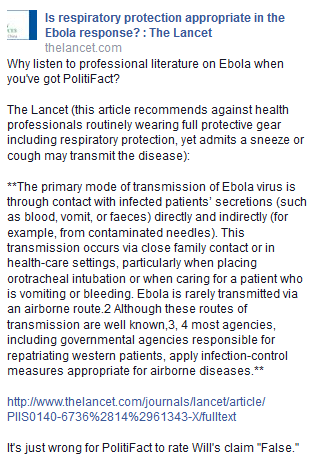
PolitiFact, remember, bundled all the supposed misinformation about Ebola into one giant and ambiguous "Lie of the Year." George Will's claim that some scientists believe Ebola may pass via a sneeze or a cough was the centerpiece of PolitiFact's award.

In truth, Will's statement was never worthy of a bad rating, let alone inclusion in a group "Lie of the Year" award. We noted at the time PolitiFact's rating relied on playing games with Will's choice of words.

Read the whole of Rothman's latest evaluation, including mentions of blogger Ace and the clip at the end of Will reminding everyone back in October that "settled science" is rarely settled.

Monday, December 22, 2014

Mailbag meets windbag

PolitiFact published a "Lie of the Year" edition of its "Mailbag" feature on Dec. 22, 2014. Criticism by Hot Air's Noah Rothman drew immediate mention:
Noah C. Rothman at the conservative blog Hot Air took issue with our Lie of the Year choice.

"Some of these assertions (that collectively earned the Lie of the Year) were misleading, but PolitiFact’s central thesis – ‘when combined, the claims edged the nation toward panic’ – is unfalsifiable. In the absence of any questioning of the federal response to the Ebola epidemic, an unlikely prospect given the government’s poor performance, PolitiFact cannot prove there would have been no broader apprehension about the deadly African hemorrhagic fever. In fact, to make that claim would be laughable.

"In response to Ebola, Sierra Leone literally canceled Christmas. In Britain, returning health care workers who may have had contact with an Ebola patient will have a lonely holiday as well. They will be forced by government mandate to isolate themselves for the duration of the 21-day incubation period, despite the protestations of health care workers. If Ebola ‘panic’ exists, it is certainly not limited to America and is not the fault of exclusively conservative lawmakers. … PolitiFact embarrassed itself again today, but I guess that’s hardly news."
Rothman's main criticism was PolitiFact's ridiculous primary focus on George Will's true claim that Ebola could be transmitted through the air by a sneeze or a cough.

PolitiFact's guidelines:
HALF TRUE – The statement is partially accurate but leaves out important details or takes things out of context.
Left out: the main part of Rothman's criticism.

PolitiFact=hypocrites.

Wednesday, December 17, 2014

Commentary: 'PolitiFact’s Ebola Distortions'

Seth Mandel has another deft dissection of PolitiFact's 2014 "Lie of the Year" up at Commentary:
Different statements being grouped together into one “lie”–especially when they’re not lies, even if they’re mistaken–will not do wonders for PolitiFact’s already rock-bottom credibility. But in fact it’s really worse than that. Here’s PolitiFact’s explanation for their choice of “Lie of the Year,” demonstrating beyond any semblance of a doubt that those who run PolitiFact don’t understand the concept around which they’ve supposedly built their business model:
Yet fear of the disease stretched to every corner of America this fall, stoked by exaggerated claims from politicians and pundits. They said Ebola was easy to catch, that illegal immigrants may be carrying the virus across the southern border, that it was all part of a government or corporate conspiracy.
The claims — all wrong — distorted the debate about a serious public health issue. Together, they earn our Lie of the Year for 2014.
You’ll notice right there that PolitiFact engages in its own bit of shameless dishonesty.
Mandel makes a great point about PolitiFact's careless reporting of its "Lie of the Year" selection, a point we're also poised to make by using even more blatant examples from Aaron Sharockman, the editor of PolitiFact's "PunditFact" venture.

It's bad enough to botch the fact-checking end of things. Telling people about the botched fact checks using a new layer of falsehoods and distortions intensifies the deceptive effects.

This is nothing out of the ordinary for PolitiFact.

We'll once again emphasize the point we made in our post yesterday: Naming more than one "Lie of the Year" has some utility when it comes to deflecting criticism. Even Mandel mumbled something about being fair to PolitiFact owing to the multiple winners before he eviscerated their inclusion of Will's claim about the airborne spread of Ebola.

Tuesday, December 16, 2014

2014: Another year, another laughable Lie of the Year

It's time for our annual criticism of PolitiFact's "Lie of the Year" award!

Leading off in a bipartisan spirit, let's note that every single one of PolitiFact's "Lie of the Year" award winners have contained some nugget of truth. This year, PolitiFact decisively elected to give the award to many quite different claims, each having something to do with the Ebola virus.

There's nothing like the meat tenderizer approach when wielding the scalpel of truth.

My handicapping job on the Lie of the Year award was pretty close. But PolitiFact threw us another curve this year by choosing two entries from its list of candidates and then throwing a bunch of other somewhat related claims in for good measure.

No, we're not even kidding.

Let's let PolitiFact's editor, Angie Drobnic Holan, tell the story:
[F]ear of the disease stretched to every corner of America this fall, stoked by exaggerated claims from politicians and pundits. They said Ebola was easy to catch, that illegal immigrants may be carrying the virus across the southern border, that it was all part of a government or corporate conspiracy.

The claims -- all wrong -- distorted the debate about a serious public health issue. Together, they earn our Lie of the Year for 2014.
PolitiFact's lead example, that Ebola is easy to catch, matches closely with the entry I marked as the most likely candidate. It's also the candidate that Hot Air's Noah Rothman identified as the worst candidate:
[T]he most undeserving of entries upon which PolitiFact has asked their audience to vote is a claim attributed to the syndicated columnist George Will. That claim stems from an October 18 appearance on Fox News Sunday in which Will criticized the members of the Obama administration for their hubristic early statements assuring the country that the Ebola outbreak in Africa was contained to that continent.

“The problem is the original assumption, said with great certitude if not certainty, was that you need to have direct contact, meaning with bodily fluids from someone because it’s not airborne,” Will said of the deadly African hemorrhagic fever. “There are doctors who are saying that in a sneeze or some cough, some of the airborne particles can be infectious.”
Rothman's post at Hot Air makes essentially the same points we posted to PolitiFact's Facebook page back in October:
 

PolitiFact's ruling was an exercise in pedantry, extolling the epidemiological understanding of "airborne" over the common understanding. Perhaps Will's statement implicitly exaggerated the risk of contracting Ebola via airborne droplets, but his statement was literally true.

What else went into the winning "Lie of the Year" grab-bag?
  • Rand Paul's claim that Ebola is "incredibly contagious" (not a candidate)
  • Internet users claiming Obama would detain persons showing Ebola symptoms (not a candidate)
  • Bloggers claiming the virus was cooked up in a bioweapons lab (not a candidate)
  • Rep. Paul Broun's claim he'd encountered reports of Ebola carriers crossing the U.S.-Mexico border (a candidate!)
  • Sen. John McCain's claim the the Obama administration said there's be no U.S. outbreak of Ebola (not a candidate).
PolitiFact tosses in a few more claims later on, but you get the idea. PolitiFact crowned every blue-eyed girl Homecoming Queen in 2014, after naming only two statements "Lie of the Year" in 2013.

Why so many lies of the year in 2014?


Sunday, December 14, 2014

PolitiFact poised to pick 2014 "Lie of the Year"

It's time for PolitiFact's "Lie of the Year" nonsense again, where the supposedly nonpartisan fact checkers set aside objectivity even more blatantly than usual to offer their opinion on the year's most significant political falsehood.

We'll first note a change from years past, as PolitiFact abandons its traditional presentation of the candidates accompanied by their corresponding "Truth-O-Meter" graphic. Does that have something to do with criticisms over last year's deceitful presentation? One can only hope, but we're inclined to call it coincidence.

And now a bit of handicapping, using a 0-10 scale to rate the strength of the candidate:

Tuesday, December 31, 2013

Volokh Conspiracy: "Politifact’s “Lie of the Year” – Part Deux"

Jonathan H. Adler, writing at the Volokh Conspiracy blog, highlights an overlooked aspect of PolitiFact's 2013 "Lie of the Year" snafu:
Avik Roy writes on how Politifact’s assessment of the “if you like your plan, you can keep it” promise went from 100% true to half-true to a “pants on fire” lie to the “lie of the year.”  The column is fairly devastating by itself, but then Politifact’s Angie Holan, who authored some of the relevant evaluations, tried to defend Politifact with a tweet:
The mind reels.  Then-Senator Obama’s 2008 health care plan had numerous elements that were sure to disrupt health insurance markets, as Roy noted in the column.
Drobnic Holan's right that the campaign proposal was different from the eventual law.  But Roy and Adler are obviously correct that the campaign proposal was, on its face, even more disruptive than the Affordable Care Act with its individual mandate.

With Drobnic Holan's response we can count her as a worthy successor to former PolitiFact editor Bill Adair, who was also notably inept at dealing with criticism.

Drobnic Holan wants to forget about the "True" rating Obama received for the "If you like your plan" pledge based on his campaign proposal.  The campaign proposal was different from the ACA, she says.  But at the same time, Drobnic Holan wants everyone to accept without question that PolitiFact can combine Obama's ACA version of the "If you like your plan" pledge with his later "What we said was" hedge.

PolitiFact combined those two statements to produce a Frankenstein's monster candidate for its 2013 "Lie of the Year" candidate.

Dr. Holanstein doesn't want the 2008 "True" rating connected to her monster.

Thursday, December 19, 2013

PolitiFact can't handle the truth about its "Lie of the Year"

Yesterday PolitiFact published an article called "The most interesting reactions to the 2013 Lie of the Year."*

It leads with a half-truth:
Last week, we unveiled our 2013 Lie of the Year, President Barack Obama’s statement, "if you like your health care plan, you can keep it," making the announcement live on CNN’s The Lead with Jake Tapper and simultaneously publishing an in-depth story on our website.
Either it's a half-truth or else Angie Drobnic Holan lied to CBS' Jake Tapper when she said "They're both the lie of the year," referring to a different claim from President Obama that PolitiFact rated "Pants on Fire" in 2013.

Half true, as PolitiFact describes it, means "the statement is partially accurate but leaves out important details or takes things out of context."  Forgetting to mention the co-winner of the award would appear to count as an important detail.

It's delicious hypocrisy from fact-checking's weakest link.  This year's "Lie of the Year" was all about covering PolitiFact's arse as it failed to adequately cover President Obama's inaccurate speech about the Affordable Care Act.

And we can't resist pointing out how PolitiFact tries to keep the bloodsucking vampires of criticism at bay with a garlicky cliche:
We had defenders on Twitter, too, like David Podhaskie, a legal editor. "Maybe people are getting mad at @Politifact because they haven't actually read their entries on Obamacare?" He linked to a few. "If a fact-checking site is making both sides mad, it's doing its job."
Kind of like John Beale was doing his job if both Democrats and Republicans are outraged at the way he defrauded the EPA and the American people.  Isn't it past time to retire that lamest of defenses?

Conservatives and liberals have the same legitimate complaint about PolitiFact:  It's inconsistent with its past practices to name a "Half True" statement as its "Lie of the Year."  Beyond that, conservatives think the "Half True" rating was too kind while liberals think a "Half True" statement shouldn't be eligible for the award.

The criticism from both sides means PolitiFact isn't doing its job.  The unusual way a "Half True" statement qualified as a "Lie of the Year" deserved a full and complete explanation from PolitiFact.  We're not getting one because PolitiFact is succeeding with the deception it intended for this year's "Lie of the Year."


*The fact that we warranted no mention in that article shows clearly we should have worked a cabal of fascist cannibalistic lesbian spies into our PolitiFact Lie-of-the-Year conspiracy article.

Friday, December 13, 2013

Hot Air: "Congratulations, Barack Obama, on winning PolitiFact’s 'Lie of the Year'!"

We're not much for using PolitiFact as evidence for much of anything, but Allahpundit's "Lie of the Year" article for Hot Air avoids some of the missteps we're seeing from other conservative voices.

Rather than simply trusting that the LOTY award hits President Obama where he lives, Allahpundit notes some of the fishy circumstances surrounding the selection and echos some of the good questions Jake Tapper posed to PolitiFact editor Angie Drobnic Holan when the award was announced on Tapper's CNN program, "The Lead":
And yet, as Sean Higgins noted last month, the hacks at PolitiFact backed Obama up on it in whole or in part no fewer than six times between 2008 and 2012. Last year, in the thick of the presidential campaign, O actually had the balls to say, “If you’re one of the more than 250 million Americans who already have health insurance, you will keep your health insurance.” That’s even more categorical than his infamous phrasing at the AMA conference in 2009. PolitiFact’s rating: Half-true.
We do wish commentators like Allahpundit were more clear on the point that PolitiFact is not budging from its "Half True" rating of  "If you like it" despite the LOTY award.  PolitiFact is using a different and later claim from Obama as a shoehorn to help squeeze "If you like it" in as the winner.

As PolitiFact editor Angie Drobnic Holan explained, "They're both the Lie of the Year."

Red Alert Politics: "PolitiFact attempts to downplay “If you like your health care plan, you can keep it” falsehood even while dubbing it ‘Lie of the Year’"

How can we not like a "Lie of the Year" blog post that dovetails with our own painstaking analysis?

Red Alert Politics:
In both 2009 and 2012, the website gave the President’s ‘if you like it, you can keep it’ assertions “half-true” ratings.

But in its “Lie of the Year” designation, PolitiFact still claimed the President was simply using “a catchy political pitch and a chance to calm nerves about his dramatic and complicated plan to bring historic change to America’s health insurance system” — instead of outright lying to achieve his political ends.
Red Alert Politics' Kelsey Osterman is right, and when one also considers the pains PolitiFact undertook to link President Obama's "If you like it" promise to his later "What we said was" explanation, the magnitude of PolitiFact's deceitfulness starts to show clearly.

PolitiFact editor: "They're both the Lie of the Year."

Alternate title:  "Oh, fuuudge"


Yesterday PolitiFact awarded its "Lie of the Year" for 2013.  The award was announced on "The Lead with Jake Tapper."

On Dec. 4 we predicted that the winner would be President Obama's 2013 claim that he said people could keep their health insurance plan if it hadn't changed since the law was passed.  We believed PolitiFact was using Obama's earlier claim that people could keep their health plans ("Period") to help sell people on the political impact of the president's "What we said was" claim.

On Dec. 10 I accepted that PolitiFact's presentation of its "Lie of the Year" nominees made it certain that "What we said was" did not receive a nomination, but "If you like your plan" was the true nominee even though PolitiFact hadn't rated it in 2013 and it had received a "Half True" rating in 2012.  We charged that PolitiFact was using the "Pants on Fire" rating for "What we said was" to make the selection of a statement from 2012 more palatable to readers.

Surprise!

We were wrong, along with pretty much everybody.  The "Lie of the Year" for 2013 ended unexpectedly in a tie!

PolitiFact editor Angie Drobnic Holan explained it to host Jake Tapper.


Newsbusters relates the key part of the conversation:
"So, the lie about what he originally said is Lie of the Year?" asked Tapper.

"They're both Lie of the Year, because this is something that unfolded over a bunch of years," Drobnic Holan answered.
PolitiFact combined the two statements into one candidate.  But didn't explain that to readers voting in their reader's poll.

We're grateful to Jake Tapper for asking some of the right questions.

If time had allowed we'd have liked to see Tapper ask one or two more questions:

How does "This is something that unfolded over a bunch of years" justify combining the two very different statements into one "Lie of the Year" candidate?  Isn't "Lie of the Year" a misnomer if candidates can unfold over a bunch of years?

It would have been fun to see Drobnic Holan's floundering turn a touch more obvious on national television after a little more questioning.

Conservatives:  Don't trust PolitiFact.  They rated the co-winner of the Lie of the Year for 2013 "Half True" and they'd do the same thing tomorrow.

Liberals:  You should complain that PolitiFact gave half the "Lie of the Year" award for 2013 to a statement PolitiFact rated "Half True" in 2012 and didn't rate again in 2013.

Conservatives and liberals should demand consistency from PolitiFact.  If it doesn't happen, get your fact checks somewhere else.


Afters

Here's another line of evidence showing how PolitiFact deliberately misled its readers with this year's "Lie of the Year":

2009 finalists
2010 finalists
2011 finalists
2012 finalists
2013 finalists

PolitiFact traditionally lists candidates on its reader's poll including the graphics for the ratings ("Related rulings").  But there's no "Half True" among the ratings listed in 2013.  PolitiFact did not want its readers knowing they might be voting for a "Half True" claim made in 2012.  That would be controversial.

Here's how PolitiFact described the process back in 2011 (bold emphasis added):
Later this month, we'll announce PolitiFact's Lie of the Year -- the most significant falsehood of 2011, as chosen by the  editors and reporters on the PolitiFact National staff. We're reviewing claims we've rated False or Pants on Fire and will choose the one that played the biggest role in the national discourse.
One assumes now they're reviewing claims they've rated Half True, Mostly False, False or Pants on Fire.  Though there's no obvious reason to think a "Mostly True" or "True" claim couldn't win it all one day.  Or at least earn a tie.

Pre-publication update:  

After PolitiFact publishes its LOTY selection we get the visual "Half True" rating reveal.  At the bottom, third of three after voters were already misled:


Better late than never?

Tuesday, December 10, 2013

The PolitiFact "Lie of the Year" conspiracy of the year

PolitiFact's "Lie of the Year" for 2013 will prove its most embarrassing effort to date.

My PolitiFact Bias co-editor, Jeff D, figured out why.  At first I didn't quite buy it.  I'm a tough sell for conspiracy theories.  The mainstream journalists I've met virtually all seem decent, and I'm typically willing to grant the benefit of the doubt.

But this year's "Lie of the Year" is a travesty.  And as a former skeptic I'll explain it to the other skeptics.

Jeff's earlier post, PolitiFact's Bait and Switch: "If You Like It" is Not a Lie of the Year Finalist, was toned down and altered at my urging.  It concludes that Obama's "If you like it" promise is not one of this year's "Lie of the Year" finalists.

But we think PolitiFact intends people to think it is one of the finalists.

Why is there any question about it?


In our earlier post, we noted that PolitiFact used bold emphasis to identify each candidate for its "Lie of the Year" prize except for one:


Why did I think "If you like it" wasn't one of the choices despite occurring with bold emphasis?  Two reasons, both mentioned by PolitiFact right along with the choice:
  1. The claim in bold came from "previous years"
  2. The description mentions a different, though related, claim from 2013 that received a "Pants on Fire" rating.  That claim would more naturally qualify as a candidate.
I charitably assumed PolitiFact would not nominate a claim it rated "Half True" in June 2012 as its 2013 "Lie of the Year" without carefully justifying that decision.  The evidence suggests that charity was misplaced.

    But the "Pants on Fire" claim is really the same thing, isn't it?

    As mentioned in our earlier post, Jeff noticed that Tampa Bay Times political editor Adam Smith appeared to think "If you like it" was one of the candidates.

    A writer for PolitiFact Oregon, Ryan Kost, said "(I) think for all intents and purposes it represents the same claim to readers."


    Does it represent the same claim to readers?

    The "If you like it" line was used repeatedly to sell the Affordable Care Act. The "What we said was" line was used in an embarrassing and short-lived attempt at damage control when the "If you like it" line came under withering criticism (after hundreds of thousands of people started receiving cancellation notices from their health insurance carriers).

    They're not the same thing at all. "If you like it" was politically important for years, and remains a major issue for the entire Democratic Party this year. "What we said was" is politically unimportant in comparison, just one of many implausible excuses Democrats have offered for Obama's failed promise. The final proof they're not the same? PolitiFact rated one of them no worse than "Half True" but rated the other one "Pants on Fire." That's a big difference.

    Why are the two different claims linked in the "Lie of the Year" competition?

    That's the key question right there.

    PolitiFact has to know the two claims aren't essentially the same, or else the two claims would receive essentially the same rating.
    Click image for larger view

    "If you like it" counts as the pre-emptive favorite. The rest of this year's candidates are pretty weak. Without "If you like it" picking favorites would be tough. There's really nothing of comparable political importance, and PolitiFact has consistently used political importance as a key criterion for making its "Lie of the Year" selection.

    PolitiFact has a problem. It didn't rate its strongest "Lie of the Year" candidate at all in 2013, so how can it justify nominating the claim? Worse, PolitiFact has rated it no lower than "Half True." Half is quite a bit of truth for a "Lie of the Year," especially if it's a 2012 rating receiving special consideration in 2013.

    Is there any way out of the conundrum?

    What if PolitiFact just sort of combined the two claims? It's not really a cop-out if the claims aren't formally combined! Mentioning the related "Pants on Fire" claim may help deflect attention from the fact PolitiFact is nominating a "Half True" claim from 2012 as a "Lie of the Year" in 2013.

    That's why PolitiFact linked the two claims when describing the nominations. No other rationale makes sense of the decision (see our handy-dandy flow chart up and to the right). Though we're mindful of Hanlon's razor, mentioning "What we said was" in the description of "If you like it" has no bearing on whether the latter is a worthy "Lie of the Year" unless the two are formally combined into one choice. PolitiFact mixed the two claims to help neutralize the downside of nominating a "Half True" statement as its "Lie of the Year."

    But it's just the reader's poll!  Who cares?


    With a hat tip to Vicini, it's inconceivable that PolitiFact will choose a claim other than "If you like it" as the "Lie of the Year" from its list of nominees.  Having gone out of the way to nominate a claim from years past made relevant by the events of 2013, PolitiFact must choose it or lose credibility.

    But what about the reader's poll?  That's just entertainment, right?

    That's what I argued to Jeff, since that's how I've viewed the "Lie of the Year" reader's poll.  But once we see the utility in PolitiFact's decision to cloud the picture by mixing the two claims, we can also see how the reader's poll helps PolitiFact fulfill its aim.

    If PolitiFact's readers support voting for a claim PolitiFact rated "Half True" in 2012, then PolitiFact gains valuable justification for doing the same thing.  With luck, PolitiFact can claim strong public support for its decision.  And mixing in that "Pants on Fire" claim with "If you like it" will help deceive readers into providing that support.

    "Lie of the Year" as political messaging

    There's good reason for anger in response to PolitiFact manipulating its "Lie of the Year" competition to burnish its own image.

    We've criticized PolitiFact's "Lie of the Year" as an obvious piece of editorializing.  Picking a "Lie of the Year" is not fact-finding.  It's editorial judgment all the way.  But think about the implications of PolitiFact using "What we said was" for purposes of misdirection.  PolitiFact is using its "Lie of the Year" in 2013 as a cover for its failure to adequately report on the "If you like it" claim as well as for its failure to admit the first failure.  And it's very hard to imagine the strategy is not deliberate.


    Jeff Adds:

    Make no mistake: Obama's "What we said was" claim will be PolitiFact's winner. Furthermore, you can guarantee that the headline announcing the winner will be pretending "If you like it" is the actual winner, despite PolitiFact failing to actually rate that claim this year.

    It hardly takes magical powers to predict PolitiFact's announcement. The field is intentionally weak in order for PolitiFact to justify the outcome. It strains credulity to even consider Obamacare will question your sex life as one of "the most significant falsehoods of the year." The notion that a chain email suggesting Muslims are exempt from Obamacare was a nationally compelling story doesn't pass the sniff test. The only one that comes close to "If you like it" is Ted Cruz's claim about Congress being exempt from the ACA. However, that rating is so comically flawed (and easily debunked) it's unlikely PolitiFact would like to draw attention to it.

    Notably absent in the finalists is any mention of Obama's claim that he didn't draw a red line on Syria's use of chemical weapons (PolitiFact courageously avoided that claim by writing an In Context article, claiming it was too nuanced. Of course, PolitiFact Wisconsin later gave Paul Ryan a Half-Flip on the red line they couldn't tell Obama drew.)

    What about James Clapper lying under oath to Congress regarding the NSA's surveillance activities? No, PolitiFact gives us an Ann Coulter article to vote for.

    Oddly enough, in the year of Lois Lerner and the IRS scandal, PolitiFact selected a chain email that unbelievably claimed Obamacare means forced home inspection as candidate for most significant falsehood of the year. 

    Once you understand PolitiFact is a self-aware political animal as opposed to an unbiased arbiter of facts, it's hardly difficult to figure out which direction they'll take. The fix is in.

    Wednesday, December 4, 2013

    PolitiFact's Bait and Switch: "If You Like It" is Not a Lie of the Year Finalist

    On Monday PolitiFact announced the Lie of the Year nominees for 2013. Twitterers went to work spreading the not-so-shocking news: Obama's claim that "If you like your health care, you can keep it." was a finalist. The lie is pretty obvious by now and the claim certainly fits PolitiFact's criteria for Lie of the Year. So what's the problem?

    It's not actually on the list.

    Let's remind readers that PolitiFact's harshest rating of Obama's most notable deception on ObamaCare is, in fact,  "Half True." As Sean Higgins chronicled over at the Washington Examiner, at least six times PolitiFact has rated some variation of this claim, once even rating a version True.

    When millions of American's [Disclosure: Including this writers' minor child] began getting their health insurance cancelled and were offered more expensive, less valuable plans in their place, Obama's promise and PolitiFact's shoddy work were exposed as frauds. Instead of issuing a correction for their obviously flawed rating, PolitiFact decided to stand firmly on both sides of the fence. Their response to the uproar over cancellations was to issue an article on a new specific target; namely, how Obama described his own promise:


    In case the slight of hand was too subtle, we'll explain: PolitiFact stands by the Half True rating of "If you like your health care, you can keep it." What they're rating Pants on Fire is Obama's new claim that his promise came with a caveat. This Pants on Fire rating is the one listed in the Lie of the Year finalists, not the widely known claim that if you like your health care, you can keep it.

    How can so many people have been fooled into misrepresenting PolitiFact's Lie of the Year nominees, and incorrectly announcing Obama's "If you like your health care, you can keep it" claim made the cut? Probably because that's exactly what PolitiFact editor Angie Holan told them in the article.  Holan highlighted in bold each of the "Lie of the Year" candidates, except kinda-sorta for one:


    If we accept Holan's claim that "If you like your health care, you can keep it." is indeed a Lie of the Year finalist, then she needs to reconcile that with the original Half True rating. Can something that is Half True simultaneously be the "most significant falsehood of the year"?

    Holan was the editor on both ratings. It's reasonably assumed she knows what she's writing about. A glance at the "Lie of the Year" announcement shows that all other finalist claims are listed in bold. Only in the "If You Like It" case does Holan choose bold font for a tangentially related claim, and further on identifying the actual finalist. It defies credulity to justify this as a mistake. The implication is that Holan is making an attempt to confuse readers as to which claim is actually being nominated.  

    The bottom line is PolitiFact included this claim to save face. The "Half True" for "If you like your health care" resulted in an embarrassing exposure of PolitiFact's ineptitude. This is another attempt to make up for it. Don't be fooled. They've stood by the "Half True" rating for years and to this day refuse to acknowledge they are wrong. PolitiFact hasn't changed the rating and they haven't changed their tune.

    "If you like your health care, you can keep it." is not a finalist for Lie of the Year. PolitiFact still rates that claim Half True. Don't let them pretend otherwise.

    Afters:

    If Holan's deceptive writing was too subtle for you, you're in good company. Check out a Tampa Bay Times editor making the same mistake:


    Holan even managed to fool one of PolitiFact's own writers (who also apparently didn't get the memo that he's not allowed to acknowledge we exist):


    Bryan adds (12/5/2013):

    It's worth noting that the voting form uses the same format as PolitiFact's post about its LOTY readers' poll. The wording will strongly encourage readers (like "anonymous" in our comments section below) to believe they have voted for Obama's "you can keep it" promise from previous years.


    Note:  I didn't vote in the poll.  I just put a check mark next to it to help make clear the screen capture comes from PolitiFact's ballot page.

    It looks like the real fun will start when and if this item wins either the readers' poll or PolitiFact's official award.  Will they say a "Half True" claim from last year won the award?  Or make clear that the winner was Obama's 2013 follow-up fib?  Or simply continue muddling around in the middle?


    Update (12/12/13 1859PST): Make sure to read Bryan's follow-up post which gives a more thorough explanation of PolitiFact's deceit: The PolitiFact "Lie of the Year" conspiracy of the year

    Sunday, January 20, 2013

    Another Black Knight for PolitiFact

    The comedy film "Monty Python and the Holy Grail" is justly famous for its fight scene between King Arthur and the mysterious Black Knight who attempts to block his path.

    Arthur defeats the Black Knight, first chopping off an arm, then another arm, then a leg and then the other leg.  As the Black Knight suffers each stage of defeat he defiantly continues to challenge Arthur to continue the fight.

    PolitiFact's efforts to defend itself from criticism often run parallel to the Black Knight's fighting prowess against Arthur.

    The latest duel pits PolitiFact editor Bill Adair against critics who say Fiat's confirmation that it will produce over 100,000 Jeep vehicles annually at a Chinese manufacturing plant undercuts PolitiFact's 2012 choice for "Lie of the Year."  The Romney campaign produced an ad saying Obama sold Jeep to Italians who will build Jeeps in China.  PolitiFact ruled the ad "Pants on Fire" in October before selecting it as the "Lie of the Year" in December.

    The original ruling drew plenty of criticism, and the recent confirmation of the deal to produce Jeeps in China produced a renewal of that criticism, perhaps best expressed by Mark Hemingway of The Weekly Standard.

    "It's just a flesh wound."

    On Jan. 18 Adair responded to the latest round of criticism:
    A number of readers emailed us this week about news reports that Chrysler is moving forward with a partnership in China to produce Jeeps. They wondered: Doesn’t that disprove our Lie of the Year -- that Mitt Romney said Barack Obama "sold Chrysler to Italians who are going to build Jeeps in China" at the cost of American jobs?
    No, it doesn’t.
    It bears emphasis that Jeep sold about 50,000 American-made Jeeps in China in 2012. Somehow no mention of Jeep exports to China crept into any of PolitiFact's fact checking of the Romney ad.

    Adair's right about one thing, at least.  All of PolitiFact's "Lie of the Year" selections contain a significant element of truth, so of course it doesn't matter to PolitiFact if the ad is true.  It can still qualify as "Lie of the Year."  The tough thing for Adair to explain, which he doesn't attempt, is how the ad can be technically true yet receive a "Pants on Fire" rating as election day approached.

    It's just another dismal defense of a PolitiFact blunder.

    Mark Hemingway, by the way, responded with Arthurian effectiveness to Adair's post the same day it was published.

    We'll give away the ending:
    PolitiFact has a reputation for alternately being unresponsive or inadequately responding to criticisms. And they haven't done anything to remedy that today.
    Exactly.

    (The video contains language some may find offensive.  Oh, and there's lots of obviously fake blood.)


    Jeff adds (1/30/13):
    Adair's most recent CYA/non-response to Hemingway is typically awful of the genre, and PolitiFact has had some stinkers. Chock full of evasions and denials, it would seem that Adair is completely unable to confront the facts that lurk in front of his face. Take a look at the opening paragraph of his nada culpa, and pay special attention to the quotation marks:

    [Readers] wondered: Doesn’t that disprove our Lie of the Year -- that Mitt Romney said Barack Obama "sold Chrysler to Italians who are going to build Jeeps in China" at the cost of American jobs?

    No, it doesn’t.
    The entire basis for the Pants of Fire rating is something the Romney ad never claimed. If it did, why didn't PolitiFact quote the relevant portion? The portion that Adair quotes is entirely accurate, even by PolitiFact's own admission. The only falsehood here is PolitiFact's invention that the Romney ad claimed it would cost American jobs.

    Another comically dishonest diversion from Adair is his assertion that PolitiFact isn't making a value judgement on Obama's policy. He writes:
    We should be clear, we are not defending President Obama’s auto policy. As independent fact-checkers, we don’t take positions on policy issues. So whether it was advisable to bail out the auto companies, and or whether the bailout  was done with proper safeguards was beyond the scope of our fact-check.
    As I pointed out in our original review of this claim back in November, PolitiFact was much more smitten with the Presidents performance back then (emphasis added):
    With Ohio’s 18 electoral votes very much in play, the Mitt Romney campaign aims to blunt one of Barack Obama’s key advantages in that state -- his rescue of the auto industry.
    Let me be clear: PolitiFact has determined that Barack Obama single-handedly rescued the entire auto industry...they're just not taking a position it.