Showing posts with label Poynter Institute. Show all posts

Monday, January 31, 2022

PolitiFact doesn't know the meaning of 'and'?

 Well, well, well.

I've had to focus on things other than PolitiFact Bias posts lately, but PolitiFact and its owner, the Poynter Institute have pulled me out of semi-retirement with an extraordinary clunker of a fact check.

Behold:
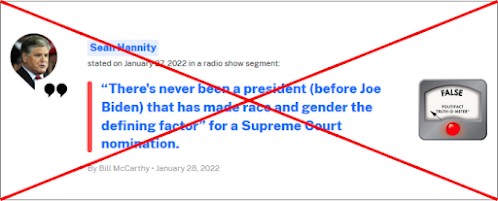

PolitiFact's fact check defies logic and establishes an early leader in the "Worst Fact Check of the Year" contest.

The "False" conclusion fails because it rests on a failure to understand the simple logic of "and." The conclusion would work for the logic of "or." But Hannity said "and" not "or."

If Bill says the square is green or red then the square confirms Bill's statement if it is red. Likewise the square confirms Bill's statement if it is green. Bill would be right either way.

But if Bill says the square is green and red then it's a different ballgame.

In the second case the square confirms Bill's statement if it is both green and red. So a square that is half green and half red could confirm Bill's statement. A square that is simply green would contradict Bill's statement. The same goes for a square that is red and not green.

This is extraordinarily basic logic and PolitiFact doesn't get it. 

 Observe how PolitiFact looks to prove Hannity false:

The claim ignored that both Trump and Reagan made similar vows to nominate women to the Supreme Court, then followed through on those promises. Other presidents in history have also considered race and religion as they have made their picks.

We rate Hannity’s claim False.

So, by analogy, PolitiFact says if Trump and Reagan both nominated green squares then both Trump and Reagan each nominated squares that were both green and red.

That's 2+2=5 territory.

Making this even more hilarious, PolitiFact's parent company, the esteemed Poynter Institute, chose to highlight this fact check at the main site. In the title, Poynter's headline writer substituted a comma for the "and," masking the error of logic for those who do not read the "fact check."


Thursday, October 6, 2016

A fact checker response to poll showing low trust in fact-checkers

On Oct. 1, 2016, we shared news of a Rasmussen Reports survey showing that most Americans do not trust fact-checking.

The Poynter Institute's* Alexios Mantzarlis tweeted about it promptly, but other than that we saw no response from fact checkers. Today, however, "The Week in Fact-Checking" newsletter (sent out by Mantzarlis and Jane Elizabeth) has a minor mention of the survey:
A Rasmussen poll says that most voters (who were asked this arguably "leading" question) don't trust media fact-checking, but a SurveyMonkey poll says many voters consulted a fact-checking site during the first presidential debate.
We agree the question Rasmussen posed was far from perfect. It placed trust in fact checkers in opposition to the idea that journalists skew the news. Asking respondents to rate their trust in fact-checkers on a scale would have given better information. Asking about trust in different specific fact checkers would give even better information.

That said, we don't see the SurveyMonkey poll as any kind of contradiction to the Rasmussen survey. SurveyMonkey found 7 percent visited a fact-checking site during the debate, 19 percent visited one after the debate, and 9 percent visited both during and after. Finally, 64 percent did not visit a fact-checking website.

With the SurveyMonkey poll we do not get information about whether people visiting fact-checking websites trust the websites they visit. We often visit fact-checking websites. It does not mean we trust them. And the same goes for people who did not visit fact-checking websites. Maybe they trust the websites but figure they know enough to judge the debate without getting help from a fact checker.

The Rasmussen survey is the best we have at this point gauging public trust in fact checkers. While we look forward to better polling on the issue, Rasmussen gives us a fairly clear picture that the fact checkers have ground to make up building trust from the public.

We do not think their current methods, particularly those of PolitiFact, will build trust from the public.

We're not surprised the fact-checking community, and we count Elizabeth and Mantzarlis in that group, do not appear eager to address a broad lack of trust in their movement.


*The Poynter Institute owns PolitiFact through the Tampa Bay Times.

Wednesday, June 29, 2016

Poynter hides criticism of PolitiFact's transparency?

The Poynter Institute, a journalism school in St. Petersburg, Florida, owns our reason for existence, PolitiFact. I sometimes read articles posted at Poynter, particularly those concerned with fact-checking.

Up through today, I believe Poynter has published every comment I have made.

Poynter re-published the guidelines for fact-checking written by PolitiFact editor Angie Drobnic Holan. I had responded to Holan's PolitiFact article with one of my own published to Medium. At the Poynter website I commented about one of my central points of rebuttal: PolitiFact's claims of accountability to the public can't be taken seriously so long as a story from PolitiFact Missouri from earlier this year sustains its train-wreck status (and it does sustain that status).


I captured the above image right after pushing the button to publish my comment. Note the message that the comment is pending approval. When I visited the page later, I was still able to see evidence I had commented and the comment was pending approval. I was also able to review the content of the yet-to-be-published comment.

Now, when I return to the page, no evidence remains of my comment activity.


Is it possible that the comment remains in moderation and Poynter will publish it later? Sure, that's possible. We will certainly update this item if Poynter publishes the comment.

Meanwhile, here is our message to PolitiFact and the Poynter Institute:

Hiding a problem of transparency does not address that problem of transparency.


Update June 30, 2016:


Pending for 11 hours. Shall we go for 36?