Showing posts with label Evidence Ignored. Show all posts

Friday, March 15, 2019

Remember Back When PolitiFact was Fair & Balanced?

PolitiFact has leaned left from the outset (2007).

It's not uncommon to see people lament PolitiFact's left-leaning bias along with the claim that once upon a time PolitiFact did an even-handed job on its fact-checking.

But we've never believed the fairy tale that PolitiFact started out well. It's always been notably biased to the left. And we just stumbled across a PolitiFact fact check from 2008 that does a marvelous job illustrating the point.


It's a well-known fact that nearly half of U.S. citizens pay no net income tax, right?

Yet note how the fact checker, in this case PolitiFact's founding editor Bill Adair, frames President Obama's claim:
In a speech on March 20, 2008, Obama took a different approach and emphasized the personal cost of the war.

"When Iraq is costing each household about $100 a month, you're paying a price for this war," he said in the speech in Charleston, W.Va.
Hold on there, PolitiFact.

How can the cost of the war, divided up per family, rightly get categorized as a "personal cost" when about half of the families aren't paying any net federal income tax?

If the fact check was serious about the personal cost, then it would look at the differences in tax burdens. Families paying a high amount of federal income tax would pay far more than the the price of their cable bill. And families paying either a small amount of income tax or no net income tax would pay much less then the cost of their cable service for the Iraq War (usually $0).

PolitiFact stuffs the information it should have used to pan Obama's claim into paragraph No. 8, where it is effectively quarantined with parentheses (parentheses in the original):
(Of course, Obama's simplified analysis does not reflect the variations in income tax levels. And you don't have to write a check for the war each month. The war costs are included in government spending that is paid for by taxes.)
President Obama's statement was literally false and highly misleading as a means of expressing the personal cost of the war.

But PolitiFact couldn't or wouldn't see it and rated Mr. Obama's claim "True."

Not that much has changed, really.


Afters (for fun)

The author of that laughable fact check is the same Bill Adair later elevated to the Knight Chair for Duke University's journalism program.

We imagine Adair earned his academic throne in recognition of his years of neutral and unbiased  fact-checking even knowing President Obama was watching him from behind his desk.

Tuesday, October 28, 2014

PolitiFact supports dishonest Democratic Party "war on women" meme


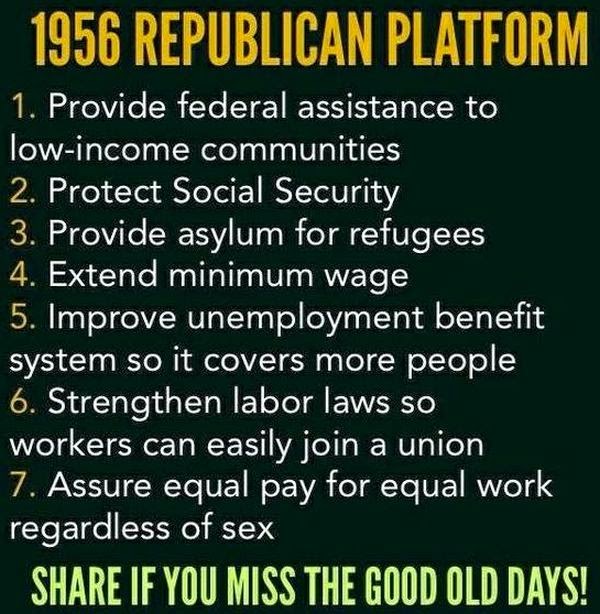
There's plenty wrong with PolitiFact's Oct. 28 fact check of a Facebook meme, but we'll focus this time only on PolitiFact's implicit support of Democrats' baseless "war on women" political attack strategy regarding equal pay for equal work.

The meme graphic looks like this:


The question at the end, "Share if you miss the good old days!" implies a contrast between today's Republican Party platform and the platform in 1956. For us, the relevant point is No. 7, "Assure equal pay for equal work regardless of sex." Democrats have made the supposed Republican "war on women" a main point of their campaigns, partly by criticizing Republican opposition of the Democrats' proposed "Paycheck Fairness Act," which places new burdens on businesses defending against pay discrimination lawsuits. Equal pay for equal work, of course, already stands as the law of the land.

PolitiFact, on its main page of fact checks, elevates the fake contrast on the equal pay issue to first place:

Image from PolitiFact.com, appropriated under Fair Use.

"What a difference 58 years makes."

Back in '56, Republicans supported equal pay for equal work. But today, PolitiFact implies, Republicans no longer support equal work for equal pay.

It's horrible and biased reporting that has no place in a fact check.

Are things better in the text of the story? Not so much (emphasis in the original):
The 2012 platform doesn’t mention two of the meme’s seven items from 1956 -- unemployment benefits and equal pay for women.

The bottom line, then, is that on most of these issues, the GOP moved to the right between 1956 and 2012, though the degree of that shift has varied somewhat issue by issue.
PolitiFact finds no evidence of a shift on equal pay other than the issue's absence in the 2014 GOP platform. But that only makes sense given that federal equal pay laws went on the books in the 1960s. So there's no real evidence of any shift other than a fallacious appeal to silence, yet we have "equal pay" as PolitiFact's lead example of the GOP's supposed move to the right.

The issue also gets top billing in PolitiFact's concluding paragraphs (bold emphasis added):
The meme says the 1956 Republican Party platform supported equal pay, the minimum wage, asylum for refugees, protections for unions and more.

That’s generally correct. However, it’s worth noting that other elements of the 1956 platform were considered conservative for that era. Also, some of the issues have changed considerably between 1956 and 2012, such as the shift from focusing on post-war refugees to focusing on illegal immigration.
There's really no need to mention anything in the fact check about federal equal pay legislation passing in the 1960s, right?

This type of journalism is exactly what one would predict if liberal bias affected the work of left-leaning journalists. This fact check serves as an embarrassment to the practice of journalism.

Saturday, August 2, 2014

Guest post: Another wrongheaded heading

We present another guest post by JLG:


Attack ad by Democrat on McConnell "False", but...
PolitiFact caught once again using deceptive subheadings favoring Democrats

Last Thursday, Politifact reviewed the latest ad by Mitch McConnell's Democratic challenger Alison Lundergan Grimes in the Kentucky Senate race. Lundergan Grimes claimed in the ad that "Mitch McConnell voted to raise Medicare costs for a current Kentucky senior by $6,000." Politifact ruled the claim "False":
Image from PolitiFact.com, red oval added for emphasis
The line circled in red will appear false to many readers, positioned as it is under a "Truth-O-Meter" graphic blaring the message "False." But it's only false, PolitiFact's presentation implies, because the bill wouldn't have taken effect now but in the future. That reading impugns McConnell along with his Democrat attacker.  Worse, it isn't even accurate.
The PolitiFact article makes each of the following points:
Her figure was based on the Paul Ryan budget plan.
There have been several incarnations of the Ryan budget over the years and Lundergan  Grimes chose to go all the way back to the 2011 version.
Every version of the Ryan budget since then was re-tooled to eliminate that $6,000 cost.
Now here are the three points that really tell the tale:
Don Disney, the man in the ad who claimed McConnell "voted to raise my Medicare costs by $6,000" is 75 years old, so no version of the Ryan plan would saddle him with $6,000-plus in additional out-of-pocket costs.
That bill wouldn't have gone into effect until 2022 and would not have affected people like Disney who were seniors when the bill was passed.
McConnell voted for a motion to proceed on the Ryan budget.  That allowed it to proceed to the Senate floor for debate and amendments.  But McConnell never voted on the final passage of the bill.

Summary
There was no bill passed to raise Disney's Medicare costs by $6,000, McConnell never voted for the passage of any bill that would have raised Disney's costs by $6,000, and McConnell didn't vote for the passage of any bill that would have cost any senior on Medicare $6,000 in extra expenses. 

The content of the article confirms this summary, yet PolitiFact mentions nothing about the fact McConnell didn't actually vote for the passage of the bill. On top of that, the graphic on the main page gives people the impression that McConnell voted to raise costs to seniors by $6,000, with those costs inflicted on seniors at a later date.  That's false.

Conclusion
Liberal bias leads to another "Politifact fail"

JLG

Saturday, July 19, 2014

Guest post: PolitiFact and the Washington Redskins

At debatepolitics.com we ran across a criticism of PolitiFact by Grim17.  We obtained permission from JLG, the author, to reproduce the post here (edited for style).

Also see our afterword.

********************************

Politifact recently decided to evaluate and rule on the following story/claim:
The U.S. Patent and Trademark Office "received zero complaints" about the Washington Redskins name.
It is the one and only story that PolitiFact has fact checked that evaluates the validity of the "zero complaints" claim and just so there are no misunderstandings, let me make some things clear:

1. Evaluating that claim is legitimate and completely valid.
2. This issue is a political one and their ruling has political implications for those on both sides of the Redskins issue.
3. This review also has the potential to negatively affect the credibility of certain conservative media organizations.

PolitiFact ruled that the claim was "False", but I have concluded that their evaluation displays a clear liberal bias on their part, and does so in several different ways.


Perception

Here is the headline from PolitiFact's front page:


As you see they rate the "received zero complaints" claim as false, and use their subheading to further substantiate that rating by saying "Except for the complaint that started this case" (take note of the subheading, as it will come into play in the future).

People arriving at the PolitiFact website who haven't yet read the actual article, or who choose not to read it, are sent a very clear, cut-and-dry message through that headline. It tells them that both the story and the claim are false and the patent office did in fact receive public complaints about the Redskins name, prior to making their ruling.


Political implications

That headline and subsequent ruling bode well for those on the political left who believe the name is offensive and should be changed, and harms the reputation and credibility of the Washington Times, since they are the ones who broke the story. It also harms the reputation and credibility of the media outlets and conservative pundits who chose to run with the story.


Methodology - Sources used to evaluate the claim

The original story which made headlines on July 1st was titled "Patent office didn’t receive a single public complaint before stripping Redskins trademark" and was published by the conservative-leaning newspaper the Washington Times. You would think that if PolitiFact wanted to fact check the story and the "zero complaints" claim, they would use the original article that was written by the Washington Times to do so... but that isn't what they did.

PolitiFact decided they would fact check the claim by evaluating the opinions written about the story on the Internet by various conservative bloggers, rather than using the actual article written by the newspaper that broke the story in the first place. The reason they chose to evaluate the claim in this way will become clear shortly. 

PolitiFact's ruling and the flaws behind it:

Conservative blog posts smell a scandal in the cancellation of the Washington Redskins trademark, pointing out that the U.S. Patent and Trademark Office "received zero complaints" about it before an administrative law court ruled in June.

The case was opened because someone complained -- so that assertion is wrong on its face. But even that aside, the post is misleading in suggesting that public comments are part of the U.S. Patent and Trademark Office process when they are not.

When people have a problem with patents and trademarks and want them removed, they file formal complaints, prove their standing in the case, pay a fee, and provide evidence to support their case.In other words, they do exactly what the five plaintiffs in this case did here.

We rate the claim False.
So PolitiFact rules the claim that the patent office "received zero complaints" as "False" based on two reasons. That the five Native Americans who filed the legal challenge qualify as a "complaint" and because they claim an opinion posted on the Conservative Tribune blog misled readers by suggesting that public comments are part of the U.S. Patent and Trademark Office process.

The first reason is flawed because it's public knowledge that five Native Americans filed a formal complaint challenging the renewal of the trademark, which led to the USPTO review in the first place. Plus the blog even linked to the original story, making that perfectly clear. So it's obvious that both the blog and the Washington Times were saying "zero complaints other than the formal complaint that started all of this" because they assumed their readers were fully knowledgeable of the controversy, including the USPTO ruling and the factors that led to it.  This is a case of PolitiFact choosing to omit logic and common sense.

The second reason isn't flawed, it's just flat out incorrect, as well as being totally irrelevant to the validity of the quote. Nowhere in the post made by the Conservative Tribune blog, in the post they quoted from the Weasel Zippers blog, or in the original story from the Washington Times, was it ever implied in any way that "public comments are part of the U.S. Patent and Trademark Office process". That is a completely false claim by PolitiFact.  But even if bought into their assertion, it would still have nothing to do with whether the "zero complaints" claim was true or not. Their headline and subheading on their front page simply says that the claim that the patent office "received zero complaints" about the Washington Redskins name, is false, and any implications based on that claim are totally irrelevant.


Conclusions:

1. PolitiFact rating that story/claim as "false", is itself false. One of their two conclusion requires a parsing of words that defies logic, is devoid of common sense and ignores the content of the original story, while the other conclusion is a falsehood that is not supported by any of the 3 sources they used to render their ruling.

2. Claiming that "The case was opened because someone complained -- so that assertion is wrong on its face" would not have been possible if they evaluated the original story, because it explained how the five Native Americans were responsible for the trademark being reviewed. It would have made their conclusion an absolute joke. Evaluating the claim through an opinion on a conservative blog however, allowed them to use a technicality to parse words and make that claim, because the blog never mentioned the 5 Native Americans... they only linked to the original story that did mention them.

3. It's obvious that PolitiFact was aware that saying "The case was opened because someone complained -- so that assertion is wrong on its face" was extremely weak, which is why they tried to strengthen it by falsely claiming that the blog article was misleading, when it wasn't.

________________________________________________________________

After reading the PolitiFact article and the 3 stories they used to make their ruling, it's obvious that their ruling was bogus. They took a story that looked bad for the political left that should have been ruled "Mostly true" or "True", and deemed it "False". On their front page, they falsely led their readers into believing that people had in fact complained about the Redskins name, and that the entire story that Washington Times published was a lie, bringing into question the credibility of other conservative media outlets, conservative bloggers and conservative pundits who ran with the story. The "liberal biased" icing on the cake is the fact that PolitiFact chose to evaluate the story through the opinions published by conservative bloggers, rather than just evaluating the original story itself, because that was the only way they could avoid having to rule that the claim and the story were in fact true.

Liberal bias CONFIRMED
********************************
(end of post by JLG)

Afterword

Another member of the debate.politics community, "Hatuey," challenged Grim17's post, noting that complaints were lodged against the name "Redskins" at a public hearing held by the USPTO.  While that information does have bearing on whether the "zero complaints" claim is literally true, it has no bearing on the quality of PolitiFact's fact check.  PolitiFact does not list the public hearing on its source list, therefore Grim17's central criticism of PolitiFact's method stands. 


Edit 7-20-2014: Added link to PolitiFact/Redskins article to the word "False."- Jeff

Friday, November 29, 2013

Planetizen: 'How Many Bicycles Can Park In The Space Required By One Car? Don’t Ask PolitiFact'

Though we think PolitiFact unfairly harms conservatives more than liberals, we recognize that PolitiFact's ineptitude can potentially harm anything it touches.  We have a handy example of that from PolitiFact Oregon, courtesy of Todd Littman and the website Planetizen.

Littman wrote a report that undergirded Democrat Earl Blumenauer's claim that 20 bicycles can park in the space required by one car.

PolitiFact pulled its patented methods of misinterpretation and assumed that the "space required by one car" is a parking space.  Littman explained that his report isn't about parking spaces alone but takes into account the total space of a parking lot on a per-car basis.  He then related how he went through the all-too-typical runaround with the PolitiFact gang trying to get them to see his point and change the ruling.

His dealings with PolitiFact culminated in yet another disappointing exchange with the editor of PolitiFact national, this time with new national editor Angie Drobnic Holan:
I then contacted PolitiFact editor Angie Drobnic Holan, who, after several queries finally replied,
I looked at the report and I didn't see anything that wasn't factually accurate. In addition, the report seemed very thorough. I appreciate that you disagree with the rating, but at the end of the day, the rating is the judgment of the editors.
These responses indicate that the PolitiFact organization has little interest in helping their readers understand complex issues. It is news as sport rather than education. They showed no interest in making the column more accurate and fair by explaining the difference between on- and off-street parking facilities, and admitting that the statement would be "True" for the majority of car parking. Most readers will simply look at the Truth-o-Meter rating, few will understand that the conclusion only applies to a subset of total car parking.
The only way we could imagine PolitiFact could justify its stand was if Blumenauer was clearly talking about an individual parking space.  So we looked up the statement from Blumenauer:
Between 6 and 20 bicycles can be parked in the space required by one car.  The average cost of one parking space for a car in a paved lot is $2,200; in parking garages, a single car space averages $12,500. An independent cost-benefit analysis of Portland Oregon’s Bicycle Master Plan concluded that the plan would lower fuel costs by as much as $218 million (depending on the level of final investments) by 2040. (Journal of Physical Activity and Health, Vol 8 Supplement, January, 2011)
The context supports Littman.  Did PolitiFact object to the difference in cost between a parking space in a paved lot and that same space in a parking garage?  There's no excuse for the disparity in price unless one considers the structures as a whole.

This sort of thing is all too normal for PolitiFact.

We recommend Littman's critique.  He's got all the support he needs for some scathing commentary about PolitiFact.

Wednesday, May 29, 2013

Flub & Scrub: Mitch McConnell edition, Part II

On May 28 PolitiFact published a new version of its May 24 fact check of Sen. Mitch McConnell (R-Ky.).

It's mostly bad, but we'll start with the good.

The good

PolitiFact republished its first version of the story and archived it while publishing a new version.  PolitiFact improved its reporting in the new version by responding to criticism from healthcare expert Michael F. Cannon of the Cato Institute.  Cannon noted that HHS Secretary Kathleen Sebelius sent a potentially intimidating letter to America's Health Insurance Plans:
An HHS spokesman told PolitiFact that the letter was in response to insurance companies using Obamacare as an excuse to raise premiums, and that the law gave the agency the authority to scrutinize excessive premium increases and require justifications from insurance companies. But we find Cannon's interpretation more accurate. The letter chastised the insurers for anti-Obamacare messages and threatened them with regulatory action.
Basely largely on Cannon's argument and the AHIP letter, PolitiFact upgraded its ruling from "Mostly False" to "Mostly True."

The bad

In its "Editor's note" preceding the new version of its McConnell fact check, PolitiFact blamed its failure on McConnell's office (bold emphasis added):
Editor's note: This item was initially published May 24, 2013, as a Mostly False because of the limited supporting information we received Sen. Mitch McConnell's office. The office cited a letter sent to Humana, a government contractor for Medicare Advantage. We found that letter provided relatively little support for the senator's claim and rated it Mostly False.
PolitiFact's failure was not the fault of McConnell's office.  We pointed out in our previous post that PolitiFact omitted key information from its original fact check--information readily available from a Government Accountability Office report that PolitiFact itself cited in the original reporting.  We failed to credit PolitiFact with its fractional disclosure of the key information:
[T]he Humana mailing prompted CMS to send a memo to all other Medicare Advantage and Part D contractors, warning them "to suspend potentially misleading mailings to beneficiaries about health care and insurance reform."
That doesn't sound so much like a "gag order," does it?  But the GAO report related a different account (bold emphasis added):
Although CMS's actions generally conformed to its policies and procedures, the September 21, 2009, memorandum instructing all MA organizations to discontinue communications on pending legislation while CMS conducted its investigation was unusual.
Note the difference between suspending "potentially misleading mailings" with "communications on pending legislation."  GAO uses language like the latter twice in its report.

But what about the version PolitiFact quotes?  All the CMS did was ask MA insurers to stop potentially misleading mailings.  Right?

Most likely the GAO has it right.  PolitiFact quoted from a CMS press release announcing the Sept. 21, 2009 memo, not the memo itself.  The press release does not appear to use language directly from the memo.  PolitiFact presents the press release quotation as though it comes from the memo.  The CMS press release does not express the type of policy the GAO highlighted in its report.  PolitiFact blew the reporting.

The new version of the McConnell fact check doesn't even mention the CMS memo or the GAO report (the latter remains among the sources listed on the sidebar).  The CMS memo, based on the GAO report detailing its instructions, serves as the best evidence supporting McConnell's claim.


We applaud PolitiFact for keeping the original version of the article available to the public, even if the posting followed a disappointing delay.  It should be a simple matter to archive the post as soon as the decision was made to replace it.  The original page URL could link to the archived version, explain why it was archived and assure the reader a new version is in the works.

We condemn PolitiFact for blaming its poor reporting on McConnell's office and for publishing a new version that's almost as defective as the first version.  Certainly the new "Mostly True" rating appropriately gives McConnell more credit, but it's inexcusable for journalists to simply leave out easily accessed information that supports McConnell.  That's just poor journalism.


Correction May 29, 2013:  Fixed title to agree with original title (added "Mitch" and reversed "Scrub" with "Flub") aside from the "Part II."

Saturday, May 25, 2013

Flub & Scrub: Mitch McConnell edition

[Also see "Flub & Scrub:  Mitch McConnell edition Part II"]

On Friday May 24 PolitiFact posted a fact check of Sen. Mitch McConnell (R-Ky.).  I won't quote from it because PolitiFact, perhaps only temporarily, has scrubbed the story from its website with apparently only an announcement on Twitter in explanation:
We're revising our fact-check on Sen. McConnell's claim on health insurers. New item will be posted later today.
PolitiFact later tweeted that it would publish the revised item next week.  We'll see.

So what happened?

PolitiFact rated "Mostly False" a claim from McConnell that HHS Secretary Kathleen Sebelius had forbidden insurance companies from sending information to policyholders about the effects of Obamacare.  Then Michael F. Cannon happened.  Cannon sent out a tweet of his own:
Cannon's URL led to his 2010 article "Secretary Sebelius Slips on the Brass Knuckles," where he detailed Sebelius' demands that insurers not communicate to policyholders information about the Affordable Care Act she considered false or misleading.

I ran across the McConnell rating on PolitiFact's Facebook page that afternoon, well after Cannon had tweeted about it.  I spot-checked the story as I sometimes do.  The story claimed a GAO report said the HHS office "in general" acted properly in responding to what it regarded as a misleading taxpayer-funded message the insurer Humana sent out to Medicare Advantage policyholders.

I looked at the report.  I confirmed that PolitiFact reported more-or-less accurately that the report "in general" found nothing amiss in the handling of situation.

But I also found a significant caveat PolitiFact failed to mention (bold emphasis added):
Although CMS’s actions generally conformed to its policies and procedures, the September 21, 2009, memorandum instructing all MA organizations to discontinue communications on pending legislation while CMS conducted its investigation was unusual. Officials from the MA organizations and CMS regional offices that we interviewed told us they were unaware of CMS ever directing all MA organizations to immediately stop an activity before CMS had determined whether that activity violated federal laws, regulations, or MA program guidance. When asked about this directive, officials from CMS’s central office stated that, given the degree of potential harm to beneficiaries, the action was appropriate for the circumstances.
A source PolitiFact cited provided information supporting McConnell's claim.  And PolitiFact didn't mention it.

I posted this evidence to PolitiFact's Facebook page, arguing that PolitiFact's story was more misleading than McConnell's statement.

As it happens, PolitiFact scrubbed its Facebook page of the link to the scrubbed article at its main website.  So those Facebook comments are gone along with PolitiFact's wall post about its McConnell article.  Mostly gone, that is.  We have a few screen captures.


I argue that a reporter's background knowledge and ideology predispose the reporter to make mistakes of this type--missing obvious evidence mentioned in a source document--in cases where that ideology is threatened or attacked.  This applies even if journalists otherwise keep their ideology secret.

This was a big mistake.  Journalistic organizations do not lightly pull entire articles from a website.  Count it as yet another evidence helping to show PolitiFact's liberal bias.

And now we'll get another opportunity to gauge PolitiFact's transparency as it deals with a big mistake.  The past record isn't particularly good.


Addendum 5/27/2013

J.D. points out something that helps cinch the stink factor on PolitiFact's move to unpublish.

The article I provided about unpublishing stories includes quoted material from Craig Silverman.  Silverman works for the Poynter Institute, which owns the Tampa Bay Times and PolitiFact.

Here's Silverman in his Poynter Institute "Regret the Error" column dealing with issue of pulling a story offline (leading off with a quotation from the Washington Post):

* We should never “unpublish” stories from the Web. Once a story is up, however, the content can be removed with the approval of a senior editor. In those rare cases when we remove the content of a story from the page, it must be replaced with an editor’s note explaining the reason for the deletion. For example if an embargo has been broken, the note would read: “Editors’ Note: This article was published inadvertently and has been removed.”
This is the right standard when it comes to unpublishing. First of all, you try to never unpublish. But if you do have to remove content, be sure to publish an explanation/apology at the same URL.
Why doesn't PolitiFact follow Poynter Institute-recommended standards for unpublishing a story?

Here's what I don't want to see:  "We did follow our guidelines.  We published an explanation/apology to the same URL.  A few days after we unpublished."


Meh.

http://www.politifact.com/truth-o-meter/statements/2013/may/24/mitch-mcconnell/mitch-mcconnell-says-hhs-put-gag-order-insurers-ab/


Edit 5/28/13: Corrected "Friday May 25" to "Friday May 24"-Jeff

Sunday, January 20, 2013

Another Black Knight for PolitiFact

The comedy film "Monty Python and the Holy Grail" is justly famous for its fight scene between King Arthur and the mysterious Black Knight who attempts to block his path.

Arthur defeats the Black Knight, first chopping off an arm, then another arm, then a leg and then the other leg.  As the Black Knight suffers each stage of defeat he defiantly continues to challenge Arthur to continue the fight.

PolitiFact's efforts to defend itself from criticism often run parallel to the Black Knight's fighting prowess against Arthur.

The latest duel pits PolitiFact editor Bill Adair against critics who say Fiat's confirmation that it will produce over 100,000 Jeep vehicles annually at a Chinese manufacturing plant undercuts PolitiFact's 2012 choice for "Lie of the Year."  The Romney campaign produced an ad saying Obama sold Jeep to Italians who will build Jeeps in China.  PolitiFact ruled the ad "Pants on Fire" in October before selecting it as the "Lie of the Year" in December.

The original ruling drew plenty of criticism, and the recent confirmation of the deal to produce Jeeps in China produced a renewal of that criticism, perhaps best expressed by Mark Hemingway of The Weekly Standard.

"It's just a flesh wound."

On Jan. 18 Adair responded to the latest round of criticism:
A number of readers emailed us this week about news reports that Chrysler is moving forward with a partnership in China to produce Jeeps. They wondered: Doesn’t that disprove our Lie of the Year -- that Mitt Romney said Barack Obama "sold Chrysler to Italians who are going to build Jeeps in China" at the cost of American jobs?
No, it doesn’t.
It bears emphasis that Jeep sold about 50,000 American-made Jeeps in China in 2012. Somehow no mention of Jeep exports to China crept into any of PolitiFact's fact checking of the Romney ad.

Adair's right about one thing, at least.  All of PolitiFact's "Lie of the Year" selections contain a significant element of truth, so of course it doesn't matter to PolitiFact if the ad is true.  It can still qualify as "Lie of the Year."  The tough thing for Adair to explain, which he doesn't attempt, is how the ad can be technically true yet receive a "Pants on Fire" rating as election day approached.

It's just another dismal defense of a PolitiFact blunder.

Mark Hemingway, by the way, responded with Arthurian effectiveness to Adair's post the same day it was published.

We'll give away the ending:
PolitiFact has a reputation for alternately being unresponsive or inadequately responding to criticisms. And they haven't done anything to remedy that today.
Exactly.

(The video contains language some may find offensive.  Oh, and there's lots of obviously fake blood.)


Jeff adds (1/30/13):
Adair's most recent CYA/non-response to Hemingway is typically awful of the genre, and PolitiFact has had some stinkers. Chock full of evasions and denials, it would seem that Adair is completely unable to confront the facts that lurk in front of his face. Take a look at the opening paragraph of his nada culpa, and pay special attention to the quotation marks:

[Readers] wondered: Doesn’t that disprove our Lie of the Year -- that Mitt Romney said Barack Obama "sold Chrysler to Italians who are going to build Jeeps in China" at the cost of American jobs?

No, it doesn’t.
The entire basis for the Pants of Fire rating is something the Romney ad never claimed. If it did, why didn't PolitiFact quote the relevant portion? The portion that Adair quotes is entirely accurate, even by PolitiFact's own admission. The only falsehood here is PolitiFact's invention that the Romney ad claimed it would cost American jobs.

Another comically dishonest diversion from Adair is his assertion that PolitiFact isn't making a value judgement on Obama's policy. He writes:
We should be clear, we are not defending President Obama’s auto policy. As independent fact-checkers, we don’t take positions on policy issues. So whether it was advisable to bail out the auto companies, and or whether the bailout  was done with proper safeguards was beyond the scope of our fact-check.
As I pointed out in our original review of this claim back in November, PolitiFact was much more smitten with the Presidents performance back then (emphasis added):
With Ohio’s 18 electoral votes very much in play, the Mitt Romney campaign aims to blunt one of Barack Obama’s key advantages in that state -- his rescue of the auto industry.
Let me be clear: PolitiFact has determined that Barack Obama single-handedly rescued the entire auto industry...they're just not taking a position it.


Thursday, November 1, 2012

counterirritant: "Jeepers"

We haven't heard from PolitiFact critic "counterirritant" in a while, but unlike the Great Pumpkin, he did to show up for Halloween and offered us a treat. He takes aim at PolitiFact's campaign ad for Obama fact check regarding Mitt Romney's claim about Chrysler production in China:

He writes:
PolitiFact concludes that the ad is erroneous because it “leaves the clear impression that Jeeps built in China come at the expense of American workers.” [Washington Posts Glenn] Kessler reaches a similar conclusion saying that “the unspoken message is that American jobs are being sent to China, even though the ad carefully tiptoes around that claim.”

It seems pretty simple doesn’t it? The Romney ad claims that American workers will lose their jobs when Jeep production moves to China. Chrysler implies otherwise. Therefore,one can conclude the ad is false — at least if one is a non-fact-checking “fact checker.” An actual fact checkers [sic] might see the disagreement between Romney and Chrysler views to—I don’t know–perhaps, check the facts?

There is a legitimate dispute regarding the facts of Romney's claim. But don't expect PolitiFact to sort out the truth of that. Rather, PolitiFact determined the "clear impression" of Romney's words and used Chrysler CEO Sergio Marchionne's (impartial?) claim to refute him. That's not fact checking.

Counterirritant gives readers his take:

The Jeeps currently sold in China are produced in the U.S.
...

For those slow on the uptake: Jeep vehicles that will be produced in China by Chinese workers are currently produced in the U.S by U.S. workers.

It's not entirely clear (or even a verifiable fact) that increased production of Jeeps in China will mean American workers will lose their jobs. However, Forbes automotive contributor Dale Buss points out that it's an entirely moot point with regard to Romney's statement:

Romney did not claim that Chrysler was “outsourcing” existing Jeep jobs to China but only that Chrysler is going to “build Jeeps in China.” And that is true.
...

Chrysler CEO Sergio Marchionne said in an e-mail to workers this week that Jeep assembly lines in the United States “will constitute the backbone of the brand.” But again: Romney never disputed that.
Buss also points out that "...Ohio and Michigan Jeep workers...jobs seem pretty secure right now."

Whatever the facts, the bottom line is PolitiFact failed to illuminate them. Contrary to uncovering facts, this rating is either an amateurish investigation or an intentional dodge of the truth. Regardless of intent, PolitiFact assists the Obama campaign by neglecting to dig into the story and accepting Marchionne's words at face value. PolitiFact wanders closer to a role as a campaign spinmeister with each passing day.

As always, counterirritant is well worth the read. Do yourself a favor and read his short post.

For more on the Chrysler/Romney claim, check out Bryan's analysis over at his new project: Zebra Fact Check.


Afters:

It doesn't take much to spot PolitiFact's reverence for Obama in the opening line of the article:

With Ohio’s 18 electoral votes very much in play, the Mitt Romney campaign aims to blunt one of Barack Obama’s key advantages in that state -- his rescue of the auto industry.

There you have it. An objective, non-partisan fact checking group confirming the undisputed fact that Barack Obama, single-handedly rescued the auto industry. 

Sunday, September 2, 2012

The Weekly Standard: "PolitiFact's Credulous Romney-Ryan Health Care Attacks"

The Weekly Standard's Mark Hemingway once again exemplifies what I'm talking about when I say the criticisms of PolitiFact from the right sustain a higher standard than those from the left.  Hemingway methodically dismantles PolitiFact's facade of misstatements surrounding health care claims by Mitt Romney and Paul Ryan.

Behold as Hemingway warms to his topic:
Perhaps if we all ignore PolitiFact, they'll go away. But for the time being, the supposedly independent organization continues to crank out skewed and partisan work. There's no better example of this than the the current jihad the "fact checking" organization is waging against the Romney-Ryan health care plan.
Hemingway goes on to point out PolitiFact's failure to acknowledge the power of the Independent Payment Advisory Board to implement policies that reduce services for Medicare beneficiaries by decreasing the supply of providers.

He then highlights the mendacity of the Obama campaign and its fact-checking lackey in promoting the claim that Medicare beneficiaries may bear an increased cost of $6,400 per year for Medicare insurance.  The Obama campaign attacked an obsolete version of a Ryan reform,  and PolitiFact evidently granted the Democrats the benefit of the doubt that attacking the old plan was not an attempt to mislead the audience.  The claim in the ad, says PolitiFact, is "Half True."

Hemingway:
PolitiFact presents no evidence that the current Romney-Ryan Medicare plan will costs [sic] seniors anywhere close to $6,000. So how the heck, in the total absen(c)e of evidence, does that statement rate even "half true"?
May I suggest to Hemingway that employing inconsistent standards for judgment can easily assist the opinion journalists at PolitiFact in reaching their apparently partisan conclusions?

Hemingway makes the complex easy to digest, so make the time to read the whole thing.

Thursday, August 30, 2012

PolitiFlub: PolitiFact Wisconsin, the Obama promise and the Janesville GM plant (Updated)

Crossposted from Sublime Bloviations


PolitiFact has earned its status as the least-dependable of the stable of left-leaning fact check organizations.  PolitiFact Wisconsin gives us one more sparkling example supporting that judgment with a fact check of Republican vice presidential candidate Paul Ryan.

Ryan said President Obama broke a campaign promise to keep the Janesville (Wisc.) plant open.   PolitiFact Wisconsin detected no such promise from Mr. Obama.

Here's what then-candidate Obama said in February 2008 (bold emphasis added) during a speech in Janesville:
This can be America’s future. I know that General Motors received some bad news yesterday, and I know how hard your Governor has fought to keep jobs in this plant. But I also know how much progress you’ve made – how many hybrids and fuel-efficient vehicles you’re churning out. And I believe that if our government is there to support you, and give you the assistance you need to re-tool and make this transition, that this plant will be here for another hundred years. The question is not whether a clean energy economy is in our future, it’s where it will thrive. I want it to thrive right here in the United States of America; right here in Wisconsin; and that’s the future I’ll fight for as your President.
Importantly, Obama opened his speech with references to the plant.  He then sketched his vision of America before mentioning how the Janesville plant could stay open if the government provides support.  In that context, Obama pledged to provide that support.  Does Mr. Obama use the specific term "promise" in his statement?  No, certainly not.  Does he guarantee the plant will remain open?  Again, no.  However, there is little doubt  that every person in Janesville listening to his speech took it as a pledge from the president to work to enact policies to keep the plant open. Mr. Obama did, in fact, pledge to do just that.

PolitiFact Wisconsin located no such pledge.

But it gets worse.  Much worse. PolitiFact builds its conclusion primarily on its claim that the Janesville plant closed before Mr. Obama took office (bold emphasis added):
Ryan said Obama broke his promise to keep a Wisconsin GM plant from closing. But we don't see evidence he explicitly made such a promise -- and more importantly, the Janesville plant shut down before he took office.

We rate Ryan's statement False.
GM announced the likely permanent closure of the Janesville plant in June of 2008, less than four months after Mr. Obama pledged to work toward an agenda that would keep the plant open for "another hundred years."

So, when is the plant closed?  When it closes for the last time?  When it produces its last GM vehicle?  When the company announces its permanent closure on a particular date?

When President Bush left office, he had provided Chrysler and GM loans to keep them going until the automakers could present restructuring plans to the Obama administration in April.

GM announced the final closing of the Janesville plant in April of 2008, and the final Chevy Tahoe came off the line in December 2008, before Obama took office as president.  On the other hand, the plant stayed open so that GM could build trucks for Isuzu:
The company stopped building SUVs at the plant just before Christmas.

That decision left about 1,200 workers unemployed.At the time GM said a crew would remain to complete an order for Isuzu.
But by June of 2009, while the Obama administration was still negotiating GM's fate and after completing the work for Isuzu, Janesville continued to maintain hope that its plant might reopen:
JANESVILLE (WKOW) -- There is a lot of optimism in Janesville today, after receiving word GM could reopen one of its idle plants to produce new fuel efficient cars, according to the Wisconsin Department of Workforce development.
If the GM restructuring deal brokered by the Obama administration resulted in continued production at GM's plant in Janesville, is there any doubt at all that Obama would receive credit for delivering on a promise?  Especially if the work involved hybrid vehicles?  The opportunity was there for the taking.

Why is so much of this information missing from a fact check?


Update 8/30/2012, 4:15 p.m.:

NPR fills in some of the missing information PolitiFact omitted.


Correction 8/31/2012:  Original version had wrong date for Obama's Janesville speech on first reference:  "Here's what President-elect Obama said in December 2008 (bold emphasis added) during a speech in Janesville:"  That sentence has been made accurate.

Tuesday, August 21, 2012

Madison Forum: "Not Politifact; Just Politicopinion"

In March of this year J. Randolph Evans of "The Madison Forum" clobbered PolitiFact over its failure to cleave to objective standards in its fact checks: 
(W)ith a name like Politifact, readers might think that in at least one area, newspapers had abandoned their biases for one brief moment of objectivity. Do not be fooled. Hidden within the clever marketing names like Politifact and the nifty ratings like pants-on-fire, newspapers still filter in their biases.
Evans used a fact check of Mitt Romney's claim about President Obama's international policy tour as his example.

Evans: 
Even though Politifact writers by their own admission “reviewed several analyses of what Obama’s foreign policy goals are in traveling the world and readily admitting to America’s mistakes,” they could never bring themselves to the Politifact of the matter; instead they opted for politicopinion.
Evans goes straight for his point and makes it well, though he could have strengthened his case even more by pointing out PolitiFact's eye-popping arbitrary dismissal of one of the expert opinions it sought (bold emphasis added):
We sent Obama's remarks to several different experts on foreign policy and apologies, to see if they thought Obama was apologizing.

Nile Gardiner, a foreign policy analyst with the the conservative Heritage Foundation, said Obama is definitely apologizing, and it's not good. He co-wrote the Heritage analysis, "Barack Obama's Top 10 Apologies: How the President Has Humiliated a Superpower."
That's true fact checking.  If an expert gives a take you don't agree with or is out of step with other experts, just ignore them.  In the name of the Truth, of course.

Evans makes a number of good points about modern American journalism, so pay The Madison Forum a visit and read the whole bit.

Saturday, August 18, 2012

Different but Equal: PolitiFact Jumps on the "Ryan cuts Medicare" Bandwagon

This week's liberal talking point fact-checking effort from PolitiFact comes in the form of giving Stephanie Cutter a "True" for her claim regarding Paul Ryan's budget. Once again, in lieu of an actual investigation of the facts, PolitiFact settles for good old fashion electioneering. First up, the issue:

Image from PolitiFact.com

PolitiFact tells us exactly what they're checking (emphasis added):
For this check, we’re looking specifically at what Obama campaign spokeswoman Stephanie Cutter said on Face the Nation when debating Romney spokesman Eric Fehrnstrom.

"You know, I heard Mitt Romney deride the $700 billion cuts in Medicare that the president achieved through health care reform," Cutter said. "You know what those cuts are? It’s taking subsidies away from insurance companies, taking rebates away from prescription drug company. Is that what Mitt Romney wants to protect? And interestingly enough Paul Ryan protected those cuts in his budget." 

[We] focus on the question of whether Cutter is correct that Ryan relies on those same reductions in his budget.
PFB editor Bryan White joined the chorus of critics early, and in a single line exposed how amateurish PolitiFact's effort was:
Ryan's budget is neither listed among the sources on the sidebar nor linked in the text of the story.
That's right. In a "fact-check" of Paul Ryan's budget, PolitiFact doesn't actually cite Paul Ryan's budget. Unfortunately, it goes downhill from there. Bryan continues (Bold emphasis added):
PolitiFact's source, a CBO report, communicates the nature of the [ACA's Medicare] reduction a bit more clearly than does PolitiFact (yellow highlights added):
Changes to Payment Rates in Medicare
In February 2011, CBO estimated that the permanent reductions in the annual updates to Medicare’s payment rates for most services in the fee-for-service sector (other than physicians’ services) and the new mechanism for setting payment rates in the Medicare Advantage program will reduce Medicare outlays by $507 billion during the 2012–2021 period. That figure excludes interactions between those provisions and others—namely, the effects of the changes in the fee-for-service portion of Medicare on payments to Medicare Advantage plans and the effects of changes in both the fee-for-service portion of the program and in the Medicare Advantage program on collections of premiums for Part B (Supplementary Medical Insurance).
The bulk of the reduction, then, occurs as the result of the two reductions the CBO identifies.  Therefore, we should expect to see both of those features in the Ryan budget plan at minimum to rate Cutter's statement true.
This is a subtle yet critical point, and one that PolitiFact completely dodged. The issue isn't whether or not the Ryan plan reduces Medicare spending growth as much as ObamaCare does, the issue they claim to be fact-checking is if both plans rely on the same reductions. The bulk of the $716 billion in Medicare reductions comes from "the permanent reductions in the annual updates to Medicare’s payment rates for most services in the fee-for-service sector" along with "the new mechanism for setting payment rates in the Medicare Advantage program."

PolitiFact seems to think they've found their smoking gun (bold emphasis added):
Here’s what Ryan said in an interview with George Stephanopolous of ABC News in June, before his selection as Romney’s running mate:

Stephanopoulos: "You know, several independent fact-checkers have taken a look at that claim, the $500 billion in Medicare cuts, and said that it's misleading. And in fact, by that accounting, your budget, your own budget, which Gov. Romney has endorsed, would also have $500 billion in Medicare cuts.

Ryan: "Well, our budget keeps that money for Medicare to extend its solvency. What Obamacare does is it takes that money from Medicare to spend on Obamacare. ..." (Read the full exchange.)

So Ryan has confirmed his budget includes the Medicare savings.
See what PolitiFact did? Bryan spots the bait and switch:
"The" Medicare savings?  The same exact ones from the ACA and not just the future rate of growth pegged at the same percentage?  How do we know that?  Where is the fact check?
There isn't one. PolitiFact conjures up a June interview, ignores Ryan's actual budget, calls it close enough and pats themselves on the back for being "wonks." You'd think if you have enough hubris to call yourself a wonk, you'd actually refer to the budget you're wonking. PolitiFact doesn't do that, and an article by Yuval Levin at NRO cites the part of Ryan's budget that directly refutes PolitiFacts claim:
This budget ends the raid on the Medicare trust fund that began with passage of the new health care law last year. It ensures that any potential savings in current law would go to shore up Medicare, not to pay for new entitlements. In addition to repealing the health care law’s new rationing board and its unfunded long-term care entitlement, this budget stabilizes plan choices for current seniors.
Levin nails the point. There is simply no way for PolitiFact to accurately claim that Paul Ryan's reductions are the same as the Medicare reductions in ObamaCare. Levin continues:
The “Ryan did it too” defense is perhaps the most amusing of the three, as it succeeds in being simultaneously untrue, irrelevant, and an admission of the basic charge against the Democrats. Even as they call Paul Ryan a cruel and merciless budget cutter who cares not for the weather service and would gladly see children exposed to E. coli, the Democrats justify their taking $710 billion out of Medicare and spending it on Obamacare over the next decade by pointing out that Paul Ryan didn’t put that money back into Medicare in his budget. So if he had, would that have made their cuts unjustifiable? Well it so happens that he did. By repealing all of Obamacare’s spending, the Republican budget does not spend the money Obamacare took out of Medicare and thus those funds are used to extend the Medicare trust fund. And this point is hardly hidden in the Ryan budget.
It may be the case that both Ryan's budget and the ACA reduce the growth of Medicare the same amount. But PolitiFact's suggestion that those figures are arrived at through the same methods is a 3-alarm howler. How can these people call themselves fact-checkers when this rating doesn't actually check any facts? At best, this effort between two of PolitiFact's top dogs, Angie-Drobnic Holan and Bill Adair, is little more than a wordy defense of a weak Democratic talking point.

Make sure to head over to Bryan's post detailing even more evidence of how badly they flubbed this rating, and check out Levin's full article showing the flimsiness of this entire line of attack on Ryan's Medicare plan.

Tuesday, August 14, 2012

Turning up the heat on mainstream fact checkers

Crossposted from Sublime Bloviations


Dustin Siggins' post at the conservative blog "Hot Air" serves notice that I'm not alone in pointing out the failure of mainstream fact checkers in testing claims about effective tax rates.

Siggins:
The Obama campaign is running an ad claiming that Mitt Romney pays a lower tax rate than that of the average American.  Following the ad’s release, PolitiFact published an article rating it as “Half-True.”  From the article:
There are two main ways to make this calculation, and they lead to opposite conclusions. While we believe that including payroll taxes in the calculation offers a more accurate picture of what the American public pays the IRS, it’s also true that the Obama ad didn’t specify which measurement it was using, and in fact used a figure for Romney — 14 percent — that was based on income taxes alone. On balance, then, we rate the claim Half True.
Unfortunately for PolitiFact, their analysis completely misses the boat.
Siggins links to an analysis from "Just Facts," a not-for-profit independent fact checker:
Specifically, CBO found that households in the middle 20% of the U.S. income distribution paid an effective federal tax rate of 11.1% in 2009. Using CBO’s new estimate for allocating the burden of corporate income taxes, Just Facts and Ceterus calculate that Romney’s federal tax rate was 23.3% in 2010, which is twice the middle-income tax rate in 2009.
Just Facts published the above the same day I published my critique of Farley's fact check (Aug.7).  Their fact check goes much deeper than mine--I simply noted that Farley had short shrifted an entire body of evidence indicating that Romney almost certainly paid a higher effective tax rate than the average American. 

I criticized PolitiFact along the same lines on Aug. 10, but Siggins takes note of something I missed:
(T)he PolitiFact analysis ignores data cited by its own resource.  The article cites the Tax Policy Center to look at what tax levels are at for all income quintiles.  However, PolitiFact fails to note that the Center’s chart (the same one cited in the article) shows that the top 1% (which Romney definitely falls into) pay 7.7% of their income into the corporate tax structure.
So the PolitiFact researcher, Louis Jacobson, had the information staring him in the face and missed it or ignored it.  That's on top of somehow missing the CBO studies on effective tax rates.

Not good.


Correction Aug. 15, 2012:  Apologies to Dustin Siggins for consistently finding ways to put the vowel "a" in his name where it doesn't belong.

Friday, August 10, 2012

PolitiFlub: PolitiFact again ignores data on effective federal tax rates

 Crossposted from Sublime Bloviations


PolitiFact's latest fact check involving federal taxation sticks with its persistent pattern of ignoring and/or minimizing data on effective federal tax rates, including a study by the otherwise esteemed Congressional Budget Office.
A new ad from President Barack Obama’s campaign continues the drumbeat that Mitt Romney is a privileged rich guy who isn't paying his fair share of taxes.

"You work hard, stretch every penny," a narrator says. "But chances are, you pay a higher tax rate than him: Mitt Romney made $20 million in 2010, but paid only 14 percent in taxes — probably less than you."
Huh.  The Obama campaign didn't specify federal income taxes.  No worries.  Obama isn't Michele Bachmann, so PolitiFact can overlook the campaign's oversight.

PolitiFact then:
Bachmann would have been right if she’d said, "the top 1 percent of income earners pay about 40 percent of all income taxes into the federal government." But she didn’t say that -- and even if she had, her decision to focus on income taxes, rather than looking at the whole federal tax picture, would have presented the numbers in such a way that wealthier Americans would look more heavily taxed than they are.
So we want "the whole federal tax picture"?  Not so.  PolitiFact wants the tax picture minus the effects of corporate and excise taxes.  The thread is consistent and continues through today.

PolitiFact:
If you just look at income taxes, Obama is incorrect.
Bummer.  But since Obama didn't specify "(federal) income taxes" PolitiFact can consider payroll taxes while continuing to ignore corporate and excise taxes.  Or something like that.

PolitiFact:
So what happens when you add payroll taxes to income taxes? Obama's ad is accurate. Here's the breakdown when you include income taxes and both sides of the payroll tax (the parts paid for by employee and employer):

Bottom fifth of earners: 1 percent
Second-to-bottom fifth:  7.8 percent
Middle fifth: 15.5 percent
Second-highest fifth: 18.7 percent
Highest fifth: 24.3 percent

Once again, we can’t know exactly what percentage of Americans paid a higher effective tax rate than Romney's 14 percent, but the top two ranges, plus a significant share of the middle group, most likely did. So probably more than half exceeded Romney’s rate, making the Obama ad accurate.

Yippee!  Obama's ad is accurate!  Average out the true and the false, give the president a "Half True" and nobody really needs to know about that messy corporate and excise tax stuff.

Speaking of that messy corporate and excise tax stuff:


(click image for enlarged view)

The chart comes directly from the CBO report mentioned up above.  There are two important things to note.  First, excise taxes fall more heavily on those in the lower income quintiles.  That's a minor point.  Second, the burden of corporate taxes falls heavily on those with higher incomes.  And the higher you go with income, the higher the corporate tax burden.  That likely means that persons like Romney pay higher portions of the corporate tax burden as a percentage of their federal taxes.

Using "the whole federal tax picture" that PolitiFact once cited as its ideal standard, the middle quintile pays less than half the average federal tax burden of a person in the top 1 percent in 2006 (14.2 percent compared to 31.2 percent).  That means that it is very probably false that most people pay less more in federal taxes than Romney.

Luckily for the president, PolitiFact can make it look otherwise by cherry picking.

That's PolitiFact for you.


Afters: 

See also the review of a similar story from Annenberg Fact Check.


After Afters:

Just a little review of what PolitiFact wrote while rating Bachmann "False":
[Bachmann's] decision to focus on income taxes, rather than looking at the whole federal tax picture, would have presented the numbers in such a way that wealthier Americans would look more heavily taxed than they are.
PolitiFact's hypocrisy is pretty overwhelming, isn't it?


Correction Aug. 13 2012:
Less is more, after the correction.

Wednesday, July 25, 2012

The Weekly Standard: "PolitiFact Mucks Up the Contraception Debate"

This year has sped by at a breathtaking pace so far, and we've neglected to review some worthy stories about PolitiFact simply because we placed a higher priority on some stories than others.

But it's not too late.

In February, The Weekly Standard's Mark Hemingway weighed in with yet another damning assessment of PolitiFact's talent for fact checking:
Before I explain why PolitiFact is once again being deliberately misleading, grossly incompetent, or some hellbroth of these distinguishing characteristics, you'll have bear with me. Part of the reason PolitiFact gets away with being so shoddy is that it counts on its readers believing that it can be trusted to explain any necessary context to justify its status as judge, jury, and factual executioner.
Obviously the right thing to do now is click the link and read the whole thing for yourself.

For those who don't have the time, I'll sum up:

Hemingway's latest example of PolitiFactian perfidy concerns its use of a Guttmacher Institute publication to support an Obama administration claim that 98 percent of sexually active women use birth control.

The Obama administration was trying to justify its insurance mandate requiring birth control as a basic coverage requiring no copay.

Hemingway noted the Guttmacher Institute's lack of neutrality, a number of the arguments marshaled against its findings and PolitiFact's selective use of the evidence.

At the end of the day, a study drawn from a group of women aged 15-44 does not justify extrapolating the data to the set of all women of any age.  PolitiFact went soft again on an administration claim.

Thursday, June 7, 2012

PolitiFact uses "In Context" feature to vanish Bill Clinton's clearest statement on tax hikes

Crossposted from Sublime Bloviations

I was intrigued to see the latest "In Context" article at PolitiFact minutes ago.  I was intrigued initially because it claimed to provide the context surrounding Bill Clinton's remarks that Republicans have construed as opposed to President Obama's policy stance on the future of the Bush tax cuts.  Those cuts are set to expire after this year.

I was intrigued even more because I had referenced Clinton's statement in a discussion on PolitiFact's Facebook page about the wisdom of raising taxes to the levels existing during Clinton's presidency.

And I was especially intrigued when the "In Context" story did not include the quotation of Clinton I used, which was from September of last year.

Here's what I referenced from Politico:
“I personally don’t believe we ought to be raising taxes or cutting spending, either one, until we get this economy off the ground,” Clinton told Newsmax in an interview Tuesday. “This has been a dead flat economy.”
This "In Context" feature seems designed to let Clinton make us believe the economy has taken off.  It leaves out the context of Clinton's clearer statements on tax increases.

Sunday, May 27, 2012

Nutting doing: PolitiFact's inadequate excuse

Crossposted from Sublime Bloviations


This week many liberals jumped on the meme that President Obama has the lowest spending record of any recent president.

Fortunately for all of us, PolitiFact was there to help us find out the truth in politics.

Actually, PolitiFact completely flubbed the related fact check.  And that's not particularly unusual.  Instead, it was the Washington Post's Glenn Kessler and an Associated Press fact check that helped people find the truth in politics.

PolitiFact isn't backing down so far, however.  On Friday PolitiFact offered the following response to the initial wave of criticism (bold emphasis added):
(O)ur item was not actually a fact-check of Nutting's entire column. Instead, we rated two elements of the Facebook post together -- one statement drawn from Nutting’s column, and the quote from Romney.

We haven't seen anything that justifies changing our rating of the Facebook post. But people can have legitimate differences about how to assign the spending, so we wanted to pass along some of the comments.

PolitiFact also made the distinction on Twitter:

(Image captured by Jeff Dyberg;
 click image for enlarged view)
There's a big problem with the attempt to distinguish between checking Nutting's claims and those from the Facebook post:  The Facebook post argues implicitly solely on the basis of Nutting's work.  PolitiFact likewise based its eventual ruling squarely on its rating of the Nutting graphic.

PolitiFact (bold emphasis added): 
The Facebook post says Mitt Romney is wrong to claim that spending under Obama has "accelerated at a pace without precedent in recent history," because it's actually risen "slower than at any time in nearly 60 years."

Obama has indeed presided over the slowest growth in spending of any president using raw dollars, and it was the second-slowest if you adjust for inflation. The math simultaneously backs up Nutting’s calculations and demolishes Romney’s contention.
Credit PolitiFact with accurately representing the logic of the implicit argument.  Without the fact check on Nutting's work there is no fact check of Romney's claim.  Making matters worse, PolitiFact emphasized the claim that Obama "has the lowest spending record" right next to its "Mostly True" Truth-O-Meter graphic.  The excuse that PolitiFact was fact checking the Facebook post completely fails to address that point.  Andrew Stiles is probably still laughing.

Criticisms of Nutting make clear that the accounting of bailout loans substantially skews the numbers in Obama's favor. Using the AP's estimates of 9.7 percent for 2009 (substantially attributable to Obama) and 7.8 percent in 2010, Obama's record while working with a cooperative Democrat-controlled Congress looks like it would challenge the high spending of any of his recent predecessors.  The leader from the Facebook graphic, President Reagan, tops out at 8.7 percent without any adjustment for inflation.  PolitiFact's fact check was utterly superficial and did not properly address the issue.

There is a silver lining.  The Obama administration has so aggressively seized on this issue that PolitiFact will certainly feel pressure to fact check different permutations of Nutting's claims.

I can't wait to see the contortions as PolitiFact tries to reconcile this rating with subsequent attempts.


*Many thanks to Mickey Kaus of the Daily Caller for linking this story.