Tuesday, December 20, 2016

PolitiFact Wisconsin don't need no stinkin' evidence

Is a fact check a fact check if it doesn't bother checking facts?

PolitiFact Wisconsin brings this question to the fore with its Dec. 16, 2016 fact check of former Democratic senator Russ Feingold. Feingold said Social Security was pretty much invented at the University of Wisconsin-Madison, and that's where President Franklin Delano Roosevelt got the idea.

PolitiFact agreed, giving Feingold's claim a "True" rating:


But a funny thing happened when we looked for PolitiFact Wisconsin's evidence in support of Feingold's claims. The fact check omits those facts, if they exist.

Let's review what PolitiFact offered as evidence:
When we asked Feingold spokesman Josh Orton for backup, he pointed to several Wisconsinites and people tied to the University of Wisconsin-Madison — where Feingold graduated in 1975 — who were influential in developing Social Security.
PolitiFact went on to list four persons with UW-Madison connections (among many) who were influential in bringing Social Security to pass in the United States.

Then PolitiFact Wisconsin summarized its evidence, with help from an unbiased expert from UW-Madison:
Current UW-Madison professor Pamela Herd agreed that Wisconsinites tied to the university were key figures in the development of Social Security.

"There were a lot of people involved in the creation of this program, but some of the most important players were from Wisconsin," said Herd, an expert on Social Security.
Okay, got it? Now on to the conclusion:
Feingold said that the idea for Social Security "was basically invented up on Bascom Hill, my alma mater here; that's where Franklin Roosevelt got the idea."

Historical accounts show, and an expert agrees, that officials who helped propose and initially operate Social Security had deep ties to UW-Madison.

We rate Feingold’s statement True.
And there you have it. Fact-checking.

If officials who helped propose and initially operate Social Security had deep ties to UW-Madison, then Social Security was basically invented at UW-Madison. And that's where President Roosevelt got the idea. "True."

Where was PolitiFact when Al Gore claimed to have taken the initiative in creating the Internet?

Seriously: PolitiFact Wisconsin's fact check produces no solid or unequivocal evidence supporting one of Feingold's claims and completely ignores fact-checking the other (why?). Yet Feingold's claims receive a "True" rating?

What happened to comparing the content of the federal Social Security Act to its precursor from UW-Madison? What happened to looking at where Roosevelt got his ideas about providing social insurance?

That's not fact-checking. That's rubber-stamping.


Afters:

The silver lining from PolitiFact Wisconsin's fact check comes from its links to the Social Security Administration website, which offer facts instead of supposition about the history of Social Security.

PolitiFact Wisconsin did a stellar job of keeping inconvenient facts from the Social Security website out of its fact check.

Sunday, December 18, 2016

Fact-checking the wrong way, featuring PolitiFact

Let PolitiFact help show you the right way to fact check by avoiding its mistakes

Fake and skewed news do present a problem for society. Having the best possible information allows us to potentially make the best possible decisions. Bad information hampers good decision-making. And the state of public discourse, including the state of the mainstream media, makes it valuable for the average person to develop fact-checking skills.

We found a December 11, 2016 fact check from PolitiFact that will help us learn better how to interpret claims and make use of expert sources.

The interpretation problem

PolitiFact believed it was fact-checking Republican Reince Priebus' claim that there was no report available saying Russia tried to interfere with the 2016 presidential election:


Was Priebus saying there was no "specific report" saying Russia tried to "muddy" the election? Here's how PolitiFact viewed it:
"Let's clear this up. Do you believe -- does the president-elect believe that Russia was trying to muddy up and get involved in the election in 2016?" Meet the Press host Chuck Todd asked on Dec. 11, 2016.

"No. 1, you don't know it. I don't know it," Priebus said. "There's been no conclusive or specific report to say otherwise."

That’s wrong. There is a specific report.

It was made public on Oct. 7, 2016, in the form of a joint statement from the Department of Homeland Security and the Office of the Director of National Intelligence. At the time, the website WikiLeaks was releasing a steady flow of emails stolen from the Democratic National Committee and top Hillary Clinton adviser John Podesta.

"The U.S. Intelligence Community (USIC) is confident that the Russian Government directed the recent compromises of e-mails from U.S. persons and institutions, including from U.S. political organizations," the statement said. "These thefts and disclosures are intended to interfere with the U.S. election process."
Based on the context of Priebus' appearance on "Meet the Press," we think PolitiFact botched its interpretation. NBC's Chuck Todd went back and forth with Priebus for a number of minutes on the nature of the evidence supporting the charge of Russian interference with the 2016 U.S. presidential election. The main topic was recent news reports suggesting Russia interfered with the U.S. election to help Republican candidate Donald Trump. Todd's question after "Let's clear this up" had little chance of clearing up that point. Priebus would not act unreasonably by interpreting Todd's question to refer to interference intended to help the Republican Party.

But the bigger interpretation problem centers on the word "specific." Given the discussion between Todd and Priebus around the epistemological basis for the Russian hacking angle, including "You don't know it and I don't know it" in the immediate context, both the "conclusive" and the "specific" definitions of the word address the nature of the evidence.

"Conclusive" means incontrovertible, not merely featuring a conclusion. "Specific" means including a specific evidence or evidences, and therefore would refer to a report showing evidences, not merely a particular (second definition as opposed to the first) report.

In short, PolitiFact made a poor effort at interpreting Priebus in the most sensible way. Giving conservatives short shrift in the interpretation department occurs routinely at PolitiFact.

Was the report PolitiFact cited incontrovertible? PolitiFact offered no argument to that effect.

Did the report give a clear and detailed description of Russia's attempt to influence the 2016 election? Again, PolitiFact offered no argument to that effect.

PolitiFact's "fact-checking" in this case amounted to playing games with the definitions of words.

The problem of the non-expert expert

PolitiFact routinely cites experts either without investigating or reporting (or both) their partisan leanings. Our current case gives us an example of that, as well as a case of giving the expert a platform to offer a non-expert opinion:
Yoshiko Herrera, a University of Wisconsin political scientist who focuses on Russia, called that letter, "a pretty strong statement." Herrera said Priebus’ comment represents a "disturbing" denial of facts.

"There has been a specific report, and politicians who wish to comment on the issue should read and comment on that report rather than suggest there is no such report or that no work has been done on the topic," Herrera said.
What relevant expertise does a political scientist focused on Russia bring to the evaluation of statements on issues specific to U.S. security? Even taking for granted that the letter Herrera talks about was objectively "a pretty strong statement," Herrera has no obvious qualification that lends weight to her opinion. An expert on international intelligence issues might lend weight to that opinion by expressing it.

The same goes for PolitiFact's second paragraph quoting Herrera. The opinion in this case gains some weight from Herrera's status as a political scientist (the focus on Russia counts as superfluous), but her implicit opinion that Trump made the error she cautions about does not stem from Herrera's field of expertise.

Note to would-be fact checkers: Approach your interviews with experts seeking comments that rely on their field of expertise. Anything else is fluff, and you may end up embarrassing the experts you cite by relying on their expertise for information that does not reflect their expertise.

Was Herrera offering her neutral expert opinion on Trump's comment? We don't see how her comments rely on her expertise. And reason exists to doubt her neutrality.

Source: FEC. Click image for larger view.

Yoshiko Herrera's FEC record of political giving shows her giving exclusively to Democrats, including a modest string of donations to the campaign of Hillary Rodham Clinton.

Did PolitiFact give its readers that information? No.

The wrap

Interpret comments fairly, and make sure you only quote expert sources when their opinion comes from their area of expertise. Don't ask an expert on political science and Russia for an opinion that requires a different area of expertise.

For the sake of transparency, I advocate making interview material available to readers. Did PolitiFact lead Herrera toward the conclusion a "specific report" exists? Or did Herrera offer that conclusion without any leading? An interview transcript allows readers to answer that question.

PolitiFact had announced that it plans to start making interview materials available as a standard practice. Someday? Somewhere over the rainbow?


Afters

Since the time we started this evaluation of PolitiFact's fact check, U.S. intelligence agencies have weighed in with comments hinting that they possess specific evidence showing a Russian government connection to election-related hacking and information leaks. But even these new reports do not contradict Priebus until the reports include the clear and detailed evidence of Russian meddling--from named and reliable sources.

Thursday, December 15, 2016

Angry PolitiFact co-founder speaks truth to power?

PolitiFact's founding editor Bill Adair tends to get all the credit (or blame!) these days for creating PolitiFact, but news technologist Matt Waite, once of the St. Petersburg (later Tampa Bay) Times has a claim to a role as PolitiFact's principal developer.

Thus we were surprised that Waite stuck his neck out by blaming journalists for the problems facing journalism.

Waite was one of the journalists Nieman Journalism Lab chose to make bold predictions for the coming year in journalism. Waite's contribution was a scathingly worded prediction that journalists would not resolve any of the big problems because ... journalists would not admit they are the problem. Yes, PolitiFact Bias readers, click the link and read it. It's short, pithy and angry.


PolitiFact is mainstream media journalism. The problems Waite describes in the mainstream media apply broadly to PolitiFact.


Afters:

We appreciate Mollie Z. Hemingway's prescription for journalism published at The Federalist.

Tuesday, December 13, 2016

We called it: PolitiFact's 2016 "Lie of the Year" is Fake News

Back on Dec. 5, 2016, we at PolitiFact Bias reviewed PolitiFact's candidates for "Lie of the Year" and agreed that PolitiFact would choose "Fake News" as its winner:
This surprise nominee has everything going for it. Fake news is fake by definition, so who can criticize the choice? It's total journalistic hotness, as noted. And the choice represents a call to action, opposing fake news, in symphony with a call that is already reverberating in fact-checking circles.

Is it a lame choice? Yes, it's as lame as all get out. I'd doubt journalists even have a clue about the impact of fake news, not to even mention the role fact checkers play in supporting false news memes that liberals favor.
The article PolitiFact published to announce its choice, written by editor Angie Drobnic Holan, jibes right on down the line with the reasons Jeff and I thought it was an idiotic-yet-predictable choice.

"Fake News" is so broad, we thought, that it would end up as PolitiFact's self-justification for its own existence.

We also pointed out that the choice shields PolitiFact from criticism. On the one hand, Fake News gives PolitiFact an excuse not to pick a good candidate, such as Hillary Clinton's aggressive and false defense of her email activity--one with a fairly inevitable impact on Clinton's election prospects--that would risk offending its primarily liberal audience. On the other hand, Fake News is so vague that it offers no target for criticism.

Holan even took the predictable path of tying Fake News to the election results without any real data to back her argument:
Fake news found a willing enabler in Trump, who at times uttered outrageous falsehoods and legitimized made-up reports. Clinton emboldened her detractors and turned off undecideds with a lawyerly parsing of facts that left many feeling that she was lying. Her enemies ran wild.
Got the subtext? Fake News was a big key to Trump's victory.

Another subtext throughout Holan's article presents fact-checking (the mainstream media brand, with PolitiFact as its star player) as the antidote to the society-destroying effects of Fake News.


Afters:

Even before PolitiFact announced its Lie of the Year for 2016, we planned to dip our toe into Fake News outrage by compiling a list of PolitiFact's top fake news stories for 2016. That is, we will show people how PolitiFact's articles sometimes reinforce and spread false beliefs.


We expect to publish the list next week.

Does changing from "True" to "Half True" count as a correction? Clarification? Update? Anything?

The use and abuse of the PolitiMulligan

We've pointed out before PolitiFact's propensity to correct or update its stories on the sly, contrary to statements of journalistic ethics (including its own statement of principles) regarding transparency.

Thanks to PolitiFact, we have another example in the genre, where PolitiFact California, instead of announcing a correction or update, simply executed a do-over on one of its stories.

On July 28, 2016, PolitiFact ruled it "True" that vice-presidential candidate Mike Pence had advocated diverting federal money from AIDS care services to "conversion therapy." But Timothy P. Carney, writing for the right-leaning Washington Examiner, had published an item the day before explaining why the evidence used by Pence's critics did not wash.

I wrote about PolitiFact California's faulty fact check on July 29, 2016 at Zebra Fact Check.

On Dec. 2, 2016, PolitiFact partly reversed itself, publishing a new version of the fact check with a "Half True" rating replacing the original "True" rating.

To be sure, the new item features a lengthy editor's note explaining the reason for the new version of PolitiFact California's fact check. But readers should note that PolitiFact completely avoids any admission of error in its explanation:
EDITOR’S NOTE: On July 28, 2016, PolitiFact California rated as True a statement by Democratic Lt. Gov. Gavin Newsom that Republican Indiana Governor and now Vice President-Elect Mike Pence "advocated diverting taxpayer dollars to so-called conversion therapy." We based that ruling on a statement Pence made in 2000 on his congressional campaign website, in which Pence says "Resources should be directed toward those institutions which provide assistance to those seeking to change their sexual behavior." Subsequently, our readers and other fact-checking websites examined the claim and made some points that led us to reconsider the fact check. Readers pointed out that Pence never explicitly advocated for conversion therapy in his statement and that he may have been pushing for safer sex practices. Pence’s words are open to other interpretations: Gay and lesbian leaders, for example, say his statement continues to give the impression that he supported the controversial practice of conversion therapy when his words are viewed in context with his long opposition to LGBT rights. Taking all of this into account, we are changing our rating to Half True and providing this new analysis.

PolitiFact California’s practice is to consider new evidence and perspectives related to our fact checks, and to revise our ratings when warranted.
While we credit PolitiFact California for keeping an archived version of its first attempt available for readers, we find PolitiFact's approach a bit puzzling.

First of all, there are no "new evidence and perspectives" involved in this case. Carney's July 27 article ought to have pre-empted the flaw in PolitiFact California's original July 28 fact check, and Zebra Fact Check highlighted the problem again two days later: A fact checker needs to account for the difference in wording between "changing sexual behavior" and "changing sexual preference." Also noted was PolitiFact California's failure to explain the immediate context of the smoking gun quotation it used to convict Pence: The Ryan White Care Act.

PolitiFact California made two major mistakes in its fact-checking. First, it failed to offer due attention to the wording of Pence's statement. Second, it failed to consider the context.

The two major errors resulted in no admission of error. And PolitiFact California's do-over fails to even show up on PolitiFact's list of stories that were updated or corrected.

As for the new "Half True" rating? If "changing their sexual behavior" in the context of the Ryan White Care Act is open to interpretation as "changing their sexual orientation," then we claim as our privilege the interpretation of "Half True" as "False."

In other words, PolitiFact California, creative interpretation is no substitute for facts.


Afters


So apparently it is an update. Just not the type of update that PolitiFact includes on its "Corrections and Updates" page.

Friday, December 9, 2016

PolitiFact agrees to disagree with itself on budget cuts

Bless your heart, PolitiFact.

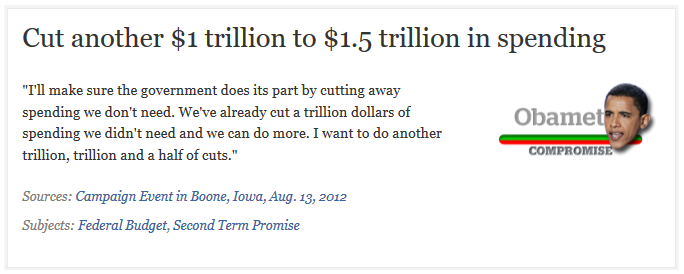
PolitiFact has lately started to wrap up its "Obameter" feature, rating whether President Obama delivered on the set of campaign promises PolitiFact tracked.

One recent item caught our eye, as Obama earned a "Compromise" rating for partially delivering on a re-election campaign promise to cut $1 trillion to $1.5 trillion in spending.

Veteran PolitiFact fact checker Louis Jacobson wrote this one.

Jacobson and PolitiFact received some great advice from an expert, then proceeded to veer into the weeds:
"Like anything else in budgeting, it's all about the baseline," said Steve Ellis, vice president of Taxpayers for Common Sense. "It's a cut relative to what?"

The most obvious way to judge how much spending went down on Obama's watch is to start with how much spending was expected in 2012, when he made the promise, and then compare that to the amount of spending that actually materialized.
Huh? What happened to the incredibly obvious method of measuring how much was spent in 2012 when he made his promise and then looking about how much was spent at the end of his term in office?

Jacobson's Dec. 5, 2016 Obameter story doesn't even acknowledge the method we're pointing out, yet Jacobson appeared well aware of it when he wrote a budget cut fact check way back in 2014:
First, while the ad implies that the law is slicing Medicare benefits, these are not cuts to current services. Rather, as Medicare spending continues to rise over the next 10 years, it will do so at a slower pace would [sic] have occurred without the law. So claims that Obama would "cut" Medicare need more explanation to be fully accurate.
Jacobson faulted a critic of Obama's health care law for using "cuts" to describe slowing the growth of future spending. Yet Jacobson finds that deceptive method "the most obvious way" to determine whether Obama delivered his promised spending cut.

But at least there's a happy ending to the discrepancy. The National Republican Senatorial Committee has "the most obvious method" counted against it (as deceptive), while President Obama receives the benefit when PolitiFact uses the Republicans' deceptive method to rate the president's promise on cutting spending.

There's nothing wrong with favoring the good guys over the bad guys, right?


Inside Baseball Stuff

In terms of fact-checking, we noted a particularly interesting feature of Louis Jacobson's rating of President Obama's promise of cutting spending by $1 trillion to $1.5 trillion: Obama was promising that spending cut over and above one he was already claiming to have achieved. Though PolitiFact's presentation makes this part of Obama's statement obvious, PolitiFact does not bother to confirm the claim.


Consideration of context serves as a fact checker's primary tool for interpreting claims. If Obama saved $1 trillion before making his promise of equal or greater savings in his second term, the means he used to achieve that savings is the means we should expect him to use to fulfill his promise for his second term unless he specifies differently.

We failed to find any mainstream fact check addressing Obama's claim of saving $1 trillion in 2011:
PRESIDENT OBAMA: Well, I-- I have to tell you, David, if-- if you look at my track record over the last two years, I cut spending by over a trillion dollars in 2011.
If Obama did not save $1 trillion in the first place, he cannot fulfill a promise to cut "another" $1 trillion. At best he can fulfill part of the promise: to cut $1 trillion.

Louis Jacobson and PolitiFact did not notice?

Checking whether Obama saved that $1 trillion in 2011 should have served as a prerequisite for rating Obama's second-term promise to save another $1 trillion or more. Fact checkers could then assume Obama would save the second $1 trillion under the same terms as the first.

Monday, December 5, 2016

Handicapping PolitiFact's "Lie of the Year" for 2016

A full plate of stuff to write about has left me a little behind in getting to PolitiFact's list of finalists for its "Lie of the Year" award--the award that makes it even more obvious that PolitiFact does opinion journalism, since judging the importance of a "lie" obviously requires subjective judgments.

I clipped an image of the most important part of the electronic ballot:


One thing jumped out right away. Typically the list of finalists includes about 10 specific fact checks from a number of sources. This year's menu includes only four specific fact checks, two each from Hillary Clinton and Donald Trump. PolitiFact rounds out the menu with two category choices, the whole 2016 election and the "fake news" phenomenon that, without much hint of irony, has galvanized the mainstream press to make even greater efforts to recapture its (legendary?) role as the the gatekeeper of what people ought to know and accept.

Given PolitiFact's recent tendency to select a "Lie of the Year" made up of multiple finalists, these changes make a great deal of sense. We've already pointed out one of the advantages PolitiFact gains from this approach. Having a multi-headed hydra as the winner allows PolitiFact to dodge criticisms of its choice. Oh, that hydra head got lopped off? No worries. These others continue to writhe and gnash their teeth.

Without further ado, I'll rate the chances of the six listed finalists. Doubtless my co-editor Jeff D. will weigh in at some point with his own comments and predictions.

Clinton "never received nor sent any email that was marked as classified" on her private email server while acting as Secretary of State

Of the specific claims listed, this one probably had the biggest impact on the election. Clinton made this claim a key part of her ongoing defense of her use of the private email server. When FBI Director James Comey contradicted this part of Clinton's story, it cinched one of Clinton's key negatives heading into the 2016 election. This one would serve as a pretty solid choice for "Lie of the Year." The main drawback of this selection stems from liberal denial of Clinton's weakness as a presidential candidate. This choice might generate some lasting resentment  from a significant segment of PolitiFact's liberal fanbase, some of whom will insist Clinton was telling the truth.


Clinton says she received Comey's seal of approval regarding her truthfulness about the email server

This item gave us a notable case where a major political figure made a pretty much indefensible and clear statement that was quickly publicized as such. Was this one politically significant? I think journalists were a bit shocked that Clinton made this unforced error. But I doubt voters regarded this case as anything other than a footnote to Clinton's earlier dissembling about her email server.

Trump claims "large-scale voter fraud"

Talk about awkward!

Trump was pilloried by the mainstream press along with pundits and politicians aplenty for his statements calling the presidential election results into doubt. But the political importance of this one gets complicated by liberal challenges to the election results in states where Trump's margin of victory was not particularly narrow (Michigan, Pennsylvania, and Wisconsin). Why challenge the results if they were not skewed by some form of large-scale fraud? This selection also suffers from the nature of the evidence. Trump received the rating not because it is known that no large-scale voter fraud has taken place in 2016, but because of a lack of evidence supporting the claim.

Donald Trump said he was against the war in Iraq

This one counts as the weakest of the specific fact checks on the list. PolitiFact and its fact-checking brethren built a very weak case that Trump had supported the Iraq War. Making this one by itself the "Lie of the Year" will result in some very good challenges in the mainstream and conservative press.


"The entire 2016 election, when falsehoods overran the facts"

Now things get interesting! Could PolitiFact opt for a "Lie of the Year" awarded to a candidate even more generalized than "campaign statements by Donald Trump," which won in 2016? And does PolitiFact have the ability to objectively quantify this election's overrunning of the facts compared to elections in the past? And could PolitiFact admit that falsehoods overran the facts despite proclamations that fact-checking enjoyed a banner year? If falsehoods overrun the facts while fact checkers enjoy a banner year then what will journalists prescribe to remedy the situation? More of what hasn't worked?

This choice will likely have good traction with PolitiFact's editors if they see a way toward picking this one while avoiding the appearance of admitting failure.


The fake news phenomenon(?)

Fake news has been around a good while, but it's the new hotness in journalistic circles. If mainstream journalism can conquer fake news, then maybe the mainstream press can again take its rightful place as society's gatekeepers of information! That idea excites mainstream journalists.

This surprise nominee has everything going for it. Fake news is fake by definition, so who can criticize the choice? It's total journalistic hotness, as noted. And the choice represents a call to action, opposing fake news, in symphony with a call that is already reverberating in fact-checking circles.

Is it a lame choice? Yes, it's as lame as all get out. I'd doubt journalists even have a clue about the impact of fake news, not to even mention the role fact checkers play in supporting false news memes that liberals favor.


Summary

Clinton's claim she never sent or received material marked as classified on her private server is the favorite according to the early established norms of the "Lie of the Year" award. But the fake news choice serves as the clear favorite in terms of sympathy with its Democratic-leaning readership and promoting its own sense of mission. I expect the latter favorite to prevail.


Jeff Adds:

I don't see much to disagree with Bryan. You can dismiss any claim relating to Trump right off the bat. Giving the award to Trump would neither shock people that hate him nor would it upset people that love him (who presumably already have low regard for liberal fact checkers.) It would be a yawner of a pick that would fail to generate buzz.

The Clinton pick would be a favorite in any other year. Because Clinton has already lost the election and her status on the left has been diminished, handing her the award wouldn't do any harm to her, but it would provide PolitiFact with a bogus token of neutrality ("See! We call Democrats liars too!") Likewise, the resulting outrage of PolitiFact's devoted liberal fanbase would generate plenty of clicks, and typically that's what the Lie of the Year has been about. It's true they would temporarily upset the faithful, but we've seen this exact scenario play out before with little consequence. Historically, PolitiFact seems motivated by clicks (and even angry liberal clicks will do, not to mention they keep the "we upset both sides" charade going.)

But the Fake News pick is the obvious favorite here. It's the hottest of hot topics in journalist circles, and PolitiFact sees themselves on the front lines in the war against opposing viewpoints unfacts. They're already trying to rally the troops and want to be seen as a beacon of truthiness in a sea of deceit.

It's been my view that while PolitiFact formerly cared primarily about generating buzz, since Holan's ascension [Angie Drobnic Holan replacing Bill Adair as chief editor--bww] they've behaved more and more like political activists. The Clinton choice would get more clicks, but I'd bet on Fake News being this year's rally cry for PolitiFact's army of Truth Hustlers.

Viva la Factismo!


Monday, November 21, 2016

Great Moments in the Annals of Subjectivity (Updated)

Did Republican Donald Trump win the electoral college in a landslide?

We typically think of a "landslide" as an overwhelming victory, and there's certainly doubt whether Trump's margin of victory in the electoral college unequivocally counts as overwhelming.

"Overwhelming" itself is hard to pin down in objective terms.

So that's why we have PolitiFact, the group of liberal bloggers that puts "fact" in its name and then proceeds to publish "fact check journalism" based on subjective "Truth-O-Meter" judgments.

When RNC Chairman Reince Priebus (and Trump's pick for his chief of staff) called Trump's electoral college victory a "landslide," PolitiFact Wisconsin's liberal bloggers sprang into action to do their thing (bold emphasis added):
Landslide, of course, is not technically defined. When we asked for information to back Priebus’ claim, the Republican National Committee merely recited the electoral figures and repeated that it was a landslide.
If "landslide" is not technically defined then what fact is PolitiFact Wisconsin checking? Is "landslide" non-technically defined to the point one can judge it true or false?

PolitiFact Wisconsin follows typical PolitiFact procedure in collecting expert opinions about whether Priebus' use of "landslide" matches its non-technical definition. One of the 10 experts PolitiFact consulted said Trump's margin was "close" to a landslide. PolitiFact said the other nine said it fell short, so PolitiFact ruled Priebus' claim "False."
Priebus said Trump’s win was "an electoral landslide."

But aside from the fact Trump lost the popular vote, his margin in the Electoral College isn’t all that high, either. None of the 10 experts we contacted said Trump’s win crosses that threshold.

We rate Priebus’ claim False.
One has to marvel at expertise sufficient to say whether the use of a term meets a non-technical definition.

One has to marvel all the more at fact checkers who concede that a term has a mushy definition ("not technically defined") and then declare that some use of the term fails to cross "that threshold."

What threshold?

One of the election experts said if Trump won by a landslide then Obama won by an even greater landslide.

RollCall, 2015:
In 2006, Democrats won back the House; two years later, President Barack Obama won by a landslide.
LA Times, 2012:
Obama officially wins in electoral vote landslide.
NPR, 2015:
President Obama won in a landslide.
NYU Journalism, 2008:
Obama Wins Landslide Victory, Charts New Course for United States.
Since Obama did not win by a landslide, therefore one cannot claim Trump won by a landslide? Is that it?

It is folly for fact checkers to try to judge the truth of ambiguous claims. PolitiFact often pursues that folly, of course, and in the end simply underscores what it occasionally admits: The ratings are subjective.

Finding experts willing to participate in the folly does not reduce the magnitude of the folly. This would have been a good subject for PolitiFact to use in continuing its Voxification trend. PolitiFact might have produced an "In context" article to talk about electoral landslides and how experts view the matter. But trying to corral the use of a term that is traditionally hard to tame simply makes a mockery of fact-checking.


Jeff Adds (Dec. 1, 2016):

Add this to a long list of opinions that PolitiFact treats as verifiable facts, including these two gems:

- Radio host John DePetro opined that the Boston Marathon bomber was buried "not far" from President John Kennedy. PolitiFact used their magical powers of objective divinity to determine the unarguable demarcation of "not far."

- Rush Limbaugh claimed "some of the wealthiest American's are African-Americans now." Using the divine wizardry of the nonpartisan Truth-O-Meter, PolitiFact's highly trained social scientists were able to conjure up a determinant definition of what "wealthiest" means, and specifically which people were included in the list.

Reasonable people may discount Trump's claim of a "landslide" victory assuming the conventional use of the term, but it's not a verifiable fact that can be confirmed or dismissed with evidence. It's an opinion.

The reality is that the charlatans at PolitiFact masquerade as truthsayers when they do little more than contribute to the supposed fake news epidemic by shilling their own opinions as unarguable fact. They're dangerous frauds whose declaration of objectivity doesn't withstand the slightest scrutiny.