Showing posts with label Angie Drobnic Holan. Show all posts

Friday, November 4, 2022

Research note: PolitiFact's 'Pants on Fire' bias through October 2022

We continue to update our research project examining PolitiFact's bias in applying its "Pants on Fire" rating.

The project notes that the difference between "False" and "Pants on Fire" ratings on PolitiFact's "Truth-O-Meter" counts as subjective. "False" statements are untrue, while "Pants on Fire" statements are untrue and "ridiculous." "Ridiculous" is a subjective judgment on its face, and PolitiFact has never published a description of the it suggesting otherwise.

Through the end of October 2022, PolitiFact had only given a Democratic Party officeholder/candidate/organization/appointee one "Pants on Fire" rating that counts toward our statistics. Our count omits claims from that attack the claimant's own political party. One of those occurred, published through PolitiFact New York.

As a result, we found PolitiFact nearly six times more likely to subjectively rate (what it views as) false claims from Republicans as "Pants on Fire" compared to such claims from Democrats.

Interestingly, PolitiFact National published its first "Pants on Fire" rating for a Democrat in 2022 not long after we tagged PolitiFact's Editor-in-Chief Angie Drobnic Holan in our tweet about this graph. A graph including the November stats as of today would put the 2022 PoF Bias number near 3.2--not the all-time record but instead solidly among the four highest bias measures taken since 2007.

Of course new ratings may move the numbers greatly by the end of the year.

Readers curious about the trends and details of the chart may wish to look at our explanation for the full chart at the end of 2021.

Tuesday, June 15, 2021

PolitiFact accidentally tells the truth about the Hunter Biden laptop

PolitiFact tried so hard to bury the Hunter Biden laptop story in a June 14, 2021 story that it ended up accidentally telling the truth about it.

Donald Trump claimed that he was "right about everything" and PolitiFact published its article to contest that claim item by item. Trump said the "Biden laptop was real," apparently trying to make the point that the Hunter Biden laptop story the mainstream media largely ignored in the runup to the 2020 election was truly based on Hunter Biden's laptop.

PolitiFact's telling:

'Hunter Biden’s laptop was real'

It was real in the sense that it exists, but it didn’t prove much. 

Trump allies obtained a laptop or copies of a laptop during the 2020 campaign that allegedly belonged to Hunter Biden, President Joe Biden’s son. Over time, there has been less doubt that the laptop did in fact belong to Hunter Biden, though how the laptop came to be obtained by Trump allies and Trump-friendly media outlets is unclear.

Conservative media have done quite a bit of reporting on how the laptop ended up in Rudy Giuliani's hands, not to mention those of the FBI. We find it interesting that PolitiFact declined to report on or link to any of those details. Instead of providing those details, PolitiFact gave us Hunter Biden's side of things and a link to that story:

Hunter Biden has been open about his history as a recovering drug addict; he’s said it’s possible the laptop was stolen from him.

Did you know the FBI is investigating Hunter Biden's business dealing with China? No? PolitiFact apparently doesn't, either. Or at least PolitiFact figured it's not relevant to this story

PolitiFact wraps up the section on Biden's laptop by accidentally telling the truth:

Nothing from the laptop has revealed illegal or unethical behavior by Joe Biden as vice president with regard to his son’s tenure as a director for Burisma, a Ukraine-based natural gas company.
Though PolitiFact's statement isn't even necessarily true in itself, it tells a series of truths in what it doesn't say. It doesn't say whether the laptop shows illegal or unethical behavior as vice president not regarding Hunter Biden's (apparently well-paid) tenure with Burisma.

What can't we fit through the loophole PolitiFact leaves open?

PolitiFact's statement is compatible with each of the following prospective assertions about what the laptop shows:

  • Illegal behavior by Joe Biden while not serving as vice president
  • Unethical behavior by Joe Biden while not serving as vice president
  • Illegal behavior by Vice President Biden unrelated to Hunter Biden's role as a Burisma employee
  • Unethical behavior by VP Biden unrelated to Hunter Biden's role as a Burisma employee

We're not saying any of the statements on our list is necessarily true. We're saying PolitiFact's disclaimer about what the Hunter Biden laptop doesn't show is so laughably narrow that it's incriminating.

Why?

Why would any news organization, let alone a fact-checking organization, include such a preposterous caveat in a story? It looks designed to mislead readers. 

If it's just simple incompetence, it's of the kind that looks much worse than simple incompetence. It looks like an attempt to deceive readers.

That's a bad look.


Typo correction June 15, 2021: Bursima=.Burisma

Correction June 16, 2021: Fixed some flawed text formatting and changed "It doesn't say whether the laptop shows illegal or unethical behavior as vice president regarding Hunter Biden's (apparently well-paid) tenure with Burisma" to "It doesn't say whether the laptop shows illegal or unethical behavior as vice president not regarding Hunter Biden's (apparently well-paid) tenure with Burisma." Our apologies for any confusion our error caused.

Thursday, March 4, 2021

Editor who won't do corrections makes correction request (Updated)

Here and at Zebra Fact Check we have documented obvious errors pointed out to PolitiFact that PolitiFact simply declines to fix.

How delicious, then, when we heard that PolitiFact Editor-in-Chief Angie Drobnic Holan requested corrections of the conservative publication the Federalist. And royally botched at least one of them.

The Federalist noted PolitiFact had done little to fact check Democratic Party politicians in the new Biden administration, and PolitiFact apparently objected.

The Federalist's Tristan Justice told the story on Feb. 20, 2021:

“Your report is wrong in multiple ways,” Holan wrote in a Friday email. “For one, we published three fact-checks on Feb. 16, so our last check on Biden was the day before your report was published. The link you use in the story shows that. Please issue a correction ASAP.”

Holan followed up two hours later, demanding an update.

The link embedded in the initial post to Biden’s fact-checks on the PolitiFact website, however, which remains unchanged, shows PolitiFact published three fact-checks after the story was published in The Federalist, of statements made on Feb. 16, including Biden’s remarks on vaccines. Contrary to Holan’s assertion, these fact-checks were published on Feb. 17 and 18, following the Federalist article.

The Federalist story included an image backing up Justice's description, which we independently verified. It looks like Holan probably mistook the date the claims were made as the publish date. When PolitiFact revamped its website about a year ago, it moved the claim date up to the top of the article and the publish date down and to the left to accompany the writer's byline.

Old way:

The old layout had the date of the claim in the box up top and the publish date next to the author's byline, down at the bottom of the header section.

New way:


With the new layout the claim date moved all the way up to the top, under the source of the claim. The publish date moved, along with the writer's byline, to the left margin. And shrank.

It looks like Holan believed the claim dates were the publish dates. It's not the kind of mistake an organization wants to see from its editor-in-chief.

We asked Holan for an explanation but received no reply.

It's worth pointing out that Holan claimed there were a number of errors in the Federalist article. We also asked her about those, after we asked Justice, the Federalist writer, about them. If Holan found legitimate problems with the Federalist story then Justice should not have buried the fact.

But as for Justice's allegation that Holan was mistaken with the first part of her correction request, the Internet Archive record from Feb. 17, 2021 shows no fact checks featuring Joe Biden published on Feb. 16, 2021.

Update March 5, 2021: A commenter has correctly noted that this post could benefit from added context. We inserted a short new paragraph in the three slot and added the link to the Federalist story that was always intended to be there. We appreciate comments that help us improve our work.

Wednesday, December 9, 2020

Does PolitiFact use consistent standards? No.

PolitiFact misleads when it tells its readers "we are applying the same standards to both sides." PolitiFact's methodology leaves open myriad ways to put fingers on the scale. The scale has fingerprints all over it.

In this article we'll focus on yet another example of uneven application of standards. We'll look at two PolitiFact fact checks in the category of health care, one from a Republican and one from a Democrat.


The Republican


On Nov. 30, 2020 PolitiFact published a fact check of Sen. Kelly Loeffler (R-Ga.) looking at her claim that her healthcare plan would protect Americans with preexisting conditions. PolitiFact issued a "False" judgment on Loeffler's claim.

Why the "False" rating?

PolitiFact's subheading suggested a lack of proof led to the rating: "No proof that Kelly Loeffler will ensure protections for preexisting conditions." 

Aside from the lack of proof, PolitiFact noted that Loeffler's plan proposed using something like high risk pools to help people get their preexisting conditions covered. PolitiFact's "If Your Time is Short" story summary gave Loeffler credit for protections that fall short of those offered by the Affordable Care Act (second bullet):

If Your Time is short

  • The GOP Georgia senator’s new plan offers no details on how protections for people with preexisting health conditions would be ensured.

  • Two provisions in the plan indicate protections will be less than those provided by the Affordable Care Act, experts say.


Why did the protections in Loeffler's plan count for nothing on PolitiFact's "Truth-O-Meter"? The special insurance groups designed for those with preexisting conditions couldn't even budget the rating up to "Mostly False"? Did PolitiFact assume that when Loeffler said "Americans" she meant "all Americans"? If so, that rationale failed to find its way into the fact check.

The Democrat

People these days tend to know (using that term advisedly) that President Obama's "You can keep your plan" pledge received PolitiFact's "Lie of the Year" in 2013. They've tended to forget, with help from PolitiFact, that the claim never received a Truth-O-Meter rating below "Half True." PolitiFact rated Obama's claim twice, in 2009 and in 2012. Both times it received a "Half True" rating. 

We'll use the 2012 rating to see how PolitiFact's application of standards compared to the ones it used for Loeffler.


PolitiFact's summary paragraphs encapsulate its reasoning:

Obama has a reasonable point: His health care law does take pains to allow Americans to keep their health plan if they want to remain on it. But Obama suggests that keeping the insurance you like is guaranteed.

In reality, Americans are not simply able to keep their insurance through thick and thin. Even before the law has taken effect, the rate of forced plan-switching among policyholders every year is substantial, and the CBO figures suggest that the law could increase that rate, at least modestly, even if Americans on balance benefit from the law’s provisions. We rate Obama’s claim Half True.

PolitiFact says Obama has a reasonable point. PolitiFact made no mention in its fact check of Loeffler to detect whether she had a reasonable point that her health care plan offered protections for preexisting conditions. Is that the same standard?

PolitiFact says Obama "suggested" that keeping one's preferred insurance is guaranteed. That might parallel the assumption that Loeffler was saying her plan guarantees coverage for preexisting conditions. PolitiFact's ruling suggests it made that assumption, though the fact check does not say so specifically. But if Obama was similarly making a guarantee, how did he skate with a "Half True" instead of the "False" rating Loeffler's claim received? Is that the same standard?

And speaking of guarantees, remember that PolitiFact docked Loeffler for not having proof that her plain would cover (all?) those with preexisting conditions. What proof did Obama's plan offer? Apparently none, as PolitiFact noted a Congressional Budget Office assessment saying the ACA would accelerate force churn of insurance plans. Is that the same standard?

We say the same standard did not apply to both. If Loeffler's "False" stems from her leading people to falsely believe her plan guarantees coverage for preexisting conditions then Obama's similar misleading would seem to equally earn a "False" rating. Or, both Loeffler and Obama could receive a "Half True" rating.

That they received quite different ratings shows the application of differing standards.

Monday, November 16, 2020

PolitiFact, misspellings and minor errors

We have noted that PolitiFact has over the years tried to minimize the impression that it often publishes things that need correction. And PolitiFact's lengthy description of its corrections policy contains loopholes that give its editors a hand in lessening the appearance of fact checker error.

The Case in Point

PolitiFact published a Nov. 10, 2020 PolitiSplainer telling readers how two incumbent Republican senators were attacking Republicans in the Georgia state government over that state's election recount.

PolitiFact reported that the senators, David Perdue and Kelly Loeffler, were "facing tough recall elections."

When PolitiFact tweeted out that misinformation to its Twitter audience someone quickly noticed the mistake:

https://twitter.com/punsultant/status/1326286056690503683


Art Allen was right. Neither Republican senator faces a recall election.

Allen wasn't the only person to highlight the mistake. But the mistake stayed on in PolitiFact's tweets and in the box summarizing the article at the main PolitiFact website (highlights added for emphasis):

To be clear, a recall election is not the same thing as a runoff election.

By November 16 PolitiFact had corrected its error, yet without admitting any wrongdoing.

The page received no "corrections or updates" tag and features no correction or update notice.

How can that be, given that PolitiFact has, according to its editor, one of the most robust and detailed corrections policies in journalism?

It's easy-peasy. And that's because the robust details in the corrections policy are ambiguous. The details make readers think PolitiFact is transparent about its mistakes when in reality the policy features (intentional?) loopholes that allow the fact checker to obscure its history of embarrassing mistakes.

The mistake on "recall elections" was likely treated under this section of PolitiFact's policy:

Typos, grammatical errors, misspellings – We correct typos, grammatical errors, misspellings, transpositions and other small errors without a mark of correction or tag and as soon as they are brought to our attention.

By counting the use of "recall" where "runoff" was meant as a typo, grammatical error, misspelling or other small error, PolitiFact ends up deceiving its audience about the robustness of its corrections policy. When we read (in the same statement of principles) that PolitiFact corrects its errors "with appropriate transparency" we expect that to include an admission when PolitiFact finds itself guilty of spreading misinformation.

PolitiFact undeniably spread misinformation. People who saw only PolitiFact's early tweets highlighting its article were misinformed that Loeffler and Perdue were facing recall elections. Those whose time was short and read only the article summary were similarly misinformed. And PolitiFact, contrary to its commitment under the principles of the International Fact-Checking Network, which it professes to follow, took no steps to make sure those who were misled had the corrected version brought to their attention.

We publish our corrections policy and follow it scrupulously. We correct clearly and transparently in line with our corrections policy, seeking so far as possible to ensure that readers see the corrected version.

That's how these Pulitzer Prize-winning journalists operate. This has always been part of their approach to corrections.

It's embarrassing to mix up "runoff election" with "recall election." Therefore, PolitiFact buries its mistake as though it merely mixed up "its" with "it's."

"Recall" is not a misspelling of "runoff" any more than "Trump" is a misspelling of "Biden." If every wrong word can count as a misspelling then journalists can completely do away with correction notices under a policy like PolitiFact's.


Correction Nov. 16, 2020: In the fifth-to-last paragraph we committed an error similar to PolitiFact's stating that PolitiFact "misinformed that Loeffler and Perdue were facing runoff elections." In fact, PolitiFact misinformed its readers that Loeffler and Perdue were facing recall elections and not runoff elections. Hat tip to Matthew Hoy for catching the error and alerting us to its existence. The problem is fixed with this update.

Tuesday, June 2, 2020

A picture worth a thousand words?

PolitiFact's executive director, Aaron Sharockman, sent out a mass email earlier today. One of those emails asking for reader support.

The image at the top of Sharockman's email was revealing, even if it happened to reveal what we already know about PolitiFact.


In journalism school we learned the importance of images. Journalists pay a great deal of attention to images and the messages they send.

So take a look. Break it down.

It's an image of protesters in front of the White House. We can see signs that say "No Justice No Peace" and "Black Lives Matter." The photo does not place the protestors in the distance as a third party. The image is taken from the midst of the protest. The point-of-view is from among the protestors. The protestors, and presumably their protests, are aimed at the White House.

The appeal makes sense, given that PolitiFact's fan base leans left and opposes Trump. The photo slyly (and with "plausible deniability!) sends an anti-Trump protest message those readers on the left will likely appreciate, even if many only appreciate it subconsciously.

The photo's an ideological tell.

But There's More

Before the fundraising email went out, we noticed PolitiFact's editor-in-chief, Angie Drobnic Holan, tweeting out an article blaming President Trump for violence directed against journalists.

Has anyone bothered to fact check that supposed cause-and-effect relationship?
We say that if a journalist truly believes Mr. Trump is responsible for violence against journalists, the journalist who thinks that should be presumed biased against Mr. Trump. Bias against Trump does not necessarily make PolitiFact's fact checks of Trump wrong. We emphasize these examples of bias mainly because PolitiFact falsely represents itself as unbiased.

Stop wearing the mask and we'll stop repeatedly peeling it away. Deal?

Thursday, December 19, 2019

PolitiFact disagrees with IG on IG report on CrossFire Hurricane

What to do when the Inspector General and PolitiFact disagree on what an IG report says?

Well, the IG has no Pulitzer Prize, so maybe trust the fact checkers?

PolitiFact, Dec. 11, 2019:

The investigation was not politically motivated

The IG report also dismissed the notion that the investigation was politically motivated.
Inspector General Michael Horowitz, during Senate testimony on Dec. 18, 2019 (The Epoch Times):
Then [Sen. Josh Hawley (R-Mo.)] asked, “Was it your conclusion that political bias did not affect any part of the Page investigation, any part of Crossfire Hurricane?”

“We did not reach that conclusion,” Horowitz told him. He added, “We have been very careful in connection with the FISA for the reasons you mentioned to not reach that conclusion, in part, as we’ve talked about earlier: the alteration of the email, the text messages associated with the individual who did that, and then our inability to explain or understand or get good explanations so we could understand why this all happened.”
We confirmed The Epoch Times' account via C-SPAN. It edits the exchange for clarity without altering the basic meaning of the exchange. We invite readers to confirm it for themselves via an embedded clip (around 3:11)*:


Seriously, we count the PolitiFact's Pulitzer as no kind of reasonable evidence supporting its reliability. Pulitzer juries do not fact check content before awarding prizes.

It seems clear PolitiFact committed the fallacy of argumentum ad ignorantiam. When the IG report repeatedly said it "found no testimonial or documentary evidence that these operations resulted from political bias or other improper considerations" or similar words, PolitiFact made the fallacious leap to conclude there was no political bias.

Pulitzer Prize-winning and IFCN-verified PolitiFact.

We need better measures of trustworthiness.


*Our embedded clip ended up shorter than we expected, for which we apologize to our readers. Find the full clip here.

Tuesday, December 3, 2019

PolitiFact ratings aren't scientific--or are they?

We stand bemused by PolitiFact's attempt to straddle the fence regarding its aggregated "Truth-O-Meter" ratings.

On the one hand, as PolitiFact Editor Angie Drobnic Holan told us a few weeks ago, "It’s important to note that we don’t do a random or scientific sample."

On the other hand, we have this eye-popping claim Holan sent out via email today (also published to the PolitiFact.com website):
Trump remains a unique figure in American politics and at PolitiFact. There’s no one we’ve fact-checked as many times who has been as consistently wrong. Out of 738 claims we’ve fact-checked as of this writing, more than 70% have been rated Mostly False, False or Pants on Fire. After four years of watching Trump campaign and govern, we see little to no increase in his use of true facts and evidence to support his arguments.
Even though it is supposedly important to note that PolitiFact doesn't do a random or scientific sample, Holan makes no mention of that important caveat in her email. Instead, she makes it appear to the reader as though Trump's "Truth-O-Meter" record offers a reasonable basis for judging whether Trump has increased "his use of true facts and evidence to support his arguments."

How would PolitiFact judge whether Trump was using more true facts to support his arguments other than by looking at unscientific fact checker ratings?

PolitiFact has made a pattern of this deception.

The occasional admission of non-random, unscientific story selection is perfunctory. It is a fig leaf.

PolitiFact wants readers to judge politicians based on its aggregated "Truth-O-Meter" ratings.

For some unknown reason, though maybe we can guess, the fact checkers think their collected ratings are pretty much accurate judges of character regardless of their departure from the scientific method. And that's why PolitiFact over its entire history has implicitly and explicitly encouraged readers to rely on its graphs and charts to judge politicians. And has steadfastly resisted the obligation to attach a disclaimer to those charts and graphs making the supposedly important point that the selection process is not random or scientific.

We call it an obligation because we view it as a requirement for journalists to avoid deliberately deceiving their audiences.

PolitiFact deceives its audience daily in this way without any visible repentance.


Friday, November 15, 2019

PolitiFact editor: "It’s important to note that we don’t do a random or scientific sample"

As we have mentioned before, we love it when PolitiFact's movers and shakers do interviews. It nearly guarantees us good material.

PolitiFact Editor Angie Drobnic Holan appeared on Galley by CJR (Columbia Journalism Review) with Mathew Ingram to talk about fact-checking.

During the interview Ingram asked about PolitiFact's process for choosing which facts to check (bold emphasis added):
MI
One question I've been asking many of our interview guests is how they choose which lies or hoaxes or false reports to fact-check when there are just so many of them? And do you worry about the possibility of amplifying a fake news story by fact-checking it? This is a problem Whitney Phillips and Joan Donovan have warned about in interviews I've done with them about this topic.
ADH
Great questions! We use our news judgement to decide what to fact-check, with the main criteria being that it’s a topic in the news and it’s something that would make a regular person say, "Hmmm, I wonder if that’s true." If it sounds wrong, we’re even more eager to do it. It’s important to note that we don’t do a random or scientific sample.
It's important, Holan says, to note that PolitiFact does not do a random or scientific sample when it chooses the topics for its fact check stories.

We agree wholeheartedly with Holan's statement in bold. And that's an understatment. We've been harping for years on PolitiFact's failure to make its non-scientific foundations clear to its audience. And here Holan apparently agrees with us by saying it's important.

How important is it?

PolitiFact's statement of principles says PolitiFact uses news judgment to pick out stories, and also mentions the "Is that true?" standard Holan mentions in the above interview segment. But what you won't find in PolitiFact's statement of principles is any kind of plain admission that its process is neither random nor scientific.

If it's important to note those things, then why doesn't the statement of principles mention it?

At PolitiFact, it's so important to note that its story selection is neither random nor scientific that no example from three pages of Google hits in the politifact.com domain when searching for "random" AND "scientific" has anything to do with PolitiFact's method for story selection.

And despite commenters on PolitiFact's Facebook page commonly interpreting candidate report cards as representative of all of a politician's statements, Holan insists "There's not a lot of reader confusion" about it.
If there's not a lot of reader confusion about it, why say it's important to note that the story selection isn't random or scientific? People supposedly already know that.

We use the tag "There's Not a Lot of Reader Confusion" on occasional stories pointing out that people do suffer confusion about it because PolitiFact doesn't bother to explain it.

Post a chart of collected "Truth-O-Meter" ratings and there's a good chance somebody in the comments will extrapolate the data to apply to all of a politician's statements.

We say it's inexcusable that PolitiFact posts its charts without making their unscientific basis clear to readers.

They just keep right on doing it, even while admitting it's important that people realize a fact about the charts that PolitiFact rarely bothers to explain.

Thursday, July 25, 2019

Ocasio-Cortez, PolitiFact and the parking lot

My, how PolitiFact beclowns itself.

A number of media outlets have noted PolitiFact's fact check of the claim Rep. Alexandria Ocasio-Cortez cried about an empty parking lot. We like the account from Amanda Prestigiacomo at the Daily Wire:
Politifact is at it again! The left-wing fact-checker purporting to be unbiased made a mockery of themselves (again) with their latest rating concerning socialist Rep. Alexandria Ocasio-Cortez (D-NY). Politifact, creating their best damage control for the freshman congresswoman, rated the claim that Ocasio-Cortez cried in front of an empty parking lot for a photo-op as "false" because it was, in fact, a "road" with some parked cars, not a parking lot, that the elected Democrat cried in front of.
The hilarity of the story took an exponential leap when PolitiFact Editor Angie Drobnic Holan took to Twitter in defense of PolitiFact:
Holan's defense falls flat because the original story with the "parking lot" language was using humor to make a point. Ocasio-Cortez had nothing to look at that should reasonably produce the emotional response she wore for the camera.There were no children or refugees in view. At most, she would have been able to see signs of the tents set up to house illegal immigrants.

Crying at the sight of distant tents is a little like breaking down upon seeing a hospital. Because of all the suffering that happens in hospitals. But that type of response is uncommon, right?

PolitiFact's reporting leaves doubt as to whether a person at the fence could see tents:
Daniel Borunda, a reporter for the El Paso Times who was at the rally on the same day, told PolitiFact that the tent complex was "visible in the distance several hundred yards away" from the fence.
Certainly PolitiFact's reporting seems intended to produce the impression one could see tents from the entryway fence. But Borunda's quotation is cut off and instead of relying on Borunda we end up relying on PolitiFact for the information. We think it likely PolitiFact fudged the facts.

There's good reason to suspect Borunda did not claim tents were visible from the fence. The Google Maps image, for example, shows great distance and a number of buildings between the entry area and the section of the complex where the tents were set up. Click through to the map and explore for yourself.

There are two buildings that appear round from above to the east of the main ICE building. The tents for the tent city (along with a sloped-roof structure that does not appear in the Google image) occur just south of those buildings in aerial photographs of the time.

It's worth pointing out that photo we just linked shows a line of buildings and a parking lot between the tent city and Ocasio-Cortez's reported location.

This image from later the same year (September 2018) shows the growth of the tent city stretching South and East from its original location--further from Ocasio-Cortez's vantage point and likewise with a view punctuated by intervening buildings and trees. And that was after Ocasio-Cortez made her visit (June 21, 2018).

Did any photographers take pictures of the tent city from outside the fence at Ocasio-Cortez's location? We'd love to see them, if they exist.


Afters

We took our analysis one step further. The images of Ocasio-Cortez, along with PolitiFact's reporting, appear to place her between two sections of wall outside the border compound. A road and a sidewalk run between the sections of wall, and it appears the north wall features a sliding fence/gate that officials may use to block the roadway.

If we're correct about the location, that puts the south part of the wall between Ocasio-Cortez and any view of the tent city.

We put a cluster of red dots where we believe Ocasio-Cortez stood.

The fall of the shadows in the photographs of Ocasio-Cortez suggest the pictures were taken in the morning, if we're correct. An image posted at the end of Time Magazine story supports our analysis (showing evidence of the line of trees to the left of the roadway, along with the utility poles). Facing the road leaves the tent city directly to the left of the protesters pictured, behind a wall and out of sight.


Update July 27, 2019: A kind reader pointed out an excess of "not" in the paragraph beginning with "Holan's defense." We took it out. Our thanks to the kind reader.

Monday, May 6, 2019

PolitiFact unfairly harms Joe Biden

On May 6, 2019, PolitiFact fact-checked a claim from Democratic Party presidential hopeful (and frontrunner) Joe Biden.

Biden said he was "always" labeled as one of the most liberal Democrats in Congress.

PolitiFact rated Biden's claim "False." Perhaps the rating is fair. But PolitiFact's would-be paraphrase of Biden's claim, below, treats Biden unfairly.


We think there's room for one to count as a "staunch liberal" without always counting as a one of the most liberal.

PolitiFact, for purposes of its headline, changed Biden's claim from one to the other. In terms of its messaging, PolitiFact offers the opinion that Biden does not count as a staunch liberal.

We think fact checks should stick to the facts and not make headlines out of their opinions. PolitiFact's opinion, trumpeted above its fact check, unfairly harmed Biden.


Note: We have always said that PolitiFact's problems go beyond left-leaning bias. PolitiFact represents fact-checking done poorly. The bad fact-checking unfairly harms right and left, with the right getting the worst of it.

Thursday, April 4, 2019

The Worst of PolitiFact's April 2, 2019 Reddit AMA

As we mentioned in a Feb. 2, 2019 post, we love it when PolitiFact folks do interviews. It's a near guarantee of generating material worth posting. In celebration of "International Fact-Checking Day," PolitiFact Director Aaron Sharockman and PolitiFact Editor Angie Drobnic Holan conducted a Reddit "Ask Me Anything" event.

I asked PolitiFact to describe why it advocates transparency while keeping the identities and votes of its "Star Chamber" secret. PolitiFact's "Star Chamber" votes on each "Truth-O-Meter" rating. The majority vote rules, though PolitiFact claims it achieves unanimity for most votes. My question wasn't answered (no great surprise there).

Most of the interactions were boilerplate answers to boilerplate questions. But there were a few items of special interest.


Observing the PolitiFact Code?

Card

Though Holan flatly said "Everything that gets a correction or an update gets tagged (see all tagged items)," we were ready with two recent cases contradicting her claim. And we let that cat out of the bag.

Card

PolitiFact makes statements giving readers the impression that it scrupulously follows its code of principles. In fact, PolitiFact loosely follows its code of principles, as in this example. How do Holan and Sharockman not know this?

One of the examples we used was corrected on approximately March 16, 2019. Most of the uncertainly about the correction date comes from PolitiFact Virginia's decision not to mark the date of the correction. As of April 3, 2019 PolitiFact Virginia had not added the "Corrections or Updates" tag and the story did not appear on PolitiFact's supposed list of all of its corrected or updated stories.


Mythical Truth-O-Meter Consistency

One participant asked a question suggesting PolitiFact does not rate statements consistently (suggesting contemporary ratings of Trump make past ratings look far too harsh). Sharockman implied PolitiFact has kept its system consistent over the years:
But beyond the sheer volume [of Trump ratings--ed.], the standards we use to use [sic] to issue our ratings really hasn't [sic] evolved in the 11 years we've been doing this. In that sense, a Pants on Fire in 2009 should still be a Pants on Fire claim today, and vice versa.
There are two big problems with Sharockman's claim. First, PolitiFact itself announced a change to its rating methodology back in 2012.

Second, PolitiFact has admitted that its ratings are pretty much subjective. Sharockman's chosen example, the dividing line between "False" and "Pants on Fire" is perhaps the most sensational example of that subjectivity. How does Sharockman not know that?


The Vast Right-Wing Conspiracy Against PolitiFact?

Someone (not me!) asked "Who fact checks you [PolitiFact--ed.]?"

We found Sharockman's response fascinating and very probably false:

Card

Sharockman's answer paints PolitiFact as the focus of a concentrated group of hostile editors. With all those people combing PolitiFact material for hours on end, it's amazing that PolitiFact makes mistakes so rarely.

Right?

But is there any evidence at all supporting Sharockman's supposition that "a lot of people are reading everything we write looking for mistakes"? We at PolitiFact Bias announced long ago that we could not do a thorough job vetting PolitiFact's body of work:
As PolitiFact expands its state operations, the number of stories it produces far exceeds our capacity to review and correct even just the most egregious examples of journalistic error or bias.  We aim to encourage an army of Davids to counteract the mistakes and bias in PolitiFact's stories.
Who else could Sharockman have had in mind? Media Matters For America? The (defunct) Weekly Standard?

(We asked Sharockman via Twitter the other day whom he had in mind but received no immediate reply)

We suspect Sharockman of Trumpian exaggeration. He knows at least some people look at some of PolitiFact's work for errors. So to convey his point he turns that into "a lot of people" looking at "everything" PolitiFact publishes looking for errors. It's likely the only organization combing over PolitiFact's entire body of work looking for errors is PolitiFact itself.

And look how many times it fails, without swallowing the fiction that this represents the entire number.

***

Holan and Sharockman are politicians advocating for PolitiFact. It appears we cannot trust PolitiFact to hold its own to account.

Friday, March 1, 2019

PolitiFact Tweezes Green New Deal Falsehoods

In our post "PolitiFact's Green New Deal Fiction Depiction" we noted how PolitiFact had decided that a Democrat posting a falsehood-laden FAQ about the Green New Deal on her official congressional website escaped receiving a negative rating on PolitiFact's "Truth-O-Meter."

At the time we noted that PolitiFact's forbearance held benefits for Democrats and Republicans alike:
Many will benefit from PolitiFact's apparent plan to give out "Truth-O-Meter" mulligans over claimed aspects of the Green New Deal resolution not actually in the resolution. Critics of those parts of the plan will not have their attacks rated on the Truth-O-Meter. And those responsible for generating the controversy in the first place by publishing FAQs based on something other than the actual resolution also find themselves off the hook.
 We were partly right.

Yes, PolitiFact let Democrats who published a false and misleading FAQ about the Green New Deal off the hook.

But apparently PolitiFact has reserved the right to fault Republicans and conservatives who base their criticisms of the Green New Deal on the false and misleading information published by the Democrats.

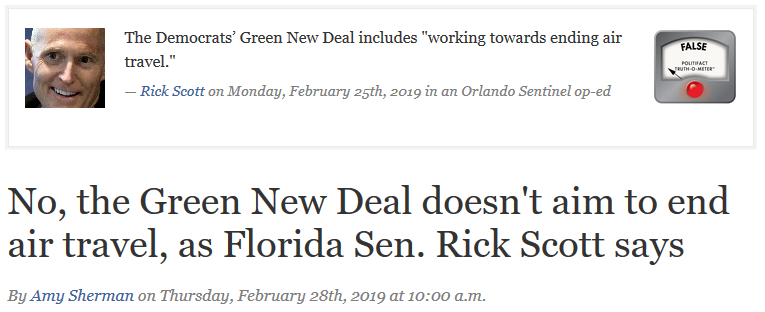
PolitiFact Florida tweezed out a such a tidbit from an editorial written by Sen. Rick Scott (R-Fla.):


False? It doesn't matter at all that Ocasio-Cortez said otherwise on her official website? There is no truth to it whatsoever? And Ocasio-Cortez gets no "False" rating for making an essentially identical claim on her website?

This case will get our "tweezers or tongs" tag because PolitiFact is once again up to its traditional shenanigan of tweezing out one supposed falsehood from a background of apparent truths:
Sen. Rick Scott, R-Fla., outlined his opposition to the Democrats’ Green New Deal in a Feb. 25th Orlando Sentinel op-ed:

"If you are not familiar with it, here’s the cliff notes version: It calls for rebuilding or retrofitting every building in America in the next 10 years, eliminating all fossil fuels in 10 years, eliminating nuclear power, and working towards ending air travel (to be replaced with high-speed rail)."

...

Let’s hit the brakes right there -- do the Democrats want to end air travel?
See what PolitiFact did, there?

Scott can get three out of four points right, but PolitiFact Florida will pick on one point to give Scott a "False" rating and build for him an unflattering graph of  "Truth-O-Meter" ratings shaped by PolitiFact's selection bias.


The Jestation Hypothesis

How does PolitiFact Florida go about discounting the fact that Ocasio-Cortez claimed on her website that the Green New Deal aimed to make air travel obsolete?

The objective and neutral fact checkers give us the Jestation Hypothesis. She must have been kidding.

No, really. Perhaps the idea came directly from one of the three decidedly non-neutral experts PolitiFact cited in its fact check (bold emphasis added):
"It seems to me those lines from the FAQ were lighthearted and ill-considered, and it’s not clear why they were posted," said Sean Hecht, Co-Executive Director, Emmett Institute on Climate Change and the Environment at UCLA law school.
Hecht's FEC contributions page is hilariously one-sided.

Does anyone need more evidence that the line about making air travel obsolete was just a joke?
"No serious climate experts advocate ending air travel -- that's simply a red-herring," said Bledsoe, who was a climate change advisor to the Clinton White House.
Former Clinton White House advisor Bledsoe is about as neutral as Hecht. The supposed "red-herring," we remind readers, was published on Ocasio-Cortez's official House of Representatives website.

The neutral and objective fact-checkers of PolitiFact Florida deliver their jestational verdict (bold emphasis added):
Scott wrote in an op-ed that the Democrats’ Green New Deal includes "working towards ending air travel."

The resolution makes no mention of ending air travel. Instead, it calls for "overhauling transportation systems," which includes "investment in high-speed rail." Scott seized on a messaging document from Democrats that mentioned, perhaps in jest, getting rid of "farting cows and airplanes." But we found no evidence that getting rid of airplanes is a serious policy idea from climate advocates.
Apparently it cannot count as evidence that Democrats have advocated getting rid of airplanes if a popular Democratic Party representative publishes this on her website:
The Green New Deal sets a goal to get to net-zero, rather than zero emissions, at the end of this 10-year plan because we aren’t sure that we will be able to fully get rid of, for example, emissions from cows or air travel before then. However, we do believe we can ramp up renewable manufacturing and power production, retrofit every building in America, build the smart grid, overhaul transportation and agriculture, restore our ecosystem, and more to get to net-zero emissions.
Oh! Ha ha ha ha ha! Get it? We may not be able to fully get rid of emissions from cows or air travel in only 10 years! Ha ha ha!

So the claim was quite possibly a joke, even if no real evidence supports that idea.

But it's all PolitiFact needs to give a Republican a "False" rating and the Democrat no rating at all for saying essentially the same thing.

This style of fact-checking undermines fact checkers' credibility with centrists and conservatives, as well as with discerning liberals.


Afters

There was one more expert PolitiFact cited apart from the two we showed/noted were blatantly partisan.

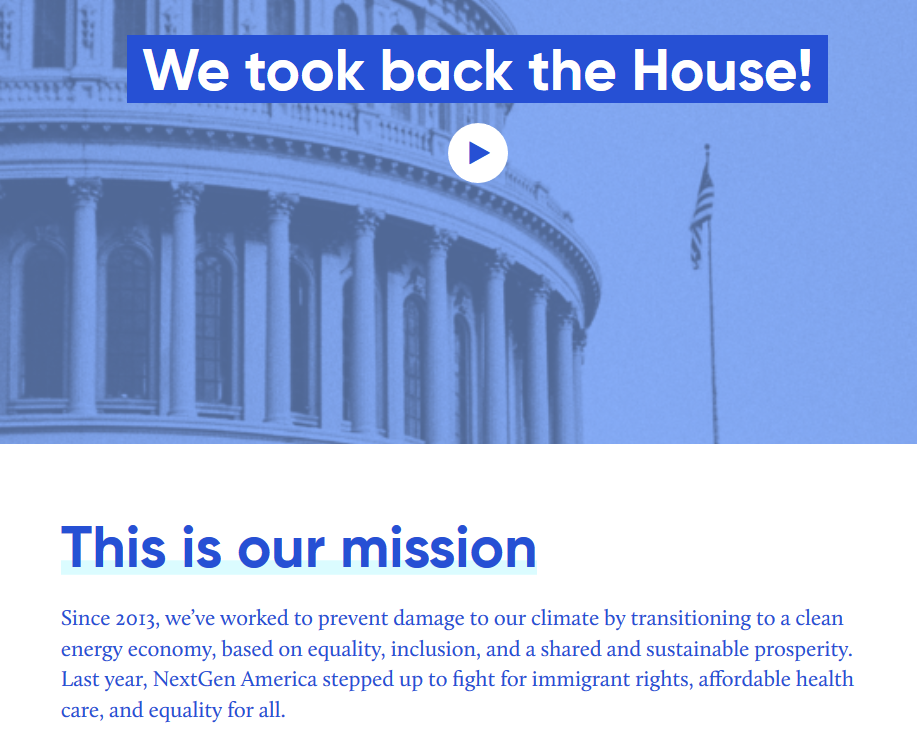
That was "David Weiskopf, climate policy director for NextGen Climate America."

Here's a snippet from the home page for NextGen Climate America:


So basically neutral, right?

PolitiFact Florida "fact checker" (liberal blogger) Amy Sherman seems to have a special gift for citing groups of experts who skew hilariously left.


Wednesday, February 27, 2019

PolitiFact's sample size deception

Is the deception one of readers, of self, or of both?

For years we have criticized as misleading PolitiFact's selection-bias contaminated charts and graphs of its "Truth-O-Meter" ratings. Charts and graphs look science-y and authoritative. But when the data set is not representative (selection bias) and the ratings are subjective (PolitiFact admits it), the charts serve no good function other than to mislead the public (if that even counts as a good function).

One of our more recent criticisms (September 2017) poked fun at PolitiFact using the chart it had published for "The View" host Joy Behar. Behar made one claim, PolitiFact rated it false, and her chart make Behar look like she lies 100 percent of the time--which was ironic because Behar had used PolitiFact charts to draw false generalizations about President Trump.

Maybe our post helped prompt the change and maybe it didn't, but PolitiFact has apparently instituted some sort of policy on the minimum number of ratings it takes to qualify for a graphic representation of one's "Truth-O-Meter" ratings.

Republican Rep. Matt Gaetz (Fla.) has eight ratings. No chart.

But on May 6, 2018 Gaetz had six ratings and a chart. A day later, on May 7, Gaetz had the same six ratings and no chart.

For PolitiFact Florida, at least, the policy change went into effect in May 2018.

But it's important to know that this policy change is a sham that would hide the central problem with PolitiFact's charts and graphs.

Enlarging the sample size does not eliminate the problem of selection bias. There's essentially one exception to that rule, which occurs in cases where sample encompasses all the data--and in such cases "sample" is a bit of a misnomer in the first place.

What does that mean?

It means that PolitiFact, by acting as though small sample size is a good enough reason to refrain from publishing a chart, is giving its audience the false impression that enlarging the sample size without eliminating the selection bias yields useful graphic representations of its ratings.

If PolitiFact does not realize what it is doing, then those in charge are dangerously ignorant (in terms of improving public discourse and promoting sound reasoning).

If PolitiFact realizes what it is doing wrong and does it regardless, then those in charge are acting unethically.

Readers who can think of any other option (apart from some combination of the ones we identified) are encouraged to offer suggestions in the comments section.


Afters


When do the liberal bloggers at PolitiFact think their sample sizes are big enough to allow for a chart?

Sen. George Allen has 23 ratings and a chart. So it's between 8 and 23.

Tennessee Republican Marsha Blackburn has 10 ratings and a chart. We conclude that PolitiFact thinks 10 ratings warrant a chart (yes, we found a case with 9 ratings and no chart).

Science. And stuff.


Thursday, February 21, 2019

PolitiFact's Magic Math on 'Medicare For All' (Updated)

Would you believe that PolitiFact bungled an explainer article on the Democratic Party's Medicare For All proposal?

PolitiFact's Feb. 19, 2019 PolitiSplainer, "Medicare For All, What it is, what it isn't" stumbled into trouble when it delved into the price tag attached to government-run healthcare (bold emphasis added):
How much would Medicare for All cost?

This is the great unknown.

A study of Medicare for All from the libertarian-oriented Mercatus Center at George Mason University put the cost at more than $32 trillion over 10 years. Health finance expert Kenneth Thorpe at Emory University looked at Sanders' earlier version during the 2016 campaign and figured it would cost about $25 trillion over a 10-year span.

Where would the money come from?

Sanders offered some possibilities. He would redirect current government spending of about $2 trillion per year into the program. To that, he would raise taxes on income over $250,000, reaching a 52 percent marginal rate on income over $10 million. He suggested a wealth tax on the top 0.1 percent of households.
PolitiFact introduces the funding issue by mentioning two estimates of the spending M4A would add to the budget. But when explaining how Sanders proposes to pay for the new spending PolitiFact claims Sanders would "redirect current government spending" to cover about $20 trillion of the 25-to-32 trillion increase from the estimates.

Superficially, the idea sounds theoretically possible. If the defense budget was $2 trillion per year, for example, then one could redirect that money toward the M4A program and it would cover a big hunk of the expected budget increase.

But the entire U.S. defense budget is less than $1 trillion per year. So what is the supposed source of this funding?

We looked to the document PolitiFact linked, sourced from Sanders official government website.

We found no proposal from Sanders to "redirect current government spending" to cover M4A.

We found this (bold emphasis added):
Introduction

Today, the United States spends more than $3.2 trillion a year on health care. About sixty-five percent of this funding, over $2 trillion, is spent on publicly financed health care programs such as Medicare, Medicaid, and other programs. At $10,000 per person, the United States spends far more on health care per capita and as a percentage of GDP than any other country on earth in both the public and private sectors while still leaving 28 million Americans uninsured and millions more under-insured.
Nothing else in the linked document anywhere near approaches PolitiFact's claim of $2 trillion per year "redirected" into M4A.


It's a Big ($2 trillion per year) Mistake

We do not think Sanders was proposing what PolitiFact said he was proposing. The supposed $2 trillion over 10 years, or $20 trillion, cannot help pay for the $25 trillion cost Thorpe estimated. Nor can it help pay for the $32 trillion cost that Charles Blahous (Mercatus Center) estimated.

Why? The reason is simple.

Both of those estimates pertained to costs added to the budget by M4A.

In other words, current government spending on healthcare programs was already accounted for in both estimates. The estimates deal specifically with what M4A would add to the budget on top of existing costs.

Need proof? Good. The expectation of proof is reasonable.

Mercatus Center/Blahous
M4A would add approximately $32.6 trillion to federal budget commitments during the first 10 years of its implementation (2022–2031).
Clear enough? The word "add" shows that Blahous is talking about costs over and above current budget commitments to government health care programs.

Page 5 of the full report features an example illustrating the same point:
National health expenditures (NHE) are currently projected to be $4.562 trillion in 2022. Subtracting the $10 billion decrease in personal health spending, as calculated in the previous paragraph, and crediting the plan with $83 billion in administrative cost savings results in an NHE projection under M4A of $4.469 trillion. Of this, $4.244 trillion in costs would be borne by the federal government. Compared with the current projection of $1.709 trillion of federal healthcare subsidy costs, this would be a net increase of $2.535 trillion in annual costs, or roughly 10.7 percent of GDP.

Performing similar calculations for each year results in an estimate that M4A would add approximately $32.6 trillion to federal budget commitments during the period from 2022 through 2031, with the annual cost increase reaching nearly 12.7 percent of GDP by 2031 and continuing to rise afterward.
The $1.709 trillion in "federal healthcare subsidy costs" represents expected spending under Medicare, Medicaid and other federally supported health care programs. That amount is already accounted for in Blahous' estimate of the added cost of M4A.

Kenneth Thorpe

Thorpe's description of his estimate doesn't make perfectly clear that he is estimating added costs. But his mention of the Sanders' campaign's estimate of $1.377 trillion per year provides the contextual key (bold emphasis added):
The plan is underfinanced by an average of nearly $1.1 trillion per year. The Sanders campaign estimates the average annual financing of the plan at $1.377 trillion per year between 2017 and 2026. Over the same time period, we estimate the average financing requirements of $2.47 trillion per year--about $1.1 trillion more on average per year over the same time period. 
When we look at the estimate from the Sanders campaign we find that the $1.377 trillion estimate pertained to added budget costs, not the gross cost of the plan.

Friedman's Table 1 makes it plain, listing 13,773 (billions) as "added public spending":


It's magical math to take the approximately $27 trillion in "continued government spending" to pay down the $13.8 trillion in "new public spending." But PolitiFact seems to suggest Sanders would use current spending to pay for his program's new spending.

Again, we do not think that is what Sanders suggests.

The liberal bloggers at PolitiFact simply botched the reporting.

Our Eye On Corrections

We think this PolitiBlunder clearly deserves a correction and apology from PolitiFact.

Will it happen?

Great question.

As part of our effort to hold PolitiFact (and the International Fact-Checking Network) accountable, we report PolitiFact's most obvious errors through the recommended channels to see what happens.

In this case we notified the author, Jon Greenberg, via Twitter about the problem. We also used Twitter (along with Facebook) to try to draw PolitiFact's attention to the mistake. When those outreach efforts drew no acknowledgement we did as PolitiFact recommends and emailed a summary of the problem to "truthometer@politifact.com."

Should PolitiFact continue to let the error stand, we will report the error to the International Fact-Checking Network (under the auspices of the Poynter Institute, just like PolitiFact) and track whether that organization will hold PolitiFact to account for its mistakes.

We will update this section to note future developments or the lack of future developments.


Update Feb. 27, 2019

A full week after we started informing PolitiFact of the mistake in its Medicare PolitiSplainer, the bad reporting in the financing section remains unchanged.


Saturday, February 2, 2019

PolitiFact Editor: "Most of our fact checks are really rock solid as far as the reporting goes"

Why do we love it when PolitiFact's principals do interviews?

Because it almost always provides us with material for PolitiFact Bias.

PolitiFact Editor Angie Drobnic Holan, in a recent interview for the Yale Politic, damned her own fact-checking organization with faint praise (bold emphasis added):

We do two things–well, we do more than two things–but we do two things that I want to mention for public trust. First, we have a list of our sources with every fact check. If you go into a fact check on the right-hand rail [of the PolitiFact webpage], we list of all of our sources, and then we explain in detail how we came to our conclusion. I also wrote a recent column on why PolitiFact is not biased to try to answer some of the critique that we got during the latest election season. What we found was that when a campaign staffer does not like our fact check on their candidate, they usually do not argue the facts with us– they usually come straight at us and say that we are biased. So, I wrote this column in response to that. And the reason that they don’t come straight out and dispute the facts with us is because the fact checks are solid. We do make some mistakes like any other human beings, but most of our fact checks are really rock solid as far as the reporting goes. And yet, partisans want to attack us anyway.
We find Holan's claim plausible. The reporting on more than half of PolitiFact''s fact checks may well be rock solid. But what about the rest? Are the failures fair game for critics? Holan does not appear to think so, complaining that even though the reporting for PolitiFact's fact checks is solid more than half the time "partisans want to attack us anyway."

The nerve of those partisans!

Seriously, with a defender like Holan who needs partisan attacks? Imagine Holan composing ad copy extolling the wonders of PolitiFact:

PolitiFact: Rock Solid Reporting Most of the Time


Holan's attempt to discredit PolitiFact's critics hardly qualifies as coherent. Even if PolitiFact's reporting was "rock solid" 99 percent of the time criticizing the errors should count as fair game. And a 1 percent error rate favoring the left would indicate bias.

Holan tries to imply that the quality reporting results in a lack of specific criticism, but research connected to Holan's predecessor at PolitiFact, Bill Adair of Duke University, contradicts that notion:
Conservative outlets were much more likely to question the validity of fact-checks and accuse fact-checkers of making errors in their research or logic.
It isn't that conservatives do not criticize PolitiFact on its reporting. They do (we do). But PolitiFact tends to ignore the criticisms. Perhaps because the partisan critiques are "rock solid"?

More interviews, please.

Thursday, January 17, 2019

PolitiFact's Heart Transplant

In the past we have mocked PolitiFact's founding editor Bill Adair for saying the "Truth-O-Meter" is the "heart of PolitiFact."

We have great news. PolitiFact has given itself a heart transplant.

PolitiFact's more recent (since May of 2018) self-descriptions now say that fact-checking is the heart of PolitiFact:


That's a positive move we applaud, while continuing to disparage the quality of PolitiFact's fact checks.

It was always silly to call a subjective sliding-scale Gimmick-O-Meter the heart of PolitiFact (even if it was or remains true).

The new approach at least represents improved branding.

Now if PolitiFact could significantly upgrade the quality of its work ...


Post-publication update: Added hotlinks to the first paragraph leading to past commentary on PolitiFact's heart.

Friday, November 9, 2018

PolitiFact: "PolitiFact is not biased--here's why" Pt. 4

In an article titled "PolitiFact is not biased--here's why" PolitiFact Editor Angie Drobnic Holan offers four points as evidence PolitiFact is not biased. This series deals with each of the four.

PolitiFact:
4. Reader support allows us to stay independent.

Our independent journalism, seeking only to sort out the truth in American policy, is what motivates us to keep publishing for the benefit of our readers. We began over a decade ago as a politics project at Florida’s largest daily newspaper, the Tampa Bay Times. Today, we are a nonprofit newsroom that is part of the Poynter Institute, a school for journalists based in Florida.
As with Holan's third point offered to show PolitiFact is not biased, her fourth point gives no reason to think PolitiFact is not biased.

Does anybody need a list of partisan causes supported by public donations? Does anybody have the slightest doubt that PolitiFact's "Truth Squad" membership skews strongly left? If anyone harbors the second doubt we recommend checking out polls like this one that show moderates and conservatives place little trust in the media.

If PolitiFact relies on donations primarily from liberals, then how does that make it more independent instead of less independent? Were PolitiFact to displease its liberal base it could expect its primary source of private donations to shrink.

Here's something we'd like to see. And it's something that will never happen. Let PolitiFact poll its "Truth Squad" to find out how its ideology trends as a group. If conservatives and moderates are a distinct minority PolitiFact can use that information to bolster its membership outreach to those groups: "We need more support from conservatives who care about objective fact-checking!"

And of course that will never happen. It tears down the facade PolitiFact built to suggest that its reliance on public support somehow keeps it politically neutral. PolitiFact has no interest in that kind of transparency. That kind of truth is not in PolitiFact's self-interest.


The Main Point? Reader $upport

We do not buy that PolitiFact sincerely tried to put forth a serious argument that it is unbiased. The argument Holan put forward toward that end was simply way too weak to make that easily believable. We think the main point was to soften misgivings people may have about joining PolitiFact's financial support club, which it has dubbed its "Truth Squad."

Holan tipped off that purpose early in her article (bold emphasis added):
We expect it (accusations of bias--ed.). Afterall [sic], as an independent group measuring accuracy, we are disrupting the agendas of partisans and political operatives across the ideological spectrum. We do it to give people the information they need to govern themselves in a democracy, and to uphold the tradition of a free and independent press.

Still, we think it’s worth explaining our mission and methods, both to answer those who make the charge against us, and for our supporters when confronted by naysayers.
Also see the trimmed screen capture image below (bottom) with an ad asking readers to support PolitiFact.

If you ask us, PolitiFact's "Truth Squad" isn't worthy of the name if they buy Holan's argument. "Dupe Squad" would be more like it. Holan wants your money. And it looks like she's willing to put forward an argument she wouldn't buy herself to help keep that money flowing.

Holan offers no real answer to those who claim PolitiFact is biased. To do that, Holan would need to specifically answer the arguments critics use to support their claims.

PolitiFact finds it preferable to simply say it is unbiased without offering real evidence supporting its claim. And without rebutting the arguments of its detractors.


Is the embedded ad asking for money a mere coincidence? We added the red border for emphasis.

Thursday, November 8, 2018

PolitiFact: "PolitiFact is not biased--here's why" Pt. 3

In an article titled "PolitiFact is not biased--here's why" PolitiFact Editor Angie Drobnic Holan offers four points as evidence PolitiFact is not biased. This series deals with each of the four.

3. We make mistakes sometimes, but we correct our errors promptly.
The facts comes first with us. That’s why it’s important for us -- or any reputable news organization -- to correct mistakes promptly and clearly. We follow a published corrections policy than anyone can read. Readers also can easily access a list of fact-checks that have been corrected or updated after the original publication.
I make mistakes sometimes, but I correct my errors promptly. Would that make me unbiased? Who believes that?

A willingness to correct errors does not bear directly on the issue of bias. Consider PolitiFact's move of paying researchers to look for examples of biased language in its work (the study found no systematic evidence of biased language). Would a policy of correcting mistakes promptly cancel out a strong propensity to use biased language?

Of course not. Correcting mistakes would only have an effect on biased language if the publisher viewed biased language as a mistake and corrected it as such.

In our experience PolitiFact often refuses to consider itself mistaken when it makes a real mistake.

What good is a thorough and detailed corrections policy if the publishing entity can't recognize the true need for a correction?

And doesn't it go without saying that the failure to recognize the need for a correction may serve as a strong indicator of bias?


Wonderful-Sounding Claim Meaning Nearly Nothing

How great is PolitiFact's corrections policy? Just let Holan tell you:
We believe it is one of the most robust and detailed corrections policies in American fact-checking.
We were momentarily tempted to fact check Holan's claim. Except she starts with "We believe" which immediately moves the claim into the realm of opinion. But if it were a claim of fact Holan could probably easily defend it because the claim doesn't really mean anything.

Think about it. "One of the the most robust and detailed corrections policies in American fact-checking." Let's take a look at the set of American fact checkers, using the list of IFCN-verified fact-checkers. When we looked on Nov. 8, 2018 there were eight (including PolitiFact).

With a pool that small PolitiFact could have the least robust and detailed corrections policy among the eight and plausibly say it has one of the most robust and detailed corrections policies in American fact-checking. Our opinion? In a pool of eight there's nothing to crow about unless you're No.1. Coming in No. 4 puts one in the middle of the pack, after all.

We think PolitiFact's corrections policy is less robust than that of its parent organization, the Poynter Institute. We're wondering why that should be the case.


Summary

The first two reasons Holan offered to support PolitiFact's "not biased" claim were incredibly weak. But the third item managed to register even lighter weight on the scale of evidence. A robust corrections policy is a poor protection against ideological bias. It's a bit like using a surgical mask for protection against mustard gas.