Showing posts with label Allison Graves. Show all posts

Tuesday, January 16, 2018

PolitiFact goes partisan on the "deciding vote"

When does a politician cast the "deciding vote"?

PolitiFact apparently delivered the definitive statement on the issue on Oct. 6, 2010 with an article specifically titled "What makes a vote 'the deciding vote'?"

Every example of a "deciding vote" in that article received a rating of "Barely True" or worse (PolitiFact now calls "Barely True" by the name "Mostly False"). And each of the claims came from Republicans.

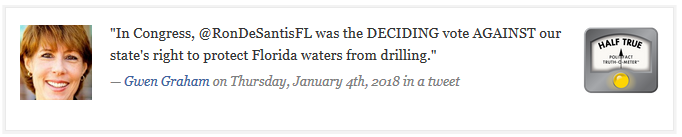
What happens when a similar claim comes from a Democrat? Now we know:

Okay, okay, okay. We have to consider the traditional defense: This case was different!

But before we start, we remind our readers that cases may prove trivially different from one another. It's not okay, for example, if the difference is that this time the claim from from a woman, or this time the case is from Florida not Georgia. Using trivial differences to justify the ruling represent the fallacy of special pleading.

No. We need a principled difference to justify the ruling. Not a trivial difference.

We'll need to look at the way PolitiFact justified its rulings.

First, the "Half True" for Democrat Gwen Graham:
Graham said DeSantis casted the "deciding vote against" the state's right to protect Florida waters from drilling.

There’s no question that DeSantis’ vote on an amendment to the Offshore Energy and Jobs Act was crucial, but saying DeSantis was the deciding vote goes too far. Technically, any of the 209 other people who voted against the bill could be considered the "deciding vote."

Furthermore, the significance of Grayson’s amendment is a subject of debate. Democrats saw it as securing Florida’s right to protect Florida waters, whereas Republicans say the amendment wouldn’t have changed the powers of the state.

With everything considered, we rate this claim Half True.
Second, the "Mostly False" for the National Republican Senatorial Committee (bold emphasis added):
The NRSC ad would have been quite justified in describing Bennet's vote for either bill as "crucial" or "necessary" to passage of either bill, or even as "a deciding vote." But we can't find any rationale for singling Bennet out as "the deciding vote" in either case. He made his support for the stimulus bill known early on and was not a holdout on either bill. To ignore that and the fact that other senators played a key role in completing the needed vote total for the health care bill, leaves out critical facts that would give a different impression from message conveyed by the ad. As a result, we rate the statement Barely True.
Third, the "False" for Republican Scott Bruun:
(W)e’ll be ridiculously lenient here and say that because the difference between the two sides was just one vote, any of the members voting to adjourn could be said to have cast the deciding vote.
The Bruun case doesn't help us much. PolitiFact said Bruun's charge about the "deciding" vote was true but only because its judgment was "ridiculously lenient." And the ridiculous lenience failed to get Bruun's rating higher than "False."  So much for PolitiFact's principle of rating two parts of a claim separately and averaging the results.

Fourth, we look at the "Mostly False" rating for Republican Ron Johnson:
In a campaign mailer and other venues, Ron Johnson says Feingold supported a measure that cut more than $500 billion from Medicare. That makes it sound like money out of the Medicare budget today, when Medicare spending will actually increase over the next 10 years. What Johnson labels a cut is an attempt to slow the projected increase in spending by $500 billion. Under the plan, guaranteed benefits are not cut. In fact, some benefits are increased. Johnson can say Feingold was the deciding vote -- but so could 59 other people running against incumbents now or in the future.

We rate Johnson’s claim Barely True.
We know from earlier research that PolitiFact usually rated claims about the ACA cutting Medicare as "Mostly False." So this case doesn't tell us much, either. The final rating for the combined claims could end up "Mostly False" if PolitiFact considered the "deciding vote" portion "False" or "Half True." It would all depend on subjective rounding, we suppose.

Note that PolitiFact Florida cited "What makes a vote 'the deciding vote'?" for its rating of Gwen Graham. How does a non-partisan fact checker square Graham's "Half True" rating with the ratings given to Republicans? Why does the fact check not clearly describe the principle that made the difference for Graham's more favorable rating?

As far as well can tell, the key difference comes from party affiliation, once again suggesting that PolitiFact leans left.


After the page break we looked for other cases of the "deciding vote."

Thursday, March 30, 2017

Hewitt v. PolitiFact: Two facts clearly favor Hewitt

Over the past week, conservative radio host Hugh Hewitt claimed on Sunday the health insurance industry has entered a "death spiral," PolitiFact rated Hewitt's claim "False" and Hewitt had PolitiFact Executive Director Aaron Sharockman on his radio show for an hour long interview (transcript here).

Aside from the central dispute over the "death spiral," where PolitiFact's work arguably commits a bifurcation fallacy, we have identified two areas where Hewitt has the right of the argument. PolitiFact has published (and superficially defended) false statements in both areas.

The New York Times article

PunditFact (PolitiFact):
Hewitt referred to a New York Times article that quotes the president of Aetna saying that in many places people will lose health care insurance.

We couldn’t find that article, but a simple remark on how premiums are rising and insurers are leaving the marketplace is not enough evidence to meet the actuarial definition of a death spiral.
We found the article in just a few minutes (it was dead easy; see hit No. 5). Two quotations from it will show it matches the content, other than the term "president," that Hewitt described on his Sunday television appearance.

One:
Aetna CEO Mark Bertolini has pronounced the ACA's health insurance markets in a "death spiral."
Two:
___

This story has been corrected to show that consumers have reduced options, not that some consumers have no health care options.
So we have the "death spiral" comment from the head of AETNA that Hewitt described, as well as the dire statement that some people have no options, though that part was reported in error in the AP story that appeared in the Times.

During his radio interview, Sharockman tried to pin on Hewitt PolitiFact's failure to find the described Times story and flatly said the article was not in the Times:
AS: You said the president of Aetna. It’s the chairman and CEO, and it was not in the New York Times, as you also know. It was originally probably in the Wall Street Journal.
The article was in The New York Times, and we have informed PolitiFact writer Allison Graves (via Twitter) and Sharockman (via email).

We expect ethical journalists to make appropriate corrections.

Where does the CBO stand on the "death spiral"?

The mainstream media widely interpreted the CBO report addressing President Trump's health care proposal as a judgment the ACA has not entered a "death spiral."

PolitiFact did likewise in its fact check of Hewitt:
CBO, independent analysis: No death spiral
Others have also concluded that the Affordable Care Act is not in a death spiral. The nonpartisan Congressional Budget Office, as part of its recent analysis of the GOP legislation, described the Affordable Care Act as stable.
Though PolitiFact did not link to the CBO report in its fact check (contrary to PolitiFact's statement of standards), we believe the claim traces to this CBO report, which contains this assessment (bold emphasis added):

Stability of the Health Insurance Market

Decisions about offering and purchasing health insurance depend on the stability of the health insurance market—that is, on having insurers participating in most areas of the country and on the likelihood of premiums’ not rising in an unsustainable spiral. The market for insurance purchased individually (that is, nongroup coverage) would be unstable, for example, if the people who wanted to buy coverage at any offered price would have average health care expenditures so high that offering the insurance would be unprofitable. In CBO and JCT’s assessment, however, the nongroup market would probably be stable in most areas under either current law or the legislation.
Note the CBO report does not call the insurance market "stable" under the ACA. Instead it projects that insurance markets will probably remain stable in most areas. Assuming PolitiFact has no better support from the CBO than the portion we have quoted, we find PolitiFact's version a perversion of the original. The CBO statement leaves open the possibility of a death spiral.

Sharockman stood behind the fact check's apparent spin during his appearance on the Hugh Hewitt Show:
AS: Hugh, you’re misleading the listeners.

HH: …is that we have gone from 7…

AS: You’re misleading the listeners. The same CBO report that you’re quoting said that the markets are stable whether it’s the AHCA…
Again, unless Sharockman has some version of a CBO report different from what we have found, we judge that Sharockman and PolitiFact are misleading people about the content of the report.

We used email to point out the discrepancy to Sharockman and asked him to provide support for his and PolitiFact's interpretation of the CBO report.

We will update this article if we receive a response from Sharockman that includes such evidence.

Tuesday, March 28, 2017

Hugh Hewitt v. PolitiFact (Power Line Blog)

Via Power Line blog, the liberal bloggers at PolitiFact tangle with conservative radio show host Hugh Hewitt:

The issue: During a television appearance, Hewitt said the ACA is in a death spiral. PolitiFact did its usual limited survey of experts and ruled Hewitt's statement "False."

Part 1: PolitiFact Strikes Hugh Hewitt

A favorite part:
Allison Graves evaluates Hugh’s assertion regarding the Obamacare death spiral for PolitiFact. She defines the question in a manner that tends to belie Hugh’s assertion, cites some relevant authorities and rates Hugh’s assertion False.

I think this is a question on which reasonable minds can disagree, depending on how the question is framed. I would rate Graves’s judgment False in implying the contrary.
Part 2: Pol[i]tiFact strikes Hugh Hewitt (2)

A favorite part (quotation of Hewitt):
PolitiFact is a liberal-agenda-driven group of classically lefty “journalists” masquerading as a non-partisan evaluators of arguments. In this case their defense of their “journalism” rests on a partial and biased recounting of a 10:20 a.m. Meet the Press roundtable discussion, one which omits my stated acknowledgment of a differing argument therein, and their discounting of the expert testimony of a major insurance company president, along with a Sunday afternoon three-hour “deadline” window for response following a perfunctory email to a booker of a show that runs Monday through Friday, when the host is himself online and answering a journalists’ questions and comments.
To this we would add that PolitiFact's story misrepresents a Congressional Budget Office report.

PolitiFact cited the CBO in support of its finding that the ACA is not in a death spiral:
The nonpartisan Congressional Budget Office, as part of its recent analysis of the GOP legislation, described the Affordable Care Act as stable.
PolitiFact failed to link to the CBO in this fact check, but the source wasn't hard to find. The tough part was figuring out why PolitiFact added its own spin to the CBO's view (bold emphasis added):

Stability of the Health Insurance Market>

Decisions about offering and purchasing health insurance depend on the stability of the health insurance market—that is, on having insurers participating in most areas of the country and on the likelihood of premiums’ not rising in an unsustainable spiral. The market for insurance purchased individually (that is, nongroup coverage) would be unstable, for example, if the people who wanted to buy coverage at any offered price would have average health care expenditures so high that offering the insurance would be unprofitable. In CBO and JCT’s assessment, however, the nongroup market would probably be stable in most areas under either current law or the legislation.

Under current law, most subsidized enrollees purchasing health insurance coverage in the nongroup market are largely insulated from increases in premiums because their out-of-pocket payments for premiums are based on a percentage of their income; the government pays the difference. The subsidies to purchase coverage combined with the penalties paid by uninsured people stemming from the individual mandate are anticipated to cause sufficient demand for insurance by people with low health care expenditures for the market to be stable.

Under the legislation, in the agencies’ view, key factors bringing about market stability include subsidies to purchase insurance, which would maintain sufficient demand for insurance by people with low health care expenditures, and grants to states from the Patient and State Stability Fund, which would reduce the costs to insurers of people with high health care expenditures. Even though the new tax credits would be structured differently from the current subsidies and would generally be less generous for those receiving subsidies under current law, the other changes would, in the agencies’ view, lower average premiums enough to attract a sufficient number of relatively healthy people to stabilize the market.
Is it defensible journalistic practice to leave out the "probably" and "most areas" caveats in the CBO report?

Something tells us that if PolitiFact caught a Republican omitting that kind of information, it would result in a rating of "Half True" or worse. Assuming the Republican wasn't making a point that a liberal would like, of course.

Afters:

We just finished listening to PolitiFact's Aaron Sharockman spending an hour on the Hugh Hewitt Show. Sharockman reaffirmed the paraphrase of the CBO we quoted above. When a transcript becomes available, we will look at whether Sharockman magnified the distortion from the original fact check.

Tuesday, March 14, 2017

There You Go Again: PolitiFact Florida makes a hash of another gender wage gap ruling

Though PolitiFact is an unreliable fact-checker, at least one can bank on the mainstream fact-checker's ability to flub gender wage gap claims.

We hit PolitiFact on this issue often, but this latest one from PolitiFact Florida is a doozy, rivaling PolitiFact Oregon's remarkable turd from 2014.

Drum roll: PolitiFact Florida, March 14, 2017:

We're presenting a big hunk of the fact check as it appears at PolitiFact Florida to show how PolitiFact Florida effectively contradicts its own reasoning.

In the next-to-last paragraph of its summary, PolitiFact Florida explains that "differences in pay can be affected by the careers women and men choose and taking time off to care for children." Those aren't the only factors affecting the raw wage gap, by the way.

Yet in the ironically named "Share The Facts" version, the "Mostly True" rating blares its message aside Democrat Patricia Farley's claim the disparities occur purely based on gender ("simply because she isn't a man"). In other words, the cause is gender discrimination, not different job choices and the like--directly contradicting PolitiFact Florida's caveat. Farley didn't just leave out context. She explicitly denied the key bit of context.

Anyone who knows the difference between the raw gender wage gap and the wage gap based solely on gender discrimination but uses the large former gap in the context of arguing for legislation to reduce gender discrimination is deceiving people. The raw gender wage gap is not a realistic representation of gender discrimination in wages because of other factors, such as men and women tending to choose careers that pay differently.

So, yes, we're saying that unless Patricia Farley is ignorant about the difference between the gender wage gap and the wage gap caused by pay discrimination, she is lying, as in deliberately deceiving her audience. And PolitiFact Florida is calling her falsehood and potentially intentional deception "Mostly True."

The PolitiFact Florida wage gap fact check is below average for PolitiFact--and that's like failing to leap over a match box.


Correction March 15, 2017: Posted the intended URL for the PolitiFact Florida fact check. We had mistakenly used the URL to a related fact check concerning Donald Trump.

Monday, September 19, 2016

"Mostly False" that France and Germany thought Iraq had WMD? Seriously?

PolitiFact recently weighed in on French and German intelligence about Iraq's WMD programs. Former Assistant Secretary of Defense Paul Wolfowitz said the French and Germans believed Iraq had WMD.

PolitiFact ruled Wolfowitz's claim "Mostly False."

Some may remember the media routinely reporting that French and German intelligence assessments, along with others, mirrored those of the United States (bold emphasis added):
U.S. government analysts were not alone in these views. In the late spring of 2002 I participated in a Washington meeting about Iraqi WMD. Those present included nearly twenty former inspectors from the United Nations Special Commission (UNSCOM), the force established in 1991 to oversee the elimination of WMD in Iraq. One of the senior people put a question to the group: Did anyone in the room doubt that Iraq was currently operating a secret centrifuge plant? No one did. Three people added that they believed Iraq was also operating a secret calutron plant (a facility for separating uranium isotopes).

Other nations' intelligence services were similarly aligned with U.S. views. Somewhat remarkably, given how adamantly Germany would oppose the war, the German Federal Intelligence Service held the bleakest view of all, arguing that Iraq might be able to build a nuclear weapon within three years. Israel, Russia, Britain, China, and even France held positions similar to that of the United States; France's President Jacques Chirac told Time magazine last February, "There is a problem—the probable possession of weapons of mass destruction by an uncontrollable country, Iraq. The international community is right ... in having decided Iraq should be disarmed." In sum, no one doubted that Iraq had weapons of mass destruction.
Some may remember French President Jacques Chirac, who opposed the invasion, nonetheless admitting the French believed Iraq had WMD:
There is a problem—the probable possession of weapons of mass destruction by an uncontrollable country, Iraq. The international community is right to be disturbed by this situation, and it's right in having decided Iraq should be disarmed.
Chirac's statement came from early 2003, not long before the invasion started.

But it's a trivial matter for PolitiFact to work its way around these inconvenient facts by making its own one-sided case against Wolfowitz's claim.

Why would PolitiFact take that approach? Incompetence? Bias? A little of both?

I'm working on a column for Zebra Fact Check that will expose PolitiFact's fact-checking sins in excruciating detail.